Difference Between a Business Plan and a Feasibility Study
Many entrepreneurs and startup founders often confuse a business plan with a feasibility study. Although both documents are important when starting a business, they serve different purposes.
Understanding the difference between a business plan and a feasibility study can help entrepreneurs make better decisions, attract investors, and reduce the risk of business failure.
In this article, we will explain what a feasibility study is, what a business plan is, and the key differences between the two.
What is a Feasibility Study?
A feasibility study is a detailed analysis conducted to determine whether a proposed business idea is practical, viable, and profitable before investing money in it.
It answers the critical question:
“Is this business idea worth pursuing?”
A feasibility study examines the technical, financial, operational, and market viability of a business idea.
Key Components of a Feasibility Study
A typical feasibility study includes:
-
Business idea description
-
Market demand analysis
-
Industry analysis
-
Technical and production requirements
-
Location analysis
-
Equipment requirements
-
Risk assessment
-
Financial viability analysis
The goal is to evaluate whether the business should be started or not.
For example, before investing in a rice mill, cassava processing plant, or poultry farm, an entrepreneur should conduct a feasibility study to understand:
-
Market demand
-
Production cost
-
Expected profitability
-
Possible risks
What is a Business Plan?
A business plan is a comprehensive document that explains how a business will operate, grow, and achieve profitability.
It answers the question:
“How will this business operate and succeed?”
A business plan is usually written after the feasibility study confirms that the business idea is viable.
Entrepreneurs use business plans to:
Key Components of a Business Plan
A standard business plan typically includes:
-
Executive Summary
-
Business Description
-
Market Analysis
-
Products and Services
-
Marketing Strategy
-
Operational Plan
-
Management Structure
-
Financial Plan
-
Growth Strategy
The business plan provides a roadmap for running the business successfully.
Major Differences Between a Business Plan and a Feasibility Study
The main difference between the two documents is their purpose and timing.
| Feature |
Feasibility Study |
Business Plan |
| Purpose |
Determines if a business idea is viable |
Explains how the business will operate |
| Timing |
Conducted before starting the business |
Written after the idea is confirmed viable |
| Focus |
Analysis and evaluation |
Implementation and strategy |
| Decision Stage |
Helps decide whether to start the business |
Helps manage and grow the business |
| Financial Analysis |
Determines profitability potential |
Provides detailed financial projections |
| Usage |
Used by entrepreneurs for decision making |
Used by investors, banks, and stakeholders |
When Should You Conduct a Feasibility Study?
You should conduct a feasibility study when:
-
You have a new business idea
-
You want to invest in a new industry
-
You want to expand an existing business
-
You need to evaluate the profitability of a project
A feasibility study helps prevent costly mistakes and investment losses.
When Do You Need a Business Plan?
A business plan is required when:
-
Applying for bank loans
-
Seeking investors
-
Applying for government grants
-
Structuring business operations
-
Planning long-term growth
Many funding organizations require a bankable business plan before providing financial support.
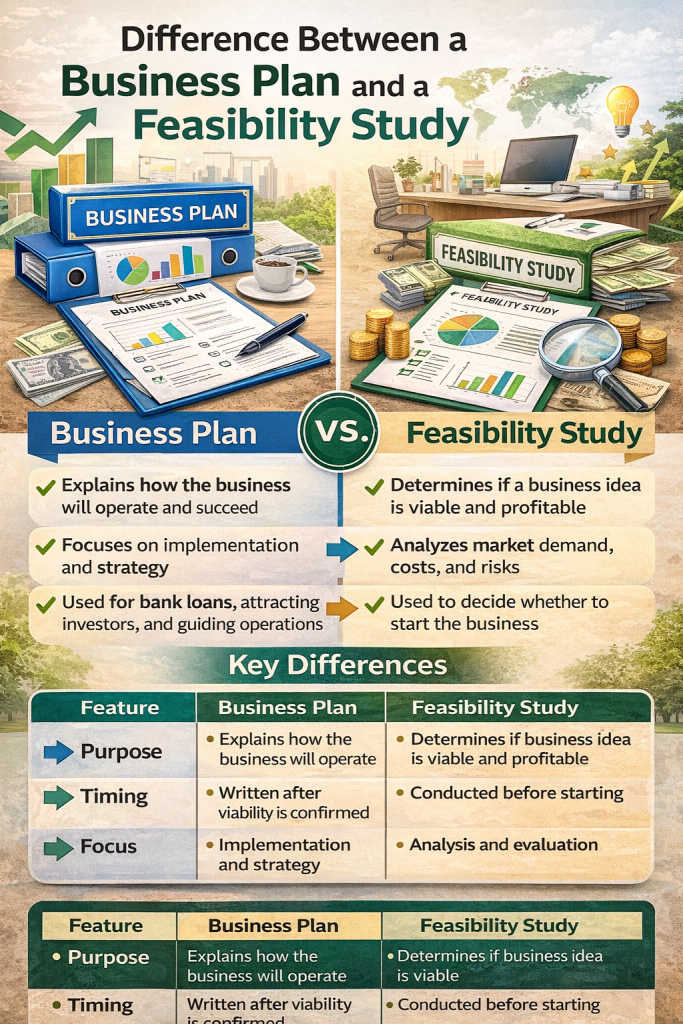 Difference Between a Business Plan and a Feasibility Study
Can You Have a Business Plan Without a Feasibility Study?
Technically yes, but it is not recommended.
Without a feasibility study, the business plan may be based on assumptions instead of real data.
A feasibility study ensures that the business plan is built on accurate market research, financial analysis, and operational realities.
Which One Do Investors Prefer?
Most investors prefer to see both documents.
The feasibility study proves that the business idea is viable, while the business plan shows how the business will succeed and generate profit.
Together, they provide a complete picture of the business opportunity.
Conclusion
A feasibility study and a business plan are not the same, but they complement each other.
Entrepreneurs who conduct proper feasibility studies before writing business plans are more likely to build sustainable and profitable businesses.
Need Help Writing a Business Plan or Feasibility Study?
If you need professional help writing a bankable business plan or feasibility study, contact:
Dr. Dayo Adetiloye
Business Development Consultant
Call/WhatsApp: +2348060779290
Email: dayoadetiloye@gmail.com
Related