How to Apply for a Donor-Funded Project for Your Organisation: A Complete Guide
Many nonprofit organisations, social enterprises, and development-focused businesses rely on donor-funded projects to implement programs that create social impact. These projects are typically funded by international development agencies, foundations, governments, and multilateral organisations. that is why how to Apply for Donor Funded Projects for Your Organisation is very important topic to explore.
Examples of common donors include organizations such as the United Nations Development Programme, World Bank, United States Agency for International Development, Bill & Melinda Gates Foundation, and Deutsche Gesellschaft für Internationale Zusammenarbeit.
However, many organizations struggle with how to apply successfully for donor-funded projects. The application process can be competitive, technical, and documentation-heavy.
This guide explains step-by-step how to apply for donor-funded projects for your organisation, including preparation, proposal writing, and submission strategies.
What is a Donor-Funded Project?
A donor-funded project is a program financed by a funding organisation (the donor) to address social, economic, environmental, or humanitarian challenges.
Donors typically fund projects in areas such as:
-
Youth empowerment
-
Agriculture and food security
-
Education and skills development
-
Health and community development
-
Climate change and environmental protection
-
Entrepreneurship and job creation
Unlike loans, donor funding is usually a grant, meaning the organisation does not need to repay the funds, provided the project is implemented according to agreed guidelines.
Why Donors Fund Projects
Donor organizations provide funding to achieve development goals and social impact.
Common objectives include:
-
Reducing poverty
-
Promoting economic growth
-
Improving education and healthcare
-
Supporting innovation and entrepreneurship
-
Addressing environmental challenges
Many donor programs align with the United Nations Sustainable Development Goals (SDGs), which focus on global development priorities such as poverty reduction, quality education, and climate action.
Organisations that align their projects with these goals have higher chances of securing funding.
Types of Organisations That Can Apply for Donor Funding
Many types of organizations are eligible to apply for donor-funded projects.
These include:
Non-Governmental Organisations (NGOs)
NGOs implement development programs in areas such as education, health, and youth development.
Social Enterprises
Businesses that combine profit with social impact are often eligible for donor funding.
Community-Based Organisations (CBOs)
These organisations operate at the grassroots level and address community challenges.
Academic and Research Institutions
Universities and research centres often receive funding for research-based projects.
Government Agencies
Local and national government institutions may receive donor funding for development initiatives.
Step 1: Identify the Right Donor Opportunities
The first step in applying for a donor-funded project is finding suitable funding opportunities.
Common places to find donor opportunities include:
-
Donor organization websites
-
Development agency portals
-
Grant databases
-
International development newsletters
-
Professional networks
Examples of donor platforms include:
-
**European Union Funding and Tenders Portal
-
**African Development Bank project funding portal
-
**Tony Elumelu Foundation entrepreneurship programme
When searching for opportunities, carefully review the eligibility requirements, including:
-
Geographic eligibility
-
Sector focus
-
Organisation type
-
Funding amount
Applying for projects that do not match your organization’s focus significantly reduces the chances of success.
Step 2: Study the Donor Guidelines Carefully
Every donor-funded project comes with specific guidelines and requirements.
These guidelines explain:
-
Project objectives
-
Eligibility criteria
-
Required documents
-
Application format
-
Deadline for submission
Failing to follow donor guidelines is one of the most common reasons proposals are rejected.
Key areas to review include:
-
Project objectives
-
Evaluation criteria
-
Funding limits
-
Reporting requirements
Understanding what the donor wants helps you design a proposal that matches their priorities.
Step 3: Conduct a Needs Assessment
A strong donor-funded proposal must clearly demonstrate the problem your project will solve.
This requires conducting a needs assessment.
A needs assessment involves gathering data to understand the problem affecting a target community.
Methods may include:
-
Surveys
-
Interviews
-
Community consultations
-
Research reports
-
Government statistics
For example, if the project focuses on youth unemployment, you should present:
Donors prefer proposals that are data-driven and evidence-based.
Step 4: Develop a Strong Project Concept
Before writing the full proposal, create a project concept note.
A concept note is a short document that summarises the project idea.
It usually includes:
Concept notes are often used during the first stage of donor applications.
If the concept note is approved, the donor may invite your organisation to submit a full proposal.
Step 5: Write a Compelling Project Proposal
The project proposal is the most important document in donor-funded project applications.
A strong proposal should include the following sections.
Executive Summary
This section provides a brief overview of the project.
It should explain:
Although it appears at the beginning, it is usually written after completing the proposal.
Problem Statement
The problem statement explains the challenge the project aims to address.
It should include:
A good problem statement convinces the donor that the project is necessary and urgent.
Project Objectives
Objectives describe what the project intends to achieve.
Good objectives are SMART:
-
Specific
-
Measurable
-
Achievable
-
Relevant
-
Time-bound
Example:
Train 500 unemployed youth in digital skills within 12 months.
Project Activities
Activities describe the actions that will be implemented to achieve the objectives.
Examples include:
Each activity should be linked to a specific objective.
Expected Outcomes and Impact
Donors want to know what results the project will achieve.
Outcomes describe the immediate results of project activities.
Impact describes the long-term change resulting from the project.
Example outcomes:
Example impact:
Reduction in youth unemployment in the community.
Monitoring and Evaluation Plan
Donors require systems to measure project progress.
The Monitoring and Evaluation (M&E) section explains:
Example indicators:
Strong M&E systems increase donor confidence.
Project Sustainability
Donors want to know what happens after the funding ends.
Sustainability strategies may include:
Projects that continue delivering impact after donor funding ends are more attractive.
Step 6: Develop a Realistic Budget
The project budget explains how the funding will be used.
A good budget should include:
Budgets must be realistic and transparent.
Overestimated or poorly justified budgets often lead to proposal rejection.
Step 7: Prepare Supporting Documents
Donor-funded project applications usually require several supporting documents.
Common documents include:
These documents demonstrate that your organisation is credible and capable of implementing the project.
Step 8: Submit the Application Correctly
Most donor-funded project applications are submitted through online portals.
Common mistakes during submission include:
-
Missing documents
-
Incorrect formatting
-
Late submission
Always ensure that:
-
All required documents are attached
-
The proposal follows the required format
-
The application is submitted before the deadline
Step 9: Prepare for Due Diligence
If your proposal is shortlisted, the donor may conduct due diligence.
This process verifies that your organisation has the capacity to manage the project.
The donor may review:
-
Financial records
-
Governance structure
-
Past project experience
Some donors may also conduct site visits or interviews.
Common Reasons Donor Proposals Are Rejected
Many proposals fail due to avoidable mistakes.
Common reasons include:
Careful preparation significantly improves your chances of success.
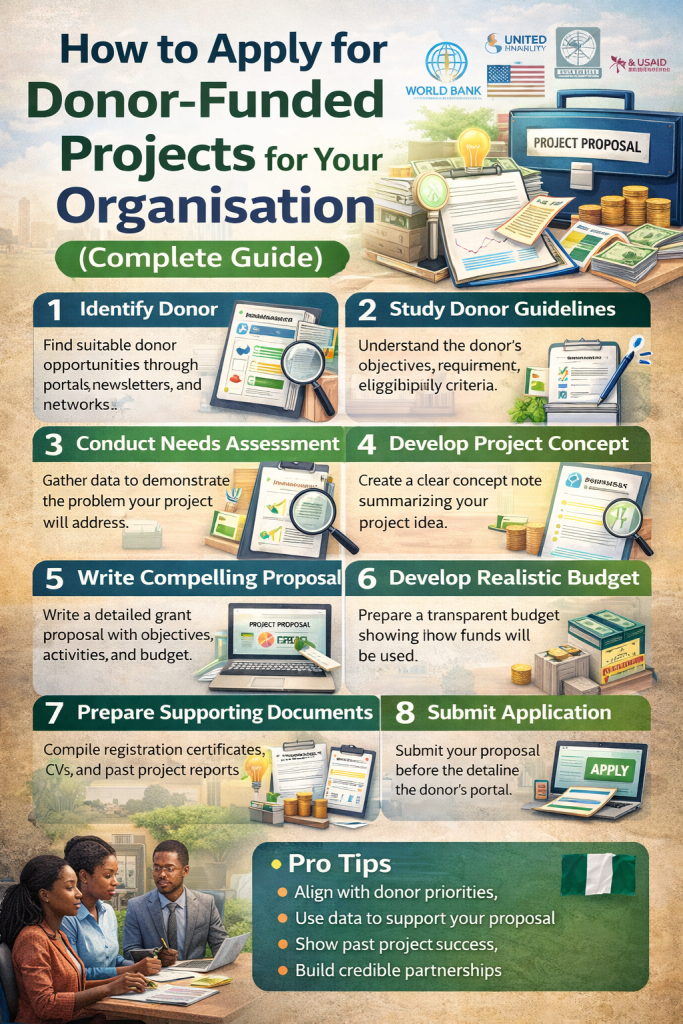 How to Apply for Donor-Funded Projects for Your Organisation (Complete Guide)
Tips for Winning Donor-Funded Projects
Organisations that successfully secure donor funding often follow these best practices:
-
Align projects with donor priorities
-
Use data to support proposals
-
Build partnerships with credible organisations
-
Demonstrate past project success
-
Maintain strong financial accountability
Building a track record of successful projects increases future funding opportunities.
Conclusion
Applying for donor-funded projects requires strategic preparation, strong proposals, and careful attention to donor guidelines.
Organisations that invest time in needs assessment, project design, and professional proposal writing are more likely to secure funding.
With the growing number of international development programs, donor-funded projects remain one of the most powerful opportunities for organizations to create social impact and expand their work.
Need Help Applying for Donor-Funded Projects?
If your organisation needs professional support with grant writing, proposal development, or donor-funded project applications, you can contact:
Authority Bio
Dr. Dayo Adetiloye is a Business Development Consultant who supports entrepreneurs, NGOs, and organisations in developing bankable business plans, feasibility studies, and grant proposals.
For consulting services:
Dr. Dayo Adetiloye
Business Development Consultant
Call/WhatsApp: +2348060779290
Email: dayoadetiloye@gmail.com
Related