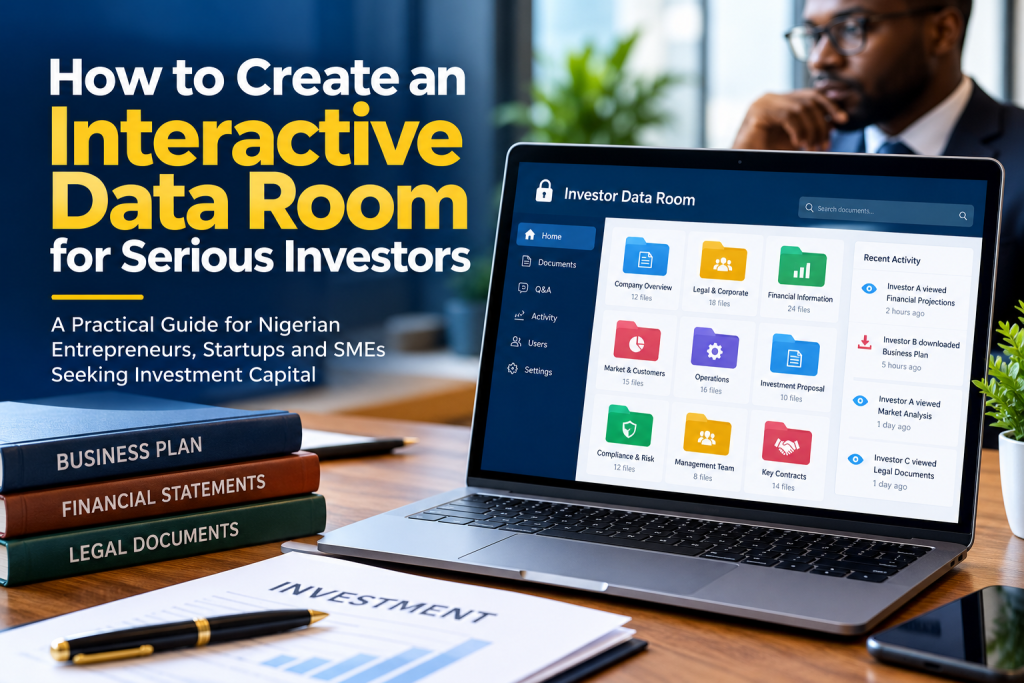
 How to Create an Interactive Data Room for Serious Investors
How to Create an Interactive Data Room for Serious Investors
A Practical Guide for Nigerian Entrepreneurs, Startups and SMEs Seeking Investment Capital
Securing investment capital involves more than presenting an attractive pitch deck or convincing investors that your business has growth potential. Serious investors want evidence that your company is financially sound, legally compliant, commercially viable and professionally managed.
This is where an interactive investor data room becomes important.
Imagine approaching an investor for ₦200 million to expand your manufacturing business. After reviewing your proposal, the investor requests your financial statements, ownership structure, customer contracts, business plan and projected cash flows.
Would you spend two weeks gathering these documents, or could you provide secure, organised access within hours?
The difference can influence investor confidence and the efficiency of the funding process.
For Nigerian entrepreneurs seeking angel investment, venture capital, private equity or strategic partnerships, an organised data room is becoming an essential component of investment readiness.
 How to Create an Interactive Data Room for Serious Investors
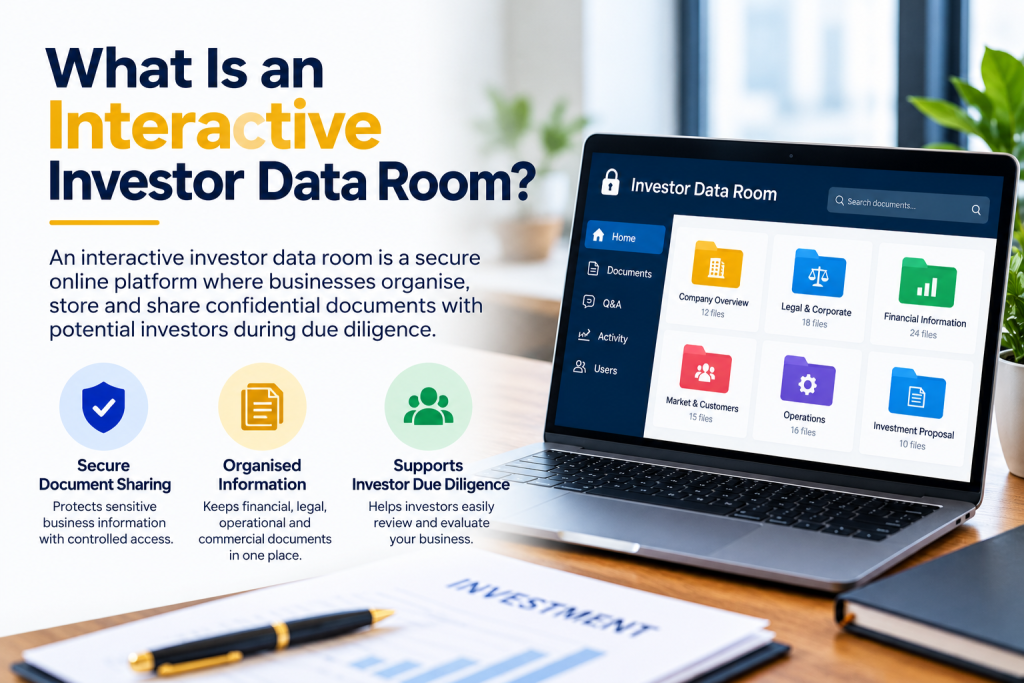
What Is an Interactive Investor Data Room?
An interactive investor data room is a secure digital platform where businesses organise, store and share confidential documents with potential investors during investment evaluation and due diligence.
Unlike ordinary file-sharing folders, a properly configured virtual data room can provide controlled access, document tracking, investor questions and answers, version management and activity reporting.
According to Carta, an equity management and fundraising platform, virtual data rooms help companies share financial, legal and operational information securely during fundraising and other corporate transactions.
An interactive data room therefore serves three purposes: demonstrating business credibility, simplifying due diligence and protecting sensitive company information.
The important distinction is that a pitch deck tells investors what your business can achieve, while a data room provides evidence supporting those claims.
Why Nigerian Businesses Need an Investor Data Room
Many Nigerian entrepreneurs concentrate on developing business plans and financial projections without adequately preparing the supporting documents investors will eventually request.
For example, a business might report ₦150 million in annual revenue but struggle to reconcile that figure with its bank statements, accounting records and tax filings.
Such inconsistencies can delay investment decisions or undermine confidence.
A properly structured data room helps investors independently evaluate financial performance, ownership arrangements, commercial agreements, regulatory compliance and operational risks.
It is particularly useful for businesses seeking substantial equity investment, international funding or acquisition opportunities.
However, creating a data room does not guarantee funding. Investors will still assess profitability, management capability, valuation, market conditions and investment risks.
1. Identify the Documents Serious Investors Expect
Before selecting a technology platform, determine which documents investors need to evaluate your business.
A practical investor data room should contain the following categories.
Corporate and Legal Documents
Include your Certificate of Incorporation, Memorandum and Articles of Association, current CAC records, shareholder agreements, board resolutions and relevant business licences.
Investors also need to understand who owns the company and whether existing shareholders have rights that could affect a proposed investment.
Nigeria’s Companies and Allied Matters Act (CAMA) 2020 provides the legal framework for company administration and corporate reporting. Businesses should ensure their applicable CAC filings are current.
Financial Documents
Provide historical financial statements, management accounts, cash-flow reports, debt schedules, bank reconciliation summaries and financial projections.
Where available or required, include audited accounts.
For an established SME, investors may request three years of historical financial information. Younger businesses should provide reliable records covering their actual operating history.
Commercial and Operational Documents
Include your business plan, market research, customer contracts, supplier agreements, sales reports, operational processes and growth strategy.
Technology businesses may also need product documentation, intellectual property records and cybersecurity policies.
The objective is to help investors understand not only what the business earns but how it generates and sustains revenue.
2. Choose a Suitable Virtual Data Room Platform
Not every business needs expensive data room software.
Early-stage Nigerian startups can begin with appropriately secured cloud storage, while businesses handling complex transactions may require dedicated virtual data room platforms.
Popular options include Google Drive, Microsoft SharePoint, DocSend and specialist virtual data room solutions.
When comparing platforms, evaluate:
- Security, encryption and multi-factor authentication.
- Investor-specific access permissions.
- Document viewing and download restrictions.
- Activity tracking, audit logs and question management.
- Subscription costs, storage limits and ease of use.
Dedicated platforms may offer advanced watermarking, analytics and access controls, although features vary by subscription.
Choose a platform based on the sensitivity of your documents and complexity of your fundraising process, not simply its popularity.
3. Organise Your Data Room Around Investor Questions
A poorly organised data room creates unnecessary work for investors.
Instead of uploading dozens of unrelated files, establish a consistent folder structure.
| Folder |
Recommended Contents |
| 01. Company Overview |
Executive summary, pitch deck, business plan |
| 02. Corporate Documents |
CAC records, ownership structure, resolutions |
| 03. Financial Information |
Historical accounts, cash flows, projections |
| 04. Market and Customers |
Market research, customer contracts, sales evidence |
| 05. Operations |
Suppliers, processes, assets, expansion plans |
| 06. Legal and Compliance |
Licences, tax records, material agreements |
| 07. Investment Proposal |
Funding requirement, valuation, use of funds |
| 08. Risks and Governance |
Risk register, management structure, policies |
Use descriptive file names such as Financial_Projections_2027-2031_v2.xlsx rather than Final_Financials_New.xlsx.
Also create a document index identifying each file, its purpose, responsible officer and last update date.
This makes the information easier to navigate and reduces repeated requests.
4. Make Your Financial Information Investor-Friendly
Financial information is often one of the most closely examined sections of an investor data room.
Investors want to understand revenue quality, profitability, working capital requirements, cash generation and the assumptions behind future growth.
Consider a hypothetical Nigerian agribusiness seeking ₦100 million in equity investment.
Its data room might present the following:
| Financial Indicator |
Amount |
| Annual revenue |
₦180 million |
| Cost of sales |
₦117 million |
| Gross profit |
₦63 million |
| Operating expenses |
₦43 million |
| Operating profit |
₦20 million |
| Gross profit margin |
35% |
These figures provide a starting point, but investors will want additional explanations.
How much revenue comes from repeat customers? What happens if production costs increase by 15%? Can the business finance its expansion without exhausting working capital?
A useful interactive data room should therefore include an editable financial model with clearly identified assumptions and sensitivity analysis.
For example, a 15% increase in cost of sales, with revenue unchanged, would reduce gross profit from ₦63 million to ₦45.45 million.
This analysis reveals how cost increases could affect profitability.
Investors are generally more interested in credible assumptions and defensible financial forecasts than impressive but unsupported projections.
5. Introduce Interactive Features That Improve Investor Engagement
An interactive data room should do more than store documents.
It should make investment evaluation easier while maintaining confidentiality.
Investor Activity Tracking
Where supported, document analytics can indicate which files investors access and how frequently they return.
This may help management identify topics requiring clarification.
However, viewing activity alone should not be interpreted as proof that an investor intends to invest.
Questions and Answers
Create a structured question-and-answer process where investors can submit enquiries and receive documented responses.
For example, an investor may ask why operating expenses increased by 25% despite revenue growing by only 10%.
Management should provide a factual explanation supported by accounting records.
Interactive Financial Models
Provide financial models that allow authorised investors to examine alternative assumptions concerning revenue growth, exchange rates, costs and funding requirements.
Protect original calculations and maintain a controlled master version.
Video and Product Demonstrations
Where relevant, include short factory walkthroughs, product demonstrations or operational presentations.
For agribusinesses, verified farm footage and production reports may help investors understand operational capacity.
These materials should supplement, not replace, independently verifiable evidence.
6. Protect Confidential Information and Manage Access
A data room contains information that competitors, fraudsters or unauthorised individuals could misuse.
Consequently, security must be considered from the beginning.
Grant access progressively. An investor attending an introductory meeting does not necessarily need immediate access to payroll records, customer identities or proprietary technical information.
Use individual invitations, multi-factor authentication, restricted downloads and access expiration where supported.
For sensitive transactions, consider appropriate confidentiality agreements and legal advice.
Businesses processing personal information must also consider Nigeria’s Data Protection Act 2023, administered by the Nigeria Data Protection Commission.
Personal data should be shared only where there is a lawful basis and appropriate safeguards. Redact unnecessary employee, customer and supplier information.
A secure data room protects the business while allowing legitimate investor scrutiny.
7. Prepare a Clear Investment Proposal and Use-of-Funds Schedule
Investors need to understand precisely how their capital will be deployed.
Suppose a manufacturing SME requires ₦200 million for expansion.
Its proposed funding allocation could be:
| Investment Requirement |
Amount |
| Production equipment |
₦90 million |
| Working capital |
₦50 million |
| Distribution expansion |
₦30 million |
| Technology and systems |
₦15 million |
| Contingency |
₦15 million |
| Total |
₦200 million |
The data room should connect these allocations to supplier quotations, implementation milestones and financial projections.
If the company offers 20% equity for ₦200 million, the implied post-money valuation is ₦1 billion, assuming a straightforward new-share investment without other adjustments.
The company must justify that valuation using credible financial and commercial evidence.
An investor will also want to know what measurable milestones the ₦200 million is expected to achieve.
8. Avoid Common Investor Data Room Mistakes
Several mistakes can undermine an otherwise promising investment opportunity.
One is uploading inconsistent financial information. If the pitch deck reports ₦100 million in revenue while the financial statements show ₦75 million, investors will expect a reconciliation.
Another is providing unrealistic forecasts without supporting assumptions.
Other problems include outdated CAC records, missing contracts, unclear shareholder ownership, unrestricted document access and failure to disclose material business risks.
Perhaps the most damaging mistake is attempting to conceal financial or legal weaknesses.
A well-prepared data room should explain identified risks and demonstrate how management intends to address them.
9. Maintain Your Data Room Throughout the Fundraising Process
Creating a data room is not a one-time administrative exercise.
Financial reports, customer information, contracts and investment documents must remain current.
Assign a responsible manager to maintain the platform, coordinate investor enquiries and control document updates.
Establish a monthly review process and keep records of significant changes.
Before granting investor access, conduct an internal due diligence review to identify missing documents, contradictory figures and unresolved compliance issues.
This preparation can reduce avoidable delays during investment negotiations.
How Dayo Adetiloye Business Hub Can Help You Become Investment-Ready
Preparing an investor data room requires more than uploading company documents. Businesses need credible financial models, commercially defensible business plans and a coherent investment proposition.
At Dayo Adetiloye Business Hub, we support Nigerian entrepreneurs and SMEs through professional business plan development, feasibility studies, market research, financial projections, pitch deck preparation, funding readiness assessments and investment advisory services.
Our approach focuses on helping businesses understand investor expectations, identify documentation gaps and present credible commercial opportunities.
Whether you are seeking angel investment, private equity, strategic partnerships or expansion financing, professional preparation can improve the quality of your investment discussions.
Contact Dayo Adetiloye Business Hub
Call/WhatsApp: 08105636015, 08076359735, 08113205312
Email: dayohub@gmail.com
Website: https://www.dayoadetiloye.com
Strengthen Your Funding Readiness
Businesses preparing for grants, loans and other funding opportunities can also explore The Ultimate Grant Readiness System™.
This practical toolkit helps entrepreneurs organise funding documents, assess readiness and prepare stronger applications.
Get the toolkit here: https://selar.com/38k7agny27?affiliate=kjj9
 How to Create an Interactive Data Room for Serious Investors
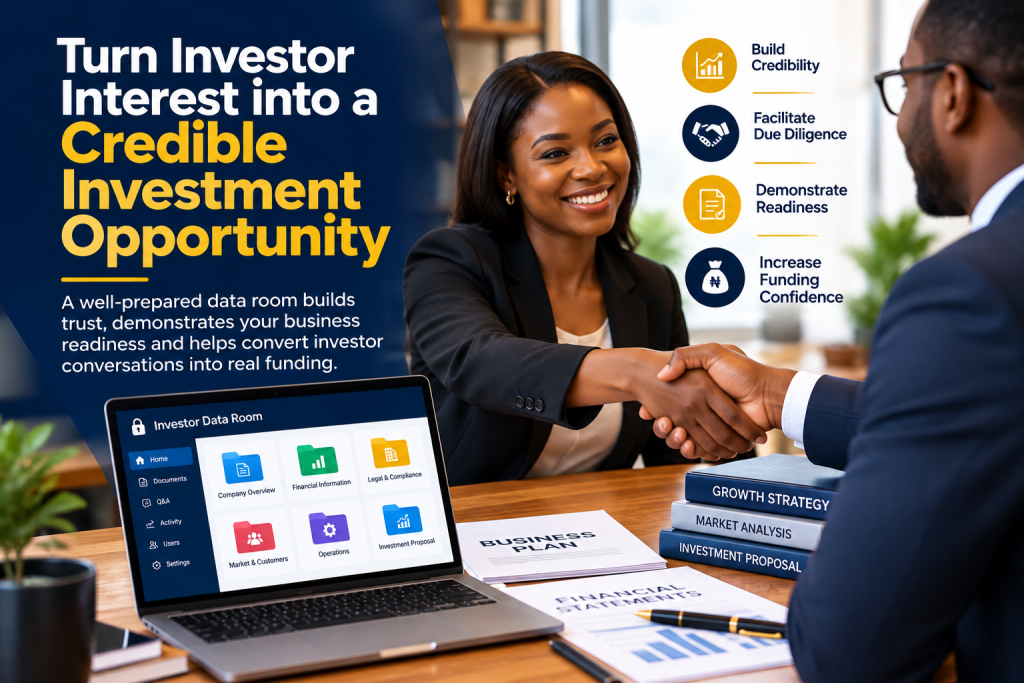
Conclusion: Turn Investor Interest into a Credible Investment Opportunity
An interactive investor data room is more than a digital filing cabinet. It is a structured system for demonstrating business credibility, financial transparency and operational readiness.
For Nigerian entrepreneurs, the most effective approach is to begin preparing before investors request documentation.
Organise your corporate records, reconcile your financial statements, develop realistic projections, secure confidential information and establish a professional investor engagement process.
Remember, investors do not fund businesses simply because their presentations look attractive. They invest when the opportunity, evidence, risks and proposed terms justify the decision.
A compelling pitch deck may open the conversation, but a credible investor data room helps move that conversation towards an informed investment decision.
Frequently Asked Questions
What is an investor data room?
An investor data room is a secure online repository containing financial, legal, commercial and operational documents that potential investors review during due diligence.
Can I create an investor data room using Google Drive?
Yes. Early-stage businesses can use properly secured Google Drive folders. However, complex transactions may require dedicated platforms offering advanced permissions, document analytics and audit trails.
What documents should Nigerian startups include in a data room?
Important documents include CAC incorporation records, shareholder information, financial statements, financial projections, pitch decks, business plans, customer contracts, tax records and relevant operating licences.
When should a business create an investor data room?
Ideally, before actively approaching investors. Preparing early allows management to resolve documentation gaps and financial inconsistencies before due diligence begins.
Related