Access to finance remains one of the biggest constraints facing businesses in Nigeria and across Africa. Entrepreneurs frequently complain that banks are unwilling to lend, investors are difficult to attract, and grant programmes are extremely competitive. While these concerns are valid, there is another side of the funding conversation that receives far less attention: many businesses are simply not ready to receive institutional funding when the opportunity appears.
A business owner may discover a ₦50 million intervention fund, a US$100,000 international grant, a Bank of Industry facility, or an accelerator offering equity investment, only to discover that the application requires documents and information the company has never prepared. The entrepreneur then spends the final days before the deadline trying to develop a business plan, reconstruct financial records, prepare projections, obtain quotations, calculate market size and assemble corporate documents.
That is not an effective funding strategy.
A better approach is to deliberately prepare your business before the funding opportunity appears.
This is what funding readiness means.
A funding-ready business has sufficient documentation, financial information, commercial evidence, governance systems and strategic clarity to demonstrate to a bank, investor, grant provider or development institution that it understands its business and can responsibly deploy external capital.
The process does not have to take years. With disciplined execution, a business can make significant progress towards funding readiness within 90 days.
This guide explains how.
What Does It Mean for a Business to Be Funding-Ready?
Funding readiness is sometimes confused with having a business plan. A business plan is important, but it is only one part of the process.
A funding-ready business should be able to demonstrate four things.
First, the business must be credible. It should be properly registered, have identifiable owners and management, maintain appropriate regulatory documentation and operate through a corporate structure that a funder can verify.
Second, it must be commercially viable. There should be a clear product or service, identifiable customers, evidence of market demand, a realistic business model and an understanding of the competitive environment.
Third, it must be financially understandable. The entrepreneur should know how much the business generates, what it spends, its margins, assets, liabilities, working-capital requirements and expected future performance.
Finally, the business must have a credible funding case. It should know exactly how much capital is required, what the money will be used for, what results the investment will produce and, where debt financing is involved, how the loan will be repaid.
This is important because different funders evaluate businesses differently.
A commercial bank primarily wants to understand repayment capacity and risk. An equity investor is interested in growth, market size, competitive advantage and potential investment returns. A grant provider may focus on innovation, economic or social impact, sustainability and measurable outcomes.
The entrepreneur therefore needs to understand not only the business but also the type of funding being pursued.
Why You Should Prepare Before You Start Looking for Funding
Many entrepreneurs reverse the process.
They first find a grant or loan and then begin preparing their businesses.
Funding readiness should happen in the opposite order.
Imagine that your company wants ₦100 million to purchase processing equipment and increase production. A lender reviewing the application may want to understand your historical sales, current production capacity, expected increase in output, customer demand, equipment cost, gross margin, working-capital requirements and projected cash flow after expansion.
If those figures have never been collected, developing credible answers within a few days will be difficult.
Investors face the same problem. A founder may claim that a business is worth ₦500 million but have no financial model, market analysis or valuation assumptions to support the figure.
Funding readiness allows you to move from statements such as:
“We need ₦100 million to expand.”
to a more credible investment case:
“We require ₦96 million, comprising ₦52 million for additional production equipment, ₦24 million in working capital, ₦12 million for distribution expansion and ₦8 million for technology and market development. Based on our projected production capacity and existing customer demand, the investment is expected to increase annual revenue from ₦180 million to approximately ₦310 million within two years.”
The First 30 Days: Put the Business Foundation in Order
The first month should not be spent writing proposals. It should be spent cleaning up the business.
Conduct a Funding Readiness Audit
Start by examining the business as though you were an external investor.
Ask yourself whether another person could independently verify the information you provide.
Review your corporate registration, ownership structure, licences, tax records, financial statements, customer information, supplier relationships, business model and management structure.
You should also examine your historical performance.
How much did the business generate in the last 12 months? What were the major expenses? Which products contributed the most revenue? Who are the largest customers? How much does the business owe? How much is owed to the business?
This exercise normally reveals gaps that entrepreneurs have ignored because they are occupied with daily operations.
For example, a business may discover that although it has been operating for four years, it does not have reliable management accounts. Another may discover that its CAC ownership information no longer reflects the current shareholders. A manufacturer may discover that it cannot accurately calculate its production cost per unit.
Create a funding-readiness gap report from these findings and prioritise the problems that could prevent a lender or investor from proceeding.
Put Your Corporate and Regulatory Documents in Order
Institutional funders need to know who they are dealing with.
For a Nigerian business, this begins with proper registration with the Corporate Affairs Commission and compliance with applicable regulatory requirements. Depending on the nature and size of the business, additional documentation may include tax records, sector licences, permits, intellectual-property documentation and statutory registrations.
Your corporate records should accurately reflect the people who own and control the company.
If an investor discovers during due diligence that the person presented as a 40% shareholder does not appear in the company’s ownership records, the discrepancy will have to be explained.
The same applies to licences. A food-processing company, healthcare facility, financial-services business or other regulated enterprise may require approvals beyond CAC registration.
Funding cannot permanently compensate for regulatory weakness.
Use the first month to identify and begin correcting these issues.
Separate Business Money from Personal Money
One of the biggest obstacles to SME funding readiness is poor financial separation.
Many small businesses receive money into both corporate and personal accounts. The owner then pays suppliers, school fees, staff salaries and personal expenses from whichever account has money available.
The business may actually be profitable, but nobody can easily prove it.
Suppose you tell a bank that your company generates ₦10 million in monthly revenue. The bank asks for statements and finds only ₦4 million in average monthly inflows.
You explain that the remaining payments go into other accounts.
From your perspective, the sales happened. From the lender’s perspective, verifying them has become unnecessarily difficult.
A business seeking institutional capital should operate increasingly like an institution.
Customer payments should be properly recorded. Business expenditure should be identifiable. Owner withdrawals should be accounted for. Invoices and receipts should be retained, and accounting records should be updated regularly.
Understand Your Current Financial Position
By the end of the first 30 days, you should be able to explain the financial condition of the business without guessing.
You should know your revenue, cost of sales, gross profit, operating expenses, operating profit, inventory, receivables, payables, assets, liabilities and cash position.
You should also understand your unit economics.
Consider a small manufacturing company selling a product for ₦25,000. If raw materials cost ₦12,000, packaging costs ₦1,500, direct labour costs ₦2,000 and variable distribution costs ₦1,000, the company has ₦8,500 remaining before fixed operating expenses.
If monthly fixed costs are ₦4.25 million, the company would need to sell approximately 500 units merely to cover those fixed costs, assuming that ₦8,500 contribution remains available per unit.
An entrepreneur who understands these numbers can have a very different conversation with a financier from someone who simply says:
“The business is profitable.”
Days 31–60: Build a Convincing Business and Funding Case
Once the company’s foundation is in better shape, the next 30 days should be used to prove that the business represents a credible opportunity.
Validate the Market Opportunity
Funding should normally enable a business to capture an existing or reasonably demonstrable opportunity.
Before asking for capital, establish why additional investment is justified.
If you want to increase production from 5,000 to 15,000 units per month, what evidence suggests that another 10,000 units can be sold?
Perhaps distributors are requesting more products than you can currently supply. You may have purchase orders that cannot be fulfilled. Your capacity utilisation may be close to its limit. You may have a waiting list, growing repeat purchases or an opportunity to enter another geographical market.
Document these signals.
A company seeking ₦200 million to build a new production line should have more than optimism to demonstrate that additional capacity will be utilised.
Market validation can include historical sales, customer surveys, signed contracts, purchase orders, letters of intent, distribution agreements, repeat-purchase data and independently researched market information.
Your market analysis should also identify competitors and substitutes.
A claim that your company has “no competitors” is rarely an advantage. It may indicate that the market has not been properly researched.
Define Exactly What the Funding Will Accomplish
One of the most important funding-readiness questions is:
What changes after we receive the money?
Suppose your company currently generates ₦150 million annually and requires ₦80 million.
What will the ₦80 million achieve?
Will it increase production?
Reduce production costs?
Open new locations?
Finance inventory?
Purchase machinery?
Obtain certification?
Enter export markets?
Acquire customers?
Build technology?
The funding request should be connected to measurable business outcomes.
For example, a poultry processing business might require ₦120 million to install processing and cold-storage equipment. The investment case should explain the current capacity, proposed capacity, expected utilisation, additional customers, projected revenue, operating costs and profitability.
Capital should have a job.
If you cannot explain what every major portion of the funding will do, the request probably needs more work.
Determine the Correct Amount to Raise
Another common mistake is deciding the funding amount before preparing the financial model.
Entrepreneurs sometimes say:
“I want to raise ₦100 million.”
Why ₦100 million?
Why not ₦60 million or ₦140 million?
Your capital requirement should emerge from the business plan.
Assume your expansion requires:
| Requirement |
Estimated Cost |
| Production equipment |
₦42 million |
| Installation and facility upgrade |
₦13 million |
| Distribution vehicle |
₦18 million |
| Additional inventory |
₦15 million |
| Marketing and market expansion |
₦5 million |
| Technology and implementation |
₦4 million |
| Total Requirement |
₦97 million |
You now have a funding requirement that can be explained.
But you still need to determine whether the entire ₦97 million should come from an external funder.
Perhaps the promoters can contribute ₦27 million and seek ₦70 million externally.
That may strengthen the funding proposition because the founders also have capital at risk.
Match the Funding Instrument to the Business Need
One of the most important funding decisions is determining whether you need a grant, loan or equity investment.
A profitable established company purchasing machinery may be better suited to debt financing than equity.
An early-stage technology company developing a highly scalable product but not yet generating sufficient cash flow to service a loan may need patient equity.
A nonprofit intervention producing measurable social outcomes may be appropriate for grant funding.
A climate or agricultural project may potentially combine grants, concessional debt and promoter capital.
The wrong financing structure can damage an otherwise good business.
If you use a short-term loan to finance equipment that requires five years to generate sufficient returns, the repayments may create severe cash-flow pressure.
Similarly, selling 30% of a valuable company merely to finance short-term inventory may be unnecessarily expensive capital.
Funding readiness therefore includes capital-structure readiness.
Develop Realistic Financial Projections
Your historical accounts tell funders where you have been.
Financial projections tell them where you expect to go.
A credible financial model should normally project revenue, direct costs, operating expenses, profitability, cash flow, working capital, capital expenditure and, where appropriate, the balance sheet.
The assumptions behind the numbers matter more than impressive growth rates.
Suppose your company forecasts revenue of ₦300 million next year.
A financier should be able to understand how that number was derived.
If you plan to sell 10,000 units at an average price of ₦30,000, the revenue calculation becomes clear.
The next question is whether 10,000 units is realistic.
Your answer may be based on historical sales, existing distributor commitments, production capacity and planned expansion.
This creates a chain of logic:
Market evidence → Sales assumptions → Revenue → Costs → Profit → Cash flow → Funding requirement → Repayment or investor return.
That chain is central to a credible funding case.
Days 61–75: Develop Your Funding Documentation
By this stage, you should have enough reliable information to begin packaging the opportunity professionally.
Prepare a Bankable Business Plan
A business plan prepared for funding should not be a 50-page academic document filled with generic information.
It should be a commercial document.
The reader should understand the business, market, competitive position, strategy, operations, management, financial performance, risks and funding requirement.
For an established company, historical performance should feature prominently.
For an early-stage company, greater emphasis may be placed on market validation, founders, innovation, business model and growth assumptions.
The business plan should ultimately answer a simple question:
Why should someone put money into this business?
Prepare a Professional Pitch Deck
A pitch deck communicates the opportunity more quickly than the full business plan.
For an equity investor, the presentation will usually emphasise the problem, solution, market, product, business model, traction, competition, growth strategy, team, financial performance and investment request.
A bank presentation may place greater emphasis on operating history, cash flow, assets, repayment capacity and risk.
A grant presentation may emphasise innovation, beneficiaries, impact, sustainability and measurable outcomes.
Do not assume that one generic pitch deck will serve every funder.
Prepare a Clear Use-of-Funds Statement
Your use-of-funds schedule should answer exactly how the requested capital will be deployed.
Avoid vague categories such as:
“Expansion – ₦50 million.”
What does expansion mean?
A better presentation might specify machinery, warehouse upgrade, inventory, certification, distribution, technology and working capital.
Where equipment will be purchased, obtain credible quotations or proforma invoices.
This is particularly important when approaching banks and development finance institutions for asset financing.
Organise a Funding Data Room
By Day 75, your important documents should not be scattered across WhatsApp chats, emails, laptops and physical folders.
Create an organised electronic data room.
It can contain your corporate documents, financial information, tax and compliance records, contracts, customer evidence, management information, business plan, financial model, pitch deck, supplier quotations, licences and other documents likely to be required during due diligence.
Not every prospective funder should immediately receive unrestricted access to everything. Sensitive information can be released progressively.
The objective is to ensure that when a serious funder requests information, you can respond professionally and quickly.
Days 76–90: Test Your Business Before Approaching Funders
The final phase should be used for scrutiny rather than hurried applications.
Conduct a Mock Investment Review
Have an experienced adviser examine the business as though they were a bank credit officer, grant evaluator or investment committee.
They should challenge your assumptions.
Why will customers buy?
What prevents competitors from taking the market?
Why do you require this amount?
Why is the projected growth achievable?
What happens if sales are 25% lower than expected?
What happens if the naira depreciates and imported equipment becomes more expensive?
What is your largest operational risk?
How dependent is the company on the founder?
Can the business repay the proposed debt?
What is the investor’s potential return?
Where did the market-size figures come from?
Weak answers at this stage are useful because you can correct them before meeting the actual funder.
Conduct a Consistency Audit
Funding applications contain many numbers.
A surprisingly common mistake is allowing those numbers to contradict one another.
Suppose your business plan requests ₦80 million.
Your pitch deck says ₦100 million.
Your financial model assumes ₦120 million.
Your application form says ₦90 million.
The discrepancy immediately creates doubt.
Check that your revenue, funding requirement, beneficiary figures where relevant, ownership structure, employee numbers, historical performance and projections agree across all documents.
Professional presentation is not merely about grammar.
It is about consistency and credibility.
Develop a Funding Pipeline Instead of Chasing Every Opportunity
The final step is to identify funding opportunities that fit your business.
Do not apply for every grant, accelerator or loan you see online.
Build a targeted funding pipeline.
For each opportunity, record the amount available, funding instrument, eligibility criteria, sector, geography, application deadline, required promoter contribution, collateral requirements where applicable and documentation required.
Then rank opportunities according to fit.
A ₦500 million manufacturing company should not spend excessive management time applying for a ₦1 million entrepreneurship competition unless there is a strategic reason.
Likewise, a pre-revenue startup should not spend months trying to obtain a conventional commercial loan it has no cash flow to repay.
Funding strategy is partly about knowing which opportunities not to pursue.
What Should Your Business Look Like After 90 Days?
By the end of this exercise, you should ideally have moved from a loosely documented business into one that can withstand external scrutiny.
You should have reliable corporate records, clearer financial information, documented evidence of market traction, realistic projections and a defined funding requirement.
You should also have a professionally prepared business plan, pitch deck and financial model appropriate to your stage.
Your management team should understand the business numbers and be capable of explaining the funding case without depending entirely on a consultant.
Perhaps most importantly, you should know which kind of funding you need and why.
That represents a significant change.
A Practical Funding-Readiness Example
Consider a small agro-processing company generating approximately ₦180 million annually.
The company has reached the limit of its current production capacity and wants to expand.
Before becoming funding-ready, the promoter simply says:
“We need ₦100 million to buy machines and expand.”
After conducting the process described above, the company discovers that the actual project cost is ₦126 million.
The breakdown is:
Processing equipment – ₦58 million.
Factory upgrade and installation – ₦18 million.
Additional working capital – ₦32 million.
Distribution and market expansion – ₦12 million.
Implementation and contingency – ₦6 million.
The promoters decide to contribute ₦26 million and seek ₦100 million externally.
Financial modelling shows that the investment could increase production capacity from 8,000 to 15,000 units monthly. Existing distributors currently request approximately 11,000 units monthly, providing evidence that part of the additional production has an identifiable market.
The company also obtains supplier quotations, updates its accounts, prepares projections and organises its regulatory documentation.
Now compare the two propositions.
The first says:
“Give us ₦100 million because we want to expand.”
The second says:
“Here is our historical performance, existing demand, expansion cost, promoter contribution, equipment quotation, projected capacity, expected cash flow and proposed financing structure.”
That is what funding readiness changes.
Do Not Confuse Funding Readiness With Guaranteed Funding
A professionally prepared business can still be rejected.
A bank may change its lending priorities.
A grant programme may receive thousands of strong applications.
An investor may decide that your sector does not fit its portfolio.
A funder may simply have limited capital.
Funding readiness therefore does not guarantee funding.
What it does is improve your ability to compete for suitable opportunities and prevents avoidable weaknesses from becoming the reason you are rejected.
That distinction is important.
Why Many Nigerian SMEs Need Professional Funding-Readiness Support
Most entrepreneurs are experts in their businesses.
A farmer understands farming.
A fashion entrepreneur understands production and customers.
A healthcare professional understands clinical services.
A manufacturer understands production.
But preparing a bankable financial model, investment memorandum, feasibility study or grant application requires a different skill set.
This is where a qualified Business Development Service Provider can add value.
The role of a BDSP should not be to invent figures or make an unviable business look attractive.
The role should be to help the entrepreneur examine the business objectively, structure the opportunity, identify weaknesses, research the market, develop realistic assumptions and package the business professionally for external funding.
Work With Dayo Adetiloye Business Hub to Become Funding-Ready
At Dayo Adetiloye Business Hub, we work with entrepreneurs, SMEs, startups, agribusinesses, NGOs and diaspora investors seeking to prepare for grants, loans and investments.
Our approach is not simply to produce documents.
We help clients understand what the funder is likely to examine and build the commercial case behind the funding request.
Depending on your needs, our support can cover business-plan development, feasibility studies, market research, financial projections, pitch decks, grant proposals, loan documentation, investment-readiness assessment and due-diligence preparation.
If you already have a business plan or application, we can also review it to identify gaps before submission.
Contact Dayo Adetiloye Business Hub
Call or WhatsApp:
08105636015, 08076359735, 08113205312
Email: dayohub@gmail.com
The earlier you begin preparing, the better.
Do not wait until the application deadline is five days away.
The Ultimate Grant Readiness System™: Build Your Funding Infrastructure Before You Need It
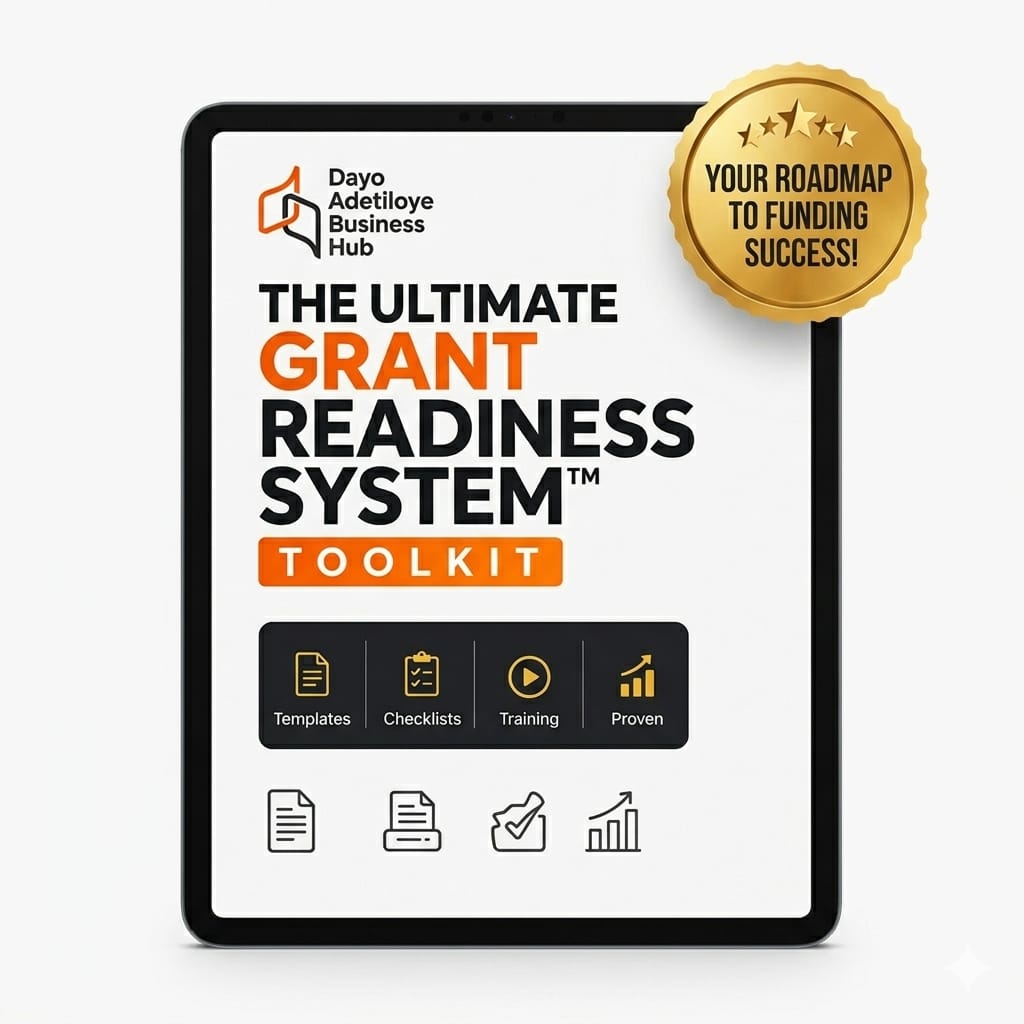
One reason we developed The Ultimate Grant Readiness System™ is that we repeatedly see businesses trying to become funding-ready only after an opportunity has opened.
By then, the entrepreneur is under pressure.
The business plan is rushed.
The financial projections are hurried.
Supporting documents are incomplete.
The entrepreneur applies anyway and hopes for the best.
There is a better approach.
The Ultimate Grant Readiness System™ provides entrepreneurs, SMEs, NGOs, social enterprises and other organisations with practical resources, templates, frameworks and funding-readiness tools that can help them prepare before opportunities arise.
Despite the name, funding readiness should not be limited to grants.
Many of the disciplines that make an organisation more competitive for grants—documentation, financial clarity, due diligence, strategic planning and professional presentation—also improve its preparation for loans, investments, accelerators and partnerships.
Your objective should be to build a permanent funding infrastructure around your business.
Then, when the right opportunity appears, you customise and apply rather than starting from zero.
Final Thoughts
Getting your business funding-ready in 90 days is not about creating beautiful documents around a weak company.
It is about using 90 days to understand and strengthen the business itself.
During the first 30 days, put your corporate, regulatory and financial foundation in order.
During the next 30 days, validate the market, determine your true capital requirement and develop realistic financial projections.
Use the following 15 days to package the business through a professional business plan, pitch deck, use-of-funds statement and organised data room.
Then spend the final 15 days stress-testing your assumptions, correcting inconsistencies and building a targeted funding pipeline.
At the end of the process, you should be able to answer confidently:
How much funding do we need?
Why do we need it?
What exactly will we spend it on?
What evidence shows that the market exists?
What happens to the business after the investment?
How will a loan be repaid or an investor generate a return?
Can our claims be verified?
When you can answer those questions with evidence rather than enthusiasm, you are moving towards genuine funding readiness.
Do not make finding money your first objective.
First, build a business worth funding.
Then position it in front of the right funders.
Related