 How to Pitch Joint Venture Opportunities to Corporate Partners
How to Pitch Joint Venture Opportunities to Corporate Partners
For Nigerian entrepreneurs seeking business expansion, corporate joint ventures can provide access to capital, technology, production facilities, distribution networks and new markets. However, convincing an established corporation to enter a joint venture requires more than presenting an attractive business idea.
Corporate partners evaluate opportunities based on strategic alignment, financial returns, operational capabilities, risk exposure and long-term commercial value.
A successful joint venture pitch must demonstrate not only what your business needs but also what the corporate partner stands to gain.
This guide explains how Nigerian SMEs and growth-stage businesses can identify suitable corporate partners, develop compelling joint venture proposals, present credible financial projections and negotiate mutually beneficial partnerships.
 How to Pitch Joint Venture Opportunities to Corporate Partners
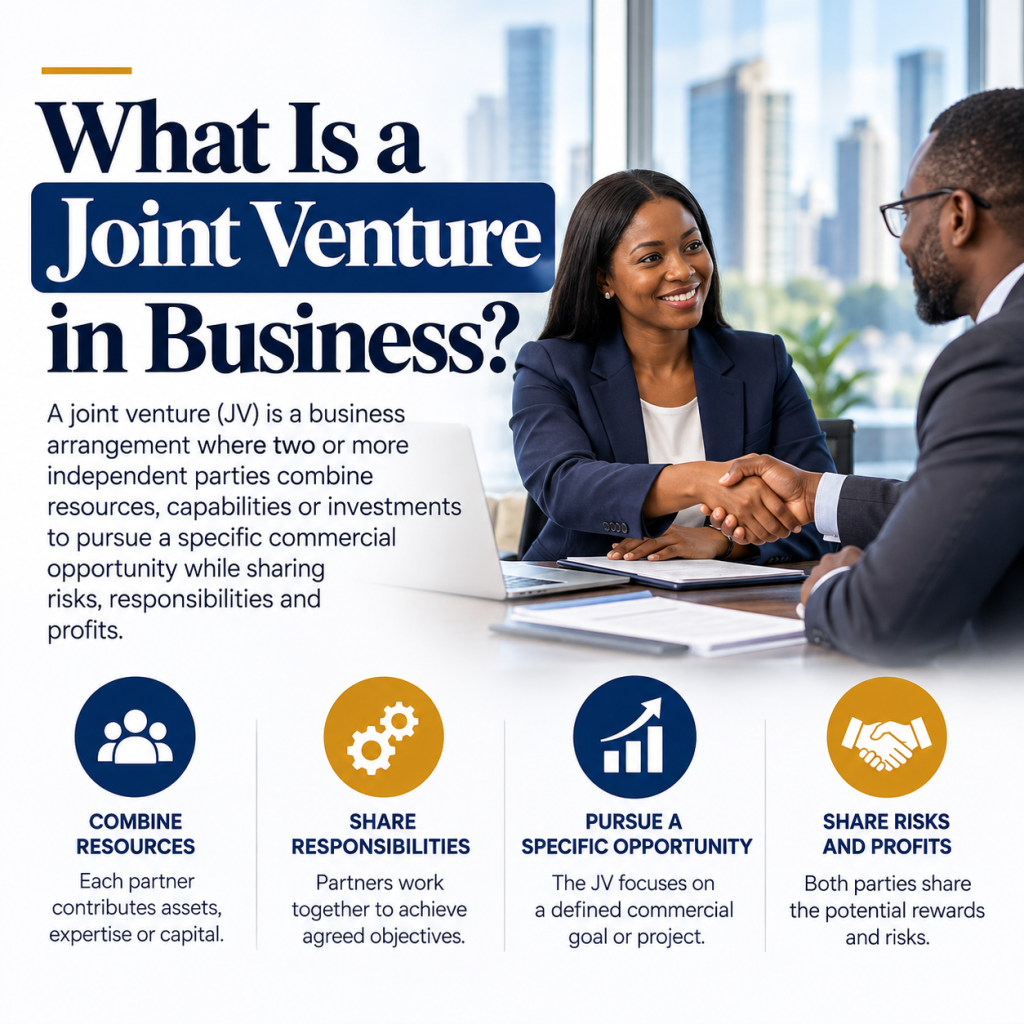
What Is a Joint Venture in Business?
A joint venture (JV) is a business arrangement in which two or more independent parties combine resources, capabilities or investments to pursue a defined commercial opportunity while sharing agreed responsibilities, risks and economic benefits.
Joint ventures may involve establishing a jointly owned company or entering a contractual collaboration without creating a separate legal entity.
For example, a Nigerian agricultural processing company may partner with an established food manufacturer. The SME contributes access to agricultural raw materials and local suppliers, while the corporate partner provides processing technology, quality assurance expertise and distribution channels.
Both parties benefit from capabilities that would otherwise be expensive or time-consuming to develop independently.
Unlike a conventional loan, a joint venture does not necessarily create a repayment obligation. Unlike a straightforward equity investment, it typically involves active commercial contributions from multiple parties.
 How to Pitch Joint Venture Opportunities to Corporate Partners
Why Do Corporate Organisations Enter Joint Ventures?
Corporations establish joint ventures when collaboration offers strategic or financial advantages over operating independently.
Common motivations include entering new geographical markets, securing reliable supply chains, reducing expansion costs, accessing specialised expertise and sharing investment risks.
For instance, an international manufacturing company entering Nigeria may prefer collaborating with an established local operator that understands distribution channels, regulatory requirements and consumer behaviour.
Similarly, a Nigerian logistics company could partner with an e-commerce platform to expand last-mile delivery operations.
The central principle is straightforward: a compelling joint venture must create measurable value for both parties.
How to Pitch Joint Venture Opportunities to Corporate Partners
1. Identify Corporate Partners with Strategic Alignment
The first step is identifying organisations whose business objectives complement your company’s capabilities.
Avoid approaching corporations simply because they are financially strong. A profitable company is not necessarily an appropriate joint venture partner.
Instead, investigate its expansion strategy, operational challenges, procurement requirements, distribution gaps and investment priorities.
A Nigerian packaging manufacturer, for example, might approach food-processing corporations seeking dependable local packaging suppliers rather than unrelated financial institutions.
Before approaching a potential partner, establish three things:
- What commercial problem does the corporation face?
- What resources or competitive advantages can your business contribute?
- How would the proposed collaboration improve revenue, efficiency or market access?
Corporate annual reports, procurement announcements, investor presentations and industry publications can provide useful intelligence.
2. Define a Clear and Profitable Joint Venture Opportunity
Corporate decision-makers want specific opportunities, not broad partnership proposals.
Instead of stating, “We want to partner with your company to expand our operations,” present a measurable commercial opportunity.
For example:
“Our company proposes establishing a jointly operated agricultural processing facility capable of processing 2,000 tonnes of produce annually, combining our established farmer sourcing network with your processing technology and national distribution infrastructure.”
This proposition identifies the business activity, production capacity and contributions expected from each partner.
The proposal should explain the market opportunity, customer demand, competitive positioning, revenue model and anticipated investment requirements.
Importantly, distinguish verified market demand from assumptions that still require validation.
3. Demonstrate Your Company’s Unique Value
One of the biggest mistakes SMEs make when approaching corporate partners is presenting themselves primarily as businesses seeking financial assistance.
Corporate joint ventures are commercial arrangements, not charitable interventions.
Your pitch must explain why the corporation should collaborate with your business rather than establish the operation independently or select another partner.
Your competitive advantages may include established customer relationships, proprietary technology, operational licences, local distribution networks, specialist expertise or access to dependable suppliers.
Support these claims with evidence.
For example, a business claiming access to 5,000 farmers should provide documentation demonstrating the nature and reliability of those relationships.
Similarly, an SME claiming strong market demand should present historical sales, customer contracts, purchase orders or independently researched market information.
Credibility becomes stronger when every major commercial claim is supported by verifiable evidence.
4. Prepare a Financially Credible Joint Venture Business Case
Corporate partners need to understand how the proposed venture will generate returns.
A convincing financial model should cover capital requirements, revenue assumptions, operating expenses, working capital, profitability, cash flow and sensitivity analysis.
Consider this hypothetical agricultural processing joint venture:
| Financial Item |
Illustrative Amount |
| Initial investment |
₦150 million |
| SME contribution |
₦45 million |
| Corporate partner contribution |
₦105 million |
| Projected annual revenue |
₦240 million |
| Estimated annual operating costs |
₦180 million |
| Projected annual EBITDA |
₦60 million |
| Illustrative EBITDA margin |
25% |
These figures are hypothetical and exclude financing costs, depreciation, taxation and certain potential capital expenditures.
The projected EBITDA margin is calculated as ₦60 million divided by ₦240 million.
However, a 25% EBITDA margin does not automatically mean a 25% investor return. Actual returns depend on ownership arrangements, taxes, reinvestment requirements, debt obligations and distributable cash flow.
Your financial projections should therefore include realistic downside scenarios covering lower sales volumes, rising input prices, delayed customer payments and exchange-rate exposure.
5. Propose a Fair Joint Venture Structure
A joint venture pitch should explain how the proposed partnership might operate.
Important considerations include ownership percentages, capital contributions, management responsibilities, board representation, profit distribution and decision-making authority.
For instance, one partner might provide capital while another contributes equipment, intellectual property, market access and operational expertise.
These contributions must be appropriately valued rather than assuming ownership should depend exclusively on cash investment.
A proposed 60:40 ownership arrangement, for example, should be supported by the negotiated value of contributions, expected responsibilities and commercial risks.
The agreement should also address deadlocks, future funding requirements, intellectual property ownership, transfer restrictions and exit provisions.
Avoid presenting an ownership split as final before independent valuation, negotiation and legal review.
6. Develop a Professional Joint Venture Pitch Deck
A corporate joint venture pitch deck should communicate the business case clearly without overwhelming decision-makers.
An effective presentation generally contains 10–12 slides covering the commercial opportunity, market evidence, proposed business model, competitive advantages, partner contributions, financial projections, risks, governance structure and implementation roadmap.
The presentation should answer one central question:
Why is this partnership commercially better than the alternatives available to the corporation?
Where possible, demonstrate the incremental value created by combining both organisations’ capabilities.
For example, quantify potential production cost reductions, distribution efficiencies or additional revenue attributable to the partnership.
Avoid inflated market projections, unrealistic profitability assumptions and unsupported promises of guaranteed returns.
7. Present a Practical Implementation and Risk Management Plan
Corporate organisations assess execution capability as carefully as projected profitability.
Your pitch should therefore explain how the venture will move from negotiation to commercial operation.
A practical implementation roadmap might include:
| Phase |
Proposed Timeline |
Key Activity |
| Feasibility and due diligence |
Months 1–2 |
Validate demand, assets and partner capabilities |
| Negotiation and approvals |
Months 2–3 |
Agree commercial terms and regulatory requirements |
| Operational setup |
Months 3–5 |
Procure equipment, recruit staff and establish systems |
| Pilot operations |
Month 6 |
Test production and customer demand |
| Commercial expansion |
Months 7–12 |
Scale operations against agreed performance targets |
Timelines should reflect the actual complexity of the project.
Your risk assessment should address operational failures, funding shortfalls, governance disputes, regulatory changes and market uncertainty.
For foreign participation, the Nigerian Investment Promotion Commission (NIPC) states that enterprises with foreign equity participation generally require NIPC registration.
The Corporate Affairs Commission (CAC) handles company incorporation, while certain joint ventures may trigger merger-control obligations under the Federal Competition and Consumer Protection Commission (FCCPC).
Not every commercial collaboration requires merger notification; the transaction structure, control arrangements and applicable thresholds matter. Obtain qualified legal advice before implementation.
8. Approach Corporate Decision-Makers Professionally
Even an excellent proposal can fail when presented to the wrong audience.
Identify individuals responsible for corporate development, strategic partnerships, business expansion, procurement or investment decisions.
A professional introductory message should briefly communicate the opportunity, strategic relevance and expected commercial benefits.
Rather than immediately sending a lengthy business plan, request an exploratory meeting supported by a concise executive summary.
During the meeting, focus on understanding the corporation’s priorities before negotiating detailed terms.
Afterwards, provide requested documentation through an organised due diligence process, using confidentiality agreements where appropriate.
Common Mistakes to Avoid When Pitching Joint Ventures
Many promising partnerships fail during initial discussions because entrepreneurs overlook fundamental commercial requirements.
Common mistakes include approaching unsuitable corporations, exaggerating market opportunities, failing to value non-cash contributions, proposing unrealistic ownership arrangements and neglecting governance issues.
Another serious mistake is confusing a joint venture with a funding request.
If your business only needs working capital and does not require an active strategic partner, a loan or conventional equity investment may be more appropriate.
Before pitching, evaluate whether the expected strategic benefits justify sharing control, profits and commercial responsibilities.
Frequently Asked Questions About Corporate Joint Ventures
Can a Small Business Enter a Joint Venture with a Large Corporation?
Yes. SMEs can establish joint ventures with larger corporations when they possess valuable capabilities, market access, intellectual property or operational advantages. Business size matters less than strategic relevance, execution capacity and commercial credibility.
What Documents Are Required for a Joint Venture Proposal?
Common documents include a company profile, executive summary, feasibility study, financial projections, pitch deck, incorporation records and evidence supporting commercial claims. Later negotiations may require a term sheet, due diligence documents and a formal joint venture agreement.
How Are Profits Shared in a Joint Venture?
Profit distribution depends on the negotiated agreement, ownership structure, capital contributions and applicable legal requirements. Ownership percentages do not necessarily determine immediate cash distributions because ventures may retain earnings for expansion.
How Long Does It Take to Secure a Corporate Joint Venture?
There is no universal timeline. Smaller contractual collaborations may progress relatively quickly, while capital-intensive joint ventures can require several months of feasibility assessment, due diligence, negotiation and regulatory approvals.
How Dayo Adetiloye Business Hub Can Help You Secure Corporate Partnerships
Developing a compelling joint venture proposal requires commercial research, financial modelling, strategic positioning and professional presentation.
At Dayo Adetiloye Business Hub, we help Nigerian entrepreneurs, SMEs and growing businesses prepare credible proposals for investment discussions and strategic partnerships.
Our relevant services include feasibility studies, market research, business plans, financial projections, investor pitch decks, investment readiness assessments and business advisory.
We help entrepreneurs translate promising commercial opportunities into structured proposals that corporate decision-makers can evaluate.
Need professional support preparing your joint venture proposal?
Call/WhatsApp: 08105636015, 08076359735, 08113205312
Email: dayohub@gmail.com
Website: www.dayoadetiloye.com
Conclusion: Turn Your Joint Venture Proposal into a Strategic Business Opportunity
Securing a corporate joint venture requires more than identifying a company with financial resources. It demands a commercially attractive opportunity, complementary capabilities, credible financial projections and a workable partnership structure.
Successful entrepreneurs approach corporate partners as potential strategic collaborators rather than simply as sources of funding.
Before presenting your proposal, validate the opportunity, quantify the benefits, assess the risks and establish why both organisations would achieve better results together.
The strongest joint venture pitch is not one that asks for the most support. It is one that demonstrates the clearest mutual commercial value.
Related