
Getting a grant is not simply about finding an opportunity and writing a convincing proposal. Many businesses lose funding opportunities because they apply for the wrong grants, are not properly prepared, submit weak financial information or fail to meet the funder’s requirements.
A good business consultant can help reduce these mistakes.
The important point, however, is that a consultant cannot guarantee a grant. The consultant’s job is to improve your readiness, strengthen your application and help you present a more credible case to the funder.
1. Use a Consultant to Determine Whether You Should Apply
Not every grant is suitable for your business.
Before spending days preparing an application, a consultant should examine the eligibility requirements, funding amount, sector, geographical restrictions, business stage, required counterpart funding and expected outcomes.
For example, if a grant requires businesses with at least two years of operations and your company was registered six months ago, writing an excellent proposal will not solve the eligibility problem.
A consultant can help you identify grants that actually fit your business.
2. Conduct a Grant Readiness Assessment
One of the best times to engage a consultant is before a grant opportunity opens.
The consultant should review your business documentation and identify gaps.
This may include your CAC documents, business plan, financial records, tax documents, company profile, bank statements, management information, evidence of previous projects and other documents commonly requested by funders.
You can then correct weaknesses before facing a tight application deadline.
3. Strengthen Your Business Plan
Many grant applications require applicants to explain their business model, market, customers, competition, operations and growth strategy.
A consultant can help ensure these sections are supported by evidence rather than exaggerated claims.
Instead of writing:
“The market is very large and everybody needs our product.”
a stronger application explains the target market, customer segments, demand, competitors and how the business intends to acquire customers.
This makes the proposal more commercially credible.
4. Develop Realistic Financial Projections
Weak financial projections can damage a grant application.
Suppose you currently generate ₦20 million annually but your application suddenly projects ₦500 million revenue next year.
A funder may reasonably ask:
What will cause this 2,400% increase?
A consultant can help develop realistic assumptions for revenue, expenses, staffing, production, cash flow and growth.
The projections should connect directly to the grant.
If you request ₦30 million for equipment, for example, the financial model should demonstrate how that equipment increases production capacity, sales, employment or other measurable outcomes.

5. Build a Strong Grant Budget
Your proposal and budget must tell the same story.
If the proposal says you will train 500 farmers but the budget provides materials for only 200, something is wrong.
A consultant can help determine:
Project Cost → Grant Request → Applicant Contribution → Activities → Expected Results
Every significant expense should have a clear reason.
The objective is not to make the budget look cheap. It is to make it reasonable, compliant and defensible.
6. Translate Your Business Into the Funder’s Language
Entrepreneurs naturally talk about what their businesses need.
Funders are interested in what their money will achieve.
Instead of:
“We need ₦20 million to expand.”
the proposal might explain that the investment will finance processing equipment that increases monthly capacity from 5 tonnes to 15 tonnes, creates eight jobs and enables the company to purchase additional raw materials from 100 smallholder farmers.
A good consultant helps connect your business need to measurable outcomes.
7. Review the Application Before Submission
A consultant can also provide an independent final review.
This is important because after working on an application for several weeks, it becomes easy to overlook mistakes.
The final review should check:
Eligibility → Questions answered → Required documents → Budget consistency → Financial figures → Word limits → Signatures → Submission requirements → Deadline
A simple compliance error can undermine weeks of work.
8. Prepare You for Due Diligence and Interviews
Getting shortlisted is not always the end of the process.
Some funders may request additional documents, interviews, pitch sessions or due diligence.
You should be able to explain:
how your business makes money;
your major costs;
your customers;
why you need the grant;
how the money will be used;
what results it will produce;
and what happens after the grant ends.
A consultant can conduct a mock interview and identify questions you are not yet prepared to answer.
What a Business Consultant Cannot Do
Be careful with anyone who promises:
“Pay me and I will guarantee you the grant.”
No credible consultant controls the funder’s final decision.
A consultant can improve your readiness and application quality, but funding decisions remain with the grant provider.
Your business must still be eligible, credible and capable of delivering what it proposes.
Work With Dayo Adetiloye Business Hub
At Dayo Adetiloye Business Hub, we help entrepreneurs, SMEs, NGOs and organisations prepare for funding opportunities.
Our services include grant application support, business plans, feasibility studies, financial projections, market research, pitch decks, BOI loan applications, funding readiness and investment readiness advisory.
Call/WhatsApp: 08105636015, 08076359735, 08113205312
Email: dayohub@gmail.com
Website: www.dayoadetiloye.com
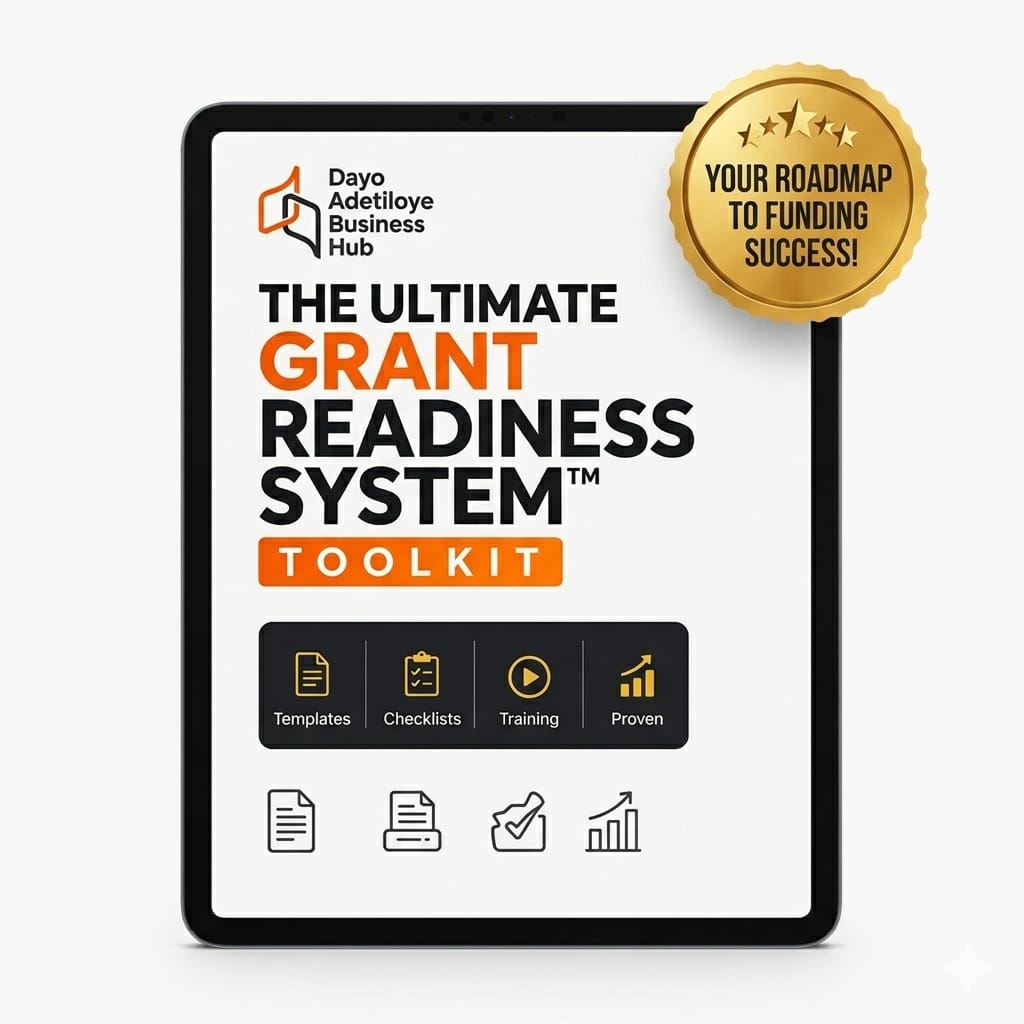
We also developed The Ultimate Grant Readiness System™ for entrepreneurs and organisations that want to organise their funding documents and become better prepared before opportunities open.
Get The Ultimate Grant Readiness System™
Related