Every year, international NGOs, foundations, and development organisations provide millions of dollars in grants to organisations implementing projects across Africa.
Yet many organisations with genuinely important projects repeatedly fail to secure funding.
The problem is not always that their ideas are weak.
Often, the problem is that they have not translated a good idea into a fundable project.
There is a major difference between saying:
“We want to empower 1,000 women.”
and presenting a proposal that clearly explains which women, where they are, what problem they face, what evidence proves the problem exists, what intervention will address it, how much it will cost, what measurable change will occur and how that change will continue after the grant ends.
International donors are not simply looking for organisations that need money.
They are looking for credible organisations capable of converting donor resources into measurable development results.
Recent calls for proposals, for example, assess applicants on areas such as relevance, organisational capacity, realistic work plans and budgets, community participation, sustainability, partnerships, monitoring and evaluation, and co-financing.
So, if you want to compete successfully for international NGO funding, your proposal must answer three fundamental questions:
Why should this project exist?
Why should your organisation implement it?
Why should the donor trust you with its money?
This guide explains how to answer those questions professionally.
1. Start With the Donor, Not With Your Organisation
One of the biggest grant-writing mistakes is preparing one proposal and sending it to every donor.
International funding does not work that way.
Every donor has its own:
- Mission
- Geographic priorities
- Thematic priorities
- Target beneficiaries
- Funding limits
- Eligibility requirements
- Preferred intervention models
- Reporting requirements
Before writing anything, study the call for proposals carefully.
If a donor is funding climate-smart agriculture for women smallholder farmers in West Africa, submitting a general youth entrepreneurship project will probably fail even if your project is excellent.
A successful proposal sits at the intersection of:
What the community needs + what your organisation can deliver + what the donor wants to fund.
That alignment is critical.
A useful first exercise is to create a simple donor compliance sheet containing the eligibility criteria, funding ceiling, project duration, geographical restrictions, target population, required documents, evaluation criteria and deadline.
Treat every requirement as compulsory unless the donor explicitly states otherwise.
2. Understand the Problem Before Designing the Project
A weak proposal begins with activities:
“We will organise training.”
A strong proposal begins with a problem:
“Why is this intervention necessary?”
Suppose you want to train 500 unemployed young women in digital skills.
Do not simply write:
“There is high unemployment among women in Nigeria.”
Go deeper.
What is the unemployment or economic exclusion problem in your specific location?
Which women are affected?
What age group?
What prevents them from accessing employment?
Is the problem inadequate technical skills, limited internet access, employer discrimination, lack of equipment, poor job-matching systems, childcare responsibilities or something else?
Use credible evidence from sources such as government statistics, World Bank reports, UN agencies, academic studies, sector reports and your organisation’s baseline surveys.
Then complement the statistics with local evidence.
For example:
“Our baseline assessment involving 320 women across three communities found that 68% had access to smartphones but only 14% had received formal digital-skills training.”
That is much stronger than saying:
“Many women lack digital skills.”
The donor needs to see that you understand the problem you are trying to solve.
3. Identify the Root Cause, Not Just the Symptom
This is where many proposals become weak.
Suppose farmers are experiencing low income.
Low income is the symptom.
The causes might include:
- Low productivity
- Poor-quality seeds
- Limited irrigation
- Post-harvest losses
- Lack of market information
- Expensive transportation
- Weak bargaining power
- Limited access to finance
Your intervention must address the causes that your project can realistically influence.
If the real problem is market access, providing another farming training programme may produce very little change.
Good proposal development therefore requires problem analysis before activity design.
One useful method is the problem tree.
Start with the central problem.
Identify its causes below it.
Identify its consequences above it.
Then determine which causes your organisation can realistically address within the available budget and timeframe.
4. Develop a Clear Theory of Change
International development organisations increasingly expect applicants to demonstrate how activities will lead to measurable change.
This is the essence of a Theory of Change.
UNDP’s programming guidance explicitly uses Theory of Change to connect activities and outputs with expected outcomes and to analyse whether interventions are producing the intended results.
A simple Theory of Change might look like this:
Problem
Rural women have low agricultural income because of poor production practices, limited market access and high post-harvest losses.
Inputs
Funding + trainers + extension specialists + technology + market partnerships.
Activities
Training, improved input distribution, demonstration farms, aggregation support and buyer linkages.
Outputs
1,000 women trained.
800 farmers receive improved inputs.
20 aggregation groups established.
Five buyer partnerships created.
Outcomes
Farm productivity increases.
Post-harvest losses decline.
More farmers sell to structured markets.
Household agricultural income improves.
Impact
Improved economic resilience and livelihoods among rural women and their households.
The logic should be easy to understand.
If the reviewer cannot see how your activities lead to your proposed outcome, your project design needs more work.
5. Write SMART Project Objectives
Avoid objectives such as:
“To empower women.”
What exactly does empowerment mean?
A stronger objective would be:
“To increase the average agricultural income of 1,000 women smallholder farmers in Ogun State by at least 25% within 18 months through improved production practices, aggregation and structured market access.”
Now the donor can measure performance.
Good objectives should generally be:
Specific
Measurable
Achievable
Relevant
Time-bound
6. Define Your Beneficiaries Precisely
Do not write:
“The project will benefit youths.”
Which youths?
Ages 18–35?
Unemployed graduates?
Young farmers?
Women?
People with disabilities?
Residents of particular communities?
Explain:
- Who the direct beneficiaries are
- How many will participate
- Where they live
- Why they were selected
- How they will be identified
- Whether vulnerable groups are included
- How beneficiaries will participate in project design and implementation
You should also distinguish between direct and indirect beneficiaries.
For example:
Direct beneficiaries: 1,000 women farmers.
Indirect beneficiaries: Approximately 5,000 household members who benefit from improved household income and food security.
Do not inflate beneficiary figures simply to make the project appear impressive.
Donors may ask how you calculated them.
7. Explain Your Methodology
This is the section where you explain how the project will actually work.
If you say you will train 1,000 entrepreneurs, explain:
How will they be recruited?
How long will training last?
What will they learn?
Who will facilitate it?
Will training be physical, online or blended?
How will attendance be verified?
What happens after training?
Will participants receive mentorship?
How will you connect them to finance or markets?
How will you track whether their businesses improve?
This transforms an idea into an implementable programme.
A reviewer should be able to read your methodology and understand how the project will move from Month 1 to completion.
8. Build a Logical Framework
For many international NGO grants, you may be required to prepare a Logical Framework – commonly called a Logframe.
A simplified version could look like this:
| Results Level |
Indicator |
Baseline |
Target |
Verification |
| Outcome |
Average farmer income |
₦120,000 |
₦150,000+ |
Surveys/records |
| Output |
Women trained |
0 |
1,000 |
Attendance records |
| Output |
Farmers linked to buyers |
0 |
800 |
Sales records |
| Output |
Aggregation groups created |
0 |
20 |
Group records |
Your logframe should agree with your narrative, work plan and budget.
If your proposal says 1,000 beneficiaries but the budget provides training materials for 500 people, reviewers will notice.
Consistency matters.
9. Develop a Serious Monitoring, Evaluation and Learning Plan
Do not wait until the end of the project to ask whether it worked.
You should know what success looks like before implementation begins.
UNDP’s monitoring framework emphasises tracking performance against indicator targets, collecting stakeholder feedback, examining contextual changes, comparing results with baselines and targets, and reviewing sustainability arrangements.
For each major result, determine:
Indicator: What are we measuring?
Baseline: Where are we starting?
Target: Where do we want to get?
Data source: Where will the information come from?
Frequency: How often will it be collected?
Responsibility: Who collects and verifies it?
Suppose your programme trains unemployed youths.
Do not measure only:
“500 youths attended training.”
That is an output.
Measure outcomes such as:
“Percentage of graduates obtaining paid employment within six months.”
or
“Percentage of participants generating income from acquired skills.”
International donors increasingly care about change, not simply activities.
10. Prepare a Realistic Work Plan
Your work plan should convert the proposal into a timetable.
For a 12-month project, you might have:
Months 1–2: Baseline, mobilisation and beneficiary selection.
Months 3–5: Training and capacity building.
Months 5–8: Enterprise support and mentorship.
Months 6–10: Market linkage and implementation.
Months 10–11: Outcome assessment.
Month 12: Evaluation, learning and close-out.
Every major budget line should connect to an activity.
Every major activity should contribute to an output.
Every output should contribute to an outcome.
That alignment is one of the hallmarks of a professionally designed proposal.
11. Build a Budget That Tells the Same Story as the Proposal
Your budget is not something the accountant should prepare independently after the proposal is finished.
The programme team and finance team should develop it together.
UNDP’s project-development procedures emphasise fully costed project budgets that capture anticipated programme and operational costs.
A budget may include personnel, training, transportation, equipment, field activities, communications, monitoring and evaluation, professional services and administrative costs where permitted.
But every expense should be:
Necessary
Reasonable
Allowable
Traceable to an activity
If you request US$30,000 for “capacity building,” the reviewer may struggle to understand the cost.
Instead, break the amount down.
For example:
20 training sessions × venue cost.
1,000 participant manuals × unit cost.
10 facilitators × agreed professional fee.
Transport support × number of beneficiaries.
A realistic budget is also essential for implementation and monitoring because actual spending can later be compared with approved expenditure.
12. Demonstrate Value for Money
International NGOs are not necessarily looking for the cheapest project.
They are looking for reasonable value for the results expected.
Suppose Organisation A requests US$500,000 to reach 1,000 beneficiaries.
Organisation B requests US$250,000 to reach 5,000 beneficiaries with a credible implementation model.
The second project may appear more efficient.
But cost per beneficiary is not the only consideration.
Quality, vulnerability, geographical difficulty and depth of intervention also matter.
Explain why your approach represents a sensible use of donor resources.
13. Show That Your Organisation Can Actually Deliver
A donor is not only evaluating your idea.
It is evaluating you.
Your organisational-capacity section should establish credibility through evidence.
Relevant information may include your registration, years of operation, governance structure, technical staff, financial-management systems, safeguarding policies, previous projects, donor experience, partnerships and audited accounts.
A recent UNDP call, for example, required applicants to demonstrate their legal status, organisational structure, governance and administrative framework, project-management experience and target populations.
Instead of saying:
“We are experienced in youth empowerment.”
write:
“Between 2023 and 2025, our organisation implemented four employability programmes reaching 3,200 young people across three states, with 64% of tracked graduates transitioning into employment or self-employment within six months.”
Evidence builds credibility.
14. Do Not Hide Your Weaknesses – Build Partnerships
Your organisation does not need to know everything.
If you are strong in community mobilisation but weak in research, partner with a university.
If you have technical agricultural expertise but weak market access, partner with an off-taker.
If your organisation lacks specialised disability-inclusion expertise, partner with an organisation that has it.
International donors often value credible collaboration. Some grant evaluation frameworks explicitly score partnerships and cooperation with public agencies, private companies and civil-society organisations.
But avoid decorative partnerships.
A partner should have a defined role, contribution and responsibility.
15. Address Gender, Inclusion and Safeguarding
Do not add:
“Women and people with disabilities will be encouraged to participate.”
as an afterthought.
Explain how inclusion affects programme design.
For example:
Will training venues be accessible?
Will sessions accommodate childcare responsibilities?
Will information be available in appropriate languages?
How will vulnerable beneficiaries be protected?
How will complaints be handled?
Who is responsible for safeguarding?
International development evaluations increasingly assess how issues such as gender equality, human rights, climate and youth are integrated into programme design and implementation.
16. Include a Risk Management Plan
Every project has risks.
Pretending otherwise reduces credibility.
Risks may include:
- Political instability
- Inflation
- Currency movements
- Beneficiary dropout
- Security challenges
- Climate events
- Staff turnover
- Supplier delays
- Regulatory changes
For each major risk, consider:
Likelihood
Impact
Mitigation
Responsible person
UNDP project-design procedures explicitly require identification and assessment of project risks and appropriate management plans.
A good proposal demonstrates that you have thought beyond approval to implementation.
17. Explain Sustainability Before the Donor Asks
One of the most important questions international funders ask is:
What happens when our funding stops?
Do not answer:
“We will look for another donor.”
That is not a sustainability strategy.
Sustainability may come from:
- Beneficiary contributions
- Revenue-generating activities
- Government adoption
- Private-sector partnerships
- Integration into existing institutions
- Community ownership
- Membership fees
- Social-enterprise income
- Training local personnel
- Replication by partners
Some UNDP funding programmes explicitly evaluate sustainability and replication, and programme guidance calls for sustainability and exit strategies that allow key achievements to continue without indefinite international financing.
18. Understand Co-Financing and Counterpart Contribution
Some international grants expect your organisation or partners to contribute something.
It may be cash or in-kind support such as office space, staff time, equipment, vehicles, volunteer time or facilities.
Requirements vary significantly.
For example, a 2026 UNDP GEF Small Grants Programme call in North Macedonia required co-financing equal to at least 50% of the total project budget, which could include cash or in-kind contributions from the applicant, government, private sector or other donors.
Never assume co-financing requirements.
Read the specific call.
And never invent counterpart contributions that you cannot document.
19. Write a Powerful Executive Summary Last
Although the executive summary appears first, write it after completing the proposal.
It should quickly communicate:
The problem
The target beneficiaries
The proposed intervention
Location
Expected results
Project duration
Funding requested
Why your organisation is qualified
A reviewer should understand the entire project after reading the executive summary.
Do not waste the opening paragraphs discussing the history of your organisation.
Lead with the development problem and proposed solution.
20. Make Every Number Agree
Before submission, conduct what we call a consistency audit.
Check every number.
If the narrative says:
2,000 beneficiaries
the work plan should say 2,000.
The logframe should say 2,000.
The budget should provide resources appropriate for 2,000.
Your monitoring plan should track 2,000.
Your executive summary should say 2,000.
The same principle applies to project duration, locations, outputs, staff, training sessions and funding amounts.
Inconsistent figures make reviewers question whether the proposal was carefully prepared.
21. Avoid These Common Grant Proposal Mistakes
Many otherwise promising applications fail because applicants:
Write generic problem statements.
Copy donor language without demonstrating understanding.
Use outdated statistics.
Propose too many activities for the available budget.
Confuse outputs with outcomes.
Promise unrealistic impact.
Submit weak financial projections.
Ignore sustainability.
Fail to explain implementation capacity.
Provide inconsistent figures.
Submit incomplete attachments.
Ignore formatting requirements.
Rush the application hours before the deadline.
And increasingly, another problem is emerging:
Submitting generic AI-generated proposals without localisation, evidence or organisational reality.
AI can assist with research, structure and editing.
It should not manufacture your impact data, partnerships, beneficiary numbers or organisational experience.
A sophisticated donor reviewer can often recognise a proposal that sounds impressive but says very little.
Read Also: 7 things investors are looking for in startups in Nigeria
A Simple Grant Proposal Structure You Can Follow
Although every donor has its own template, a comprehensive proposal may contain:
1. Executive Summary
Summarise the project and funding request.
2. Organisational Background
Establish your organisation’s credibility.
3. Problem Statement/Needs Assessment
Explain the development challenge with evidence.
4. Project Goal and Objectives
State the overall change and measurable objectives.
5. Target Beneficiaries
Identify who will benefit and why.
6. Theory of Change
Explain how your intervention produces change.
7. Methodology and Activities
Explain what will happen and how.
8. Results Framework/Logframe
Connect objectives, outputs, outcomes, indicators and targets.
9. Work Plan
Explain when activities will happen.
10. Monitoring, Evaluation and Learning
Explain how performance and outcomes will be measured.
11. Sustainability and Exit Strategy
Explain what happens after donor funding ends.
12. Risk Management
Identify risks and mitigation strategies.
13. Organisational Capacity
Demonstrate your ability to deliver.
14. Budget and Budget Narrative
Explain exactly how the funding will be used.
15. Annexes
Provide required registration documents, policies, audited accounts, CVs, references, letters of support and other supporting documents.
But remember: if the donor provides its own application format, use the donor’s format rather than imposing your preferred structure.
Your Proposal Is Only One Part of Grant Readiness
An important lesson from working with businesses, NGOs and social enterprises is that grant success does not begin when an application opens.
It begins much earlier.
Imagine discovering a US$250,000 international grant with a deadline in 14 days.
The donor requests:
- Three years’ financial statements
- Organisational profile
- Safeguarding policy
- Monitoring framework
- Previous project evidence
- Board information
- Detailed budget
- Theory of Change
- Letters from partners
- Registration documents
You cannot realistically build a credible organisation in 14 days.
That is why organisations should become grant-ready before grant opportunities arrive.
Need Professional Help With Your Grant Proposal?
At Dayo Adetiloye Business Hub, we help entrepreneurs, NGOs, social enterprises, cooperatives and organisations prepare stronger funding applications.
Our support can include:
- Grant opportunity assessment
- Eligibility review
- Grant proposal writing
- Concept note development
- Problem and needs analysis
- Theory of Change development
- Logframe development
- Project budgeting
- Monitoring and evaluation frameworks
- Sustainability strategy
- Organisational profile development
- Business plans
- Financial projections
- Pitch decks
- Proposal review and editing
- Due-diligence preparation
- Funding and investment-readiness advisory
We do not believe grant writing should simply make an organisation sound good.
The proposal must demonstrate that the organisation has a credible problem, implementable solution, realistic budget, measurable outcomes and the capacity to deliver.
Contact Dayo Adetiloye Business Hub
Call or WhatsApp:
08105636015
08076359735
08113205312
Email: dayohub@gmail.com
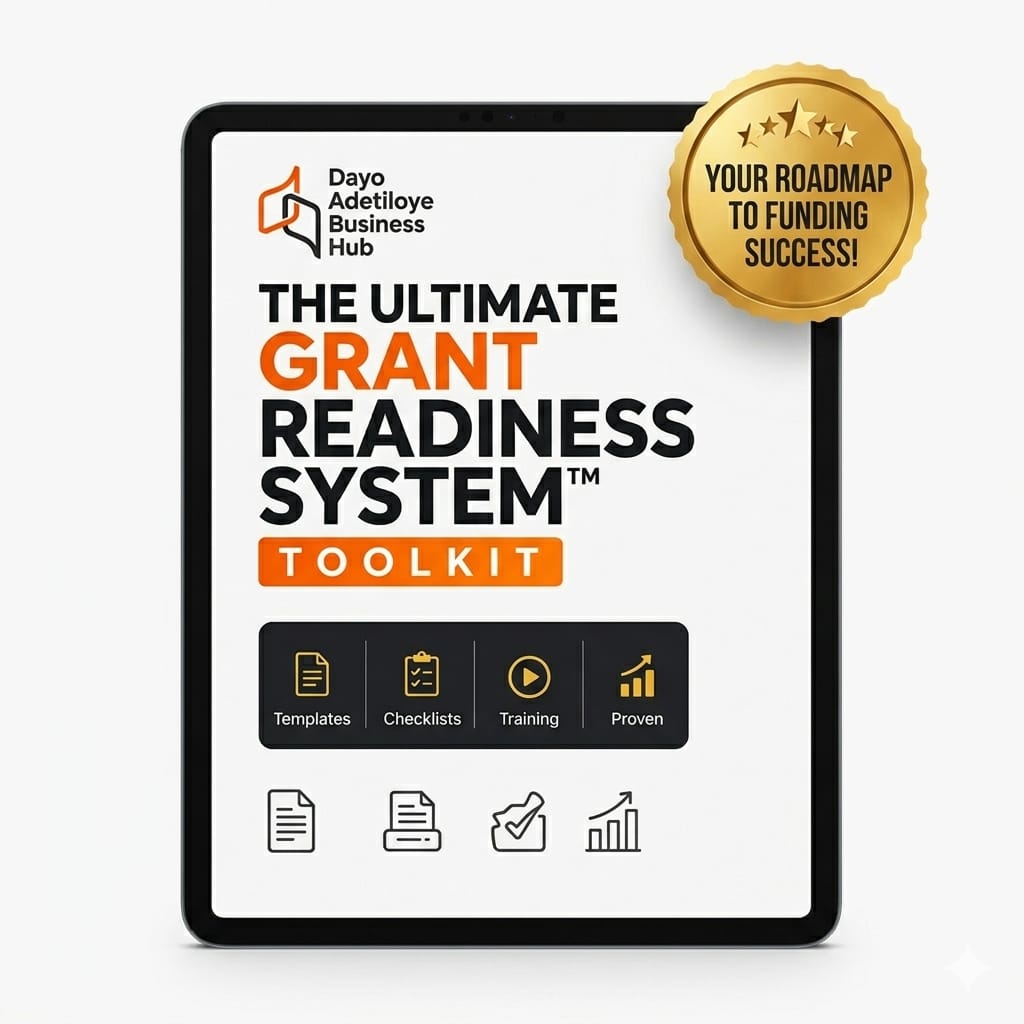
Prepare Before the Next Grant Opportunity: The Ultimate Grant Readiness System™
If you regularly apply for grants, accelerators, loans, donor funding or investment opportunities, you should not start from zero every time an opportunity appears.
That is why we developed The Ultimate Grant Readiness System™.
The system is designed to help entrepreneurs, SMEs, NGOs, social enterprises and organisations organise the templates, frameworks, funding-readiness resources and documentation they need to compete more effectively for funding opportunities.
Instead of waiting until a deadline is five days away before looking for your business plan, financial model, proposal template or due-diligence documents, you can start preparing beforehand.
Funding opportunities come and go.
Funding readiness should be permanent.
Related