Introduction
 How to Write an Investor-Ready Business Plan in 2026: A Step-by-Step Guide
How to Write an Investor-Ready Business Plan in 2026: A Step-by-Step Guide is very important for every SME. Starting a business is one thing. Convincing someone to invest their money in that business is another.
Many entrepreneurs have promising ideas, passionate founders and products they believe customers will love. Yet, when they approach investors, they struggle to answer the questions that matter most: How does the business make money? Who will buy from you? How large is the opportunity? What makes you different? How much funding do you need? And what exactly will the investor’s money achieve?
This is where an investor-ready business plan becomes important.
A business plan should be more than a document prepared because an investor, bank or funding programme requested one. It should provide a clear picture of where the business is today, where it intends to go, how it will get there and why the proposed investment makes commercial sense.
There is also an important distinction between having a business plan and having an investor-ready business plan.
A basic business plan may explain what the business does and how the entrepreneur intends to operate it. An investor-ready business plan goes further. It presents the business opportunity, market potential, business model, competitive advantage, management capability, financial projections, risks, growth strategy and funding requirement in a way that allows a potential investor to make an informed decision.
An investor-ready business plan is not simply a beautifully formatted document. It is a financial and strategic case that helps an investor understand the opportunity, the risks, the business model, the team, the numbers, and exactly how their money can create value.
This is particularly important in 2026, when investors have many opportunities to choose from and entrepreneurs must demonstrate more than enthusiasm for their ideas. Investors want to see evidence, realistic numbers and a clear path to growth.
If you are seeking equity investment, strategic investment, angel funding or other forms of private capital, your business plan should therefore answer one central question:
Why should someone invest their money in this business, and how will that investment create value?
This guide explains how to develop an investor-ready business plan step by step, from defining your business opportunity and understanding your market to preparing financial projections, determining your funding requirement and getting ready for investor due diligence.
5 Steps to Writing an Investor-Ready Business Plan in 2026
- Define the Business Opportunity and Understand Your Market
Bring together the business idea, problem being solved, target customers, market size, industry opportunity and competition.
The key question is: Is this a business opportunity worth investing in?
For example, instead of writing “We want to start an online food delivery business because food delivery is growing,” the entrepreneur should explain who the target customers are, what specific problem existing delivery options have, how large the target market is and what makes the proposed business different.
Market research is important because an investor needs evidence that the opportunity exists rather than simply relying on the founder’s enthusiasm. The SEC’s guidance on raising capital similarly places business planning and market research among the key preparation steps.
-
Explain How the Business Will Make Money and Grow
This section should combine the products/services, business model, pricing, revenue streams, marketing strategy, customer acquisition and growth plan.
The investor should be able to understand exactly how money enters the business and what will make revenue increase over time.
For example, imagine a fashion business selling ready-to-wear dresses for ₦35,000 each. If the business plans to generate ₦70 million in annual sales, the plan should show how many dresses need to be sold to achieve that figure, where the customers will come from, how much it costs to acquire them and whether the production capacity can support the target.
The important thing is to connect the sales strategy to the financial target.
-
Show That You Have the Capacity to Execute the Plan
A brilliant business opportunity is not enough if the entrepreneur cannot execute it.
This part should bring together the operations, management team, staffing, resources, technology, suppliers and systems required to run and scale the business.
For example, if a logistics company is seeking ₦30 million to expand its delivery fleet, the investor will want to know who will manage the riders, how deliveries will be assigned, how vehicles will be maintained, how customers will be monitored and what systems will prevent operational losses.
The business plan should therefore demonstrate not only what you want to build, but how you intend to build it.
-
Build Realistic Financial Projections and Determine Your Funding Need
This is one of the most important parts of an investor-ready business plan.
Your financial section should show how much the business needs, how the money will be used, expected revenue, operating costs, profitability, cash flow, break-even point and projected growth.
For example, if a manufacturing business is requesting ₦50 million, it should not simply state that ₦50 million is needed for expansion.
It could show that ₦20 million will purchase equipment, ₦12 million will finance raw materials, ₦8 million will support marketing and ₦10 million will provide working capital.
The projections should then demonstrate what those investments are expected to achieve.
The Nigerian SEC specifically advises businesses seeking capital to clearly define their funding requirements and prepare a business plan containing their strategy, target market and financial projections.
-
Address the Risks, Investment Opportunity and Supporting Evidence
Finally, an investor-ready plan should answer the questions an investor may have before committing money.
What could go wrong? What is the business doing about those risks? Why is the business positioned to succeed? What evidence supports the claims in the plan? What documents are available to verify the company’s financial and operational position?
For example, an agricultural business may identify weather conditions, rising input costs and market price fluctuations as risks. Instead of hiding these challenges, the business could explain its plans for irrigation, supplier diversification, forward contracts or other appropriate risk-management measures.
This section should also make the investment opportunity clear: how much capital is being sought, what the investor’s money will accomplish and what makes the opportunity attractive.
The supporting documents should back up the claims made in the business plan. For businesses raising capital through regulated channels, documentation and disclosure requirements can be more extensive depending on the structure of the offering.
Common Mistakes That Can Make Investors Lose Interest
- Using unrealistic financial projections. For example, projecting ₦100 million in first-year revenue without explaining how many customers are required, what they will spend and whether the business has the capacity to serve them can quickly raise questions. Investors want projections that can be traced back to realistic assumptions.
- Making claims without evidence. Saying that “there is a huge market” or “customers love our product” is not enough. Where possible, support these claims with market research, sales records, customer feedback, contracts or other credible evidence.
- Request funding without clearly explaining how it will be used. If you are asking for ₦30 million, an investor should be able to see whether the money will go towards equipment, inventory, staffing, marketing, technology or working capital and what those investments are expected to achieve.
- Ignoring competition is another red flag. Every business has competitors, even if they operate differently. Claiming that you have “no competition” may suggest that you have not researched the market properly.
- Hiding business risks. Every business faces challenges. A strong business plan identifies the major risks and explains how management intends to reduce or manage them.
The goal is not to present a perfect business. It is to present a credible business opportunity backed by realistic assumptions, evidence and a team that understands what it will take to succeed.
Prepare for Investor Due Diligence
Writing an investor-ready business plan is only part of the preparation. If an investor becomes seriously interested, they may want to verify the information presented in the plan before committing their money.
This process is known as due diligence.
Investors may want to examine your company registration documents, financial records, bank statements where appropriate, contracts, licences and permits, ownership structure, assets, customer records and other documents relevant to the business.
For example, if your business plan states that you currently serve 200 customers, you should have records that can reasonably support that claim. If you say that the business has secured a major corporate contract, the relevant agreement or evidence should be available.
This is why entrepreneurs should prepare their records before approaching investors, rather than waiting until an investor requests them.
A simple digital folder can contain your corporate documents, financial records, business plan, financial projections, contracts, licences, tax documents, asset records and other important business information.
Good record-keeping does more than make due diligence easier. It also helps investors see that the business is organised and that the founder takes financial and operational management seriously.
Most importantly, make sure the information in your business plan matches the evidence supporting it. Inconsistencies between your projections, financial records and other business documents can weaken investor confidence.
Being investor-ready therefore means more than having a well-written business plan. It means having a business that can stand up to reasonable questions and verification when an investor takes a closer look.
READ ALSO: Business Plan Writing Mistakes That Can Cost You Funding
D0 YOU KNOW?
Preparing an investor-ready business plan requires more than putting information into a document. Your market research, business model, operations and financial projections must tell the same story and support the funding you are requesting.
At Dayo Adetiloye Business Hub (DABH), we help entrepreneurs turn their business ideas and existing businesses into structured, professional and funding-ready businesses.
Our support can include:
Business Plan Development, Feasibility Studies, Market Research, Financial Projections, Cash Flow Forecasts, Break-Even Analysis, Financial Modelling, Funding Strategy, Investor Pitch Decks and Funding Application Support.
For example, if you are seeking ₦20 million to expand your business, we can help you determine whether ₦20 million is actually sufficient, how the funds should be allocated, what additional revenue the investment could generate and how the numbers should be presented in your business plan.
We also help entrepreneurs identify gaps that could affect their funding readiness before they approach investors, lenders or funding programmes.
The goal is not simply to produce a document that looks professional. It is to help you develop a credible business case backed by research, realistic financial assumptions and a clear growth strategy.
Whether you are preparing to approach an investor, applying for a loan or positioning your business for future funding opportunities, becoming prepared before the opportunity arrives can give you a significant advantage.
Contact Dayo Adetiloye Business Hub: Call or WhatsApp:
08105636015 08076359735 08113205312.
Email: dayohub@gmail.com
 How to Write an Investor-Ready Business Plan in 2026: A Step-by-Step Guide
Get Grant-Ready Before the Next Opportunity
Many organisations miss funding opportunities because they are not prepared when calls for applications open.
That’s why we created:
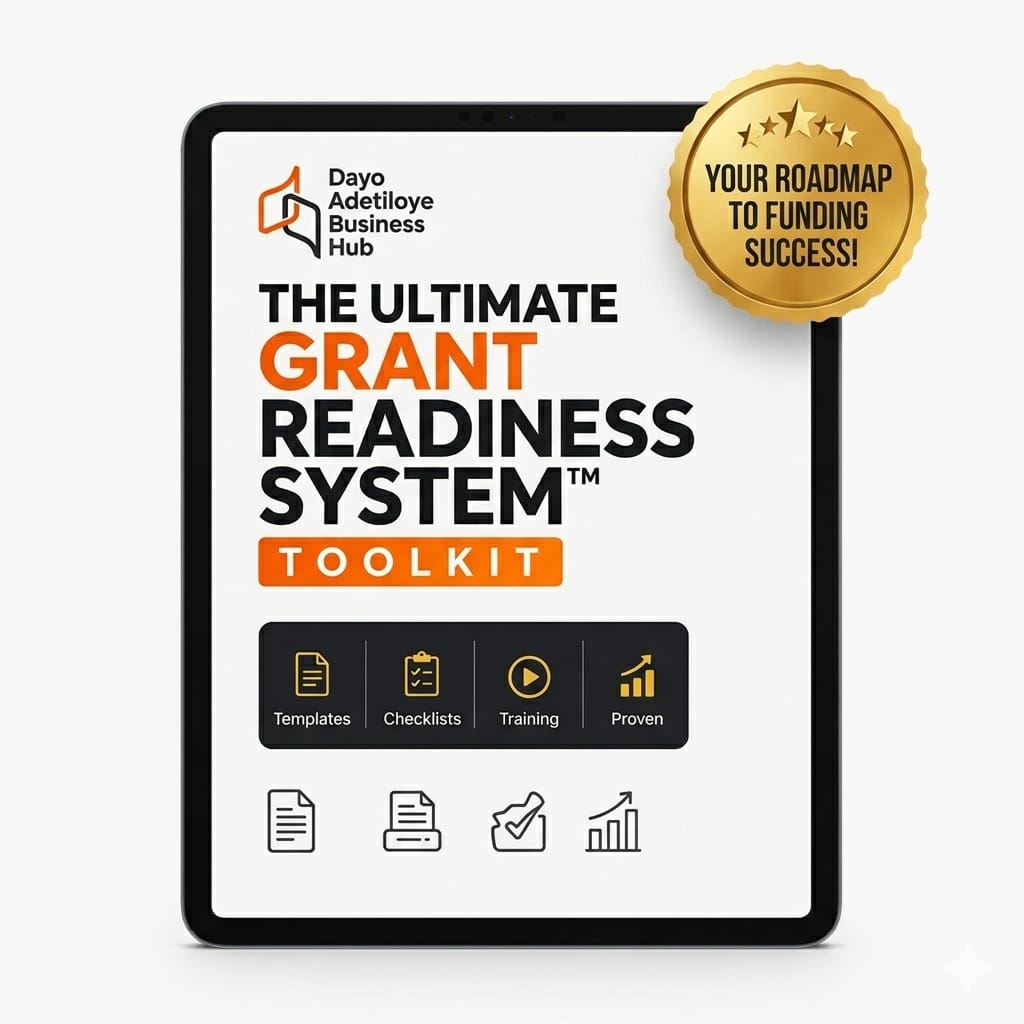
The Ultimate Grant Readiness System™
The Complete Toolkit for Grants, Funding & Investment Readiness
The toolkit includes:
- Grant Proposal Templates
- Business Plan Templates
- Financial Projection Models
- Investor Pitch Deck Templates
- Due Diligence Checklists
- NGO Proposal Templates
- Funding Readiness Resources
- Proposal Writing Guides
Whether you’re applying for international grants, innovation competitions, accelerator programmes, or investor funding, this toolkit will help you prepare professional applications with confidence.
Get instant access here:
http://selar.com/38k7agny27?affiliate=kjj9
Related