 Is Oil Palm Plantation Profitable? Complete Cost & Profit Analysis in Nigeria (2026)
Is oil palm plantation profitable in Nigeria? Yes. Oil palm plantation can be a profitable long-term agricultural investment, particularly when farmers use improved seedlings, secure suitable farmland, manage production costs, and establish reliable markets for fresh fruit bunches (FFB) or processed palm oil.
However, profitability is not automatic. Unlike annual crops such as maize or cassava, oil palm requires substantial initial investment and several years of maintenance before meaningful commercial revenue begins.
For Nigerian entrepreneurs considering oil palm cultivation in 2026, the important questions are: How much does it cost to establish a plantation? How much can one hectare generate annually? How long does it take to recover the investment?
This guide examines the cost of starting an oil palm plantation in Nigeria, expected revenue, profit margins, investment risks, and strategies for building a commercially sustainable plantation.
Why Is Oil Palm Plantation a Promising Business in Nigeria?
Nigeria has a longstanding history of oil palm cultivation, particularly in Edo, Delta, Ondo, Cross River, Akwa Ibom, Rivers, Abia, and Imo States.
Oil palm produces two commercially valuable oils: crude palm oil from the fruit’s fleshy portion and palm kernel oil from its seed.
These products serve several industries, including food processing, cosmetics, soap manufacturing, detergents, and industrial manufacturing.
According to the United States Department of Agriculture (USDA), Nigeria’s palm oil production for the 2025/2026 marketing year is estimated at approximately 1.5 million metric tonnes, representing about 1.8% of global production.
The USDA’s 2024 Nigeria Oilseeds and Products report also estimated palm oil consumption at 1.96 million metric tonnes for 2024/2025, demonstrating substantial domestic demand.
Although these figures cover different reporting periods, they illustrate the importance of palm oil to Nigeria’s agricultural economy.
For investors, the opportunity is not simply growing palm trees. It involves developing a productive agricultural asset capable of supplying processors and industrial buyers over many years.
 Is Oil Palm Plantation Profitable? Complete Cost & Profit Analysis in Nigeria (2026)
How Much Does It Cost to Start an Oil Palm Plantation in Nigeria?
The establishment cost depends on location, land ownership, plantation size, terrain, seedling quality, labour, and access to infrastructure.
A small plantation can begin with one hectare, although larger plantations may benefit from economies of scale.
Estimated Cost of Establishing One Hectare of Oil Palm Plantation in 2026
The following represents an illustrative commercial startup budget for a one-hectare plantation in Nigeria.
| Expense |
Estimated Cost (₦) |
| Land preparation and clearing |
250,000 |
| Improved oil palm seedlings |
400,000 |
| Surveying, pegging and planting |
120,000 |
| Fertiliser and soil improvement |
180,000 |
| Labour and initial maintenance |
220,000 |
| Weed and pest management |
100,000 |
| Transportation and logistics |
100,000 |
| Tools and basic farm infrastructure |
130,000 |
| Contingency allowance |
150,000 |
| Total Estimated Establishment Cost |
₦1,650,000 |
Important: This is a planning illustration, not a verified nationwide market quotation. It excludes land acquisition, legal documentation, financing costs, and subsequent years of maintenance. Actual costs should be validated through local quotations.
The Nigerian Institute for Oil Palm Research (NIFOR) currently lists oil palm seedlings at ₦2,500 each. At approximately 143 seedlings per hectare, the basic seedling purchase would be ₦357,500, excluding transportation, replacement seedlings, and handling expenses.
NIFOR also publishes a lower manual establishment-cost benchmark, but that estimate should not be confused with a comprehensive 2026 commercial investment budget.
Investors should obtain a location-specific feasibility study before committing capital.
How Many Oil Palm Trees Can Be Planted on One Hectare?
One hectare can accommodate approximately 143 oil palm trees using a triangular planting arrangement with about nine metres between palms.
This planting density is supported by guidance from the Food and Agriculture Organization (FAO).
A five-hectare plantation would therefore accommodate approximately 715 palms, before adjustments for roads, drainage, and other infrastructure.
Proper spacing allows the palms to receive sufficient sunlight, reduces competition for nutrients, and supports harvesting operations.
Planting too many trees per hectare does not necessarily increase profitability. Overcrowding can reduce productivity and make farm management more difficult.
How Long Does Oil Palm Take to Produce Fruit?
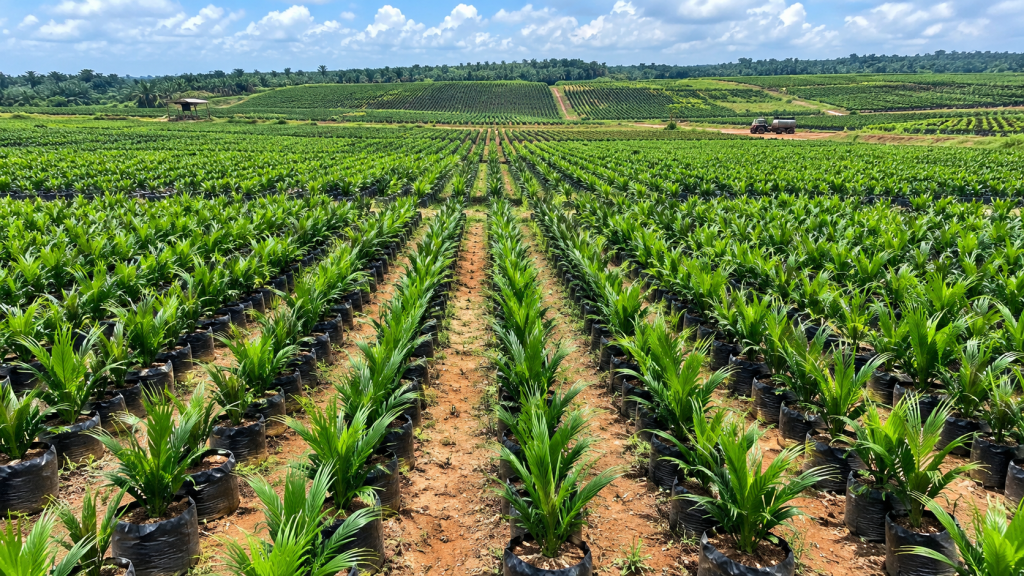
Improved Tenera oil palm varieties can begin producing fruit approximately three years after field planting.
NIFOR identifies Tenera as a high-yielding planting material suitable for commercial oil palm production.
The plantation generally progresses through three stages:
Years 1–2: Establishment stage. The farmer concentrates on planting, weed control, fertilisation, replacing failed seedlings, and protecting the plantation.
Years 3–5: Early production stage. The palms begin producing harvestable fruit bunches, although yields remain below mature plantation levels.
Years 6 onward: Expanding commercial production. With suitable growing conditions and good management, output increases as the plantation matures.
NIFOR indicates that fresh fruit bunch yields can begin around three tonnes per hectare and rise substantially as palms mature.
This delayed production period explains why oil palm plantation investors require patient capital and realistic cash-flow planning.
How Much Profit Can One Hectare of Oil Palm Generate Annually?
Profitability depends primarily on three factors: fruit bunch yield, selling price, and operating expenditure.
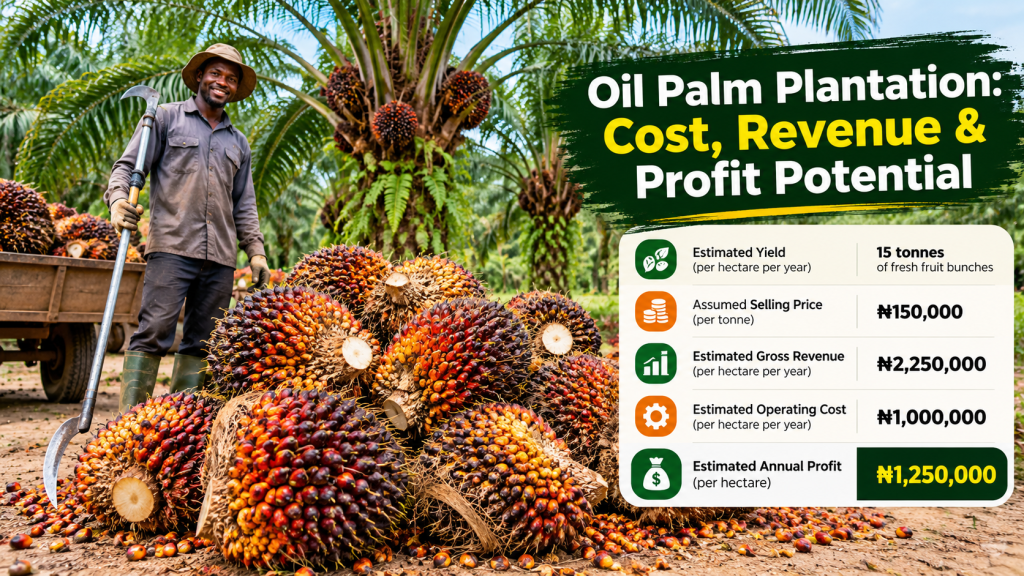
Consider an established one-hectare plantation producing 15 tonnes of fresh fruit bunches annually.
Assume the farmer sells the harvested bunches to a local processor at ₦150,000 per tonne.
Illustrative Annual Revenue Calculation
| Financial Indicator |
Amount |
| Plantation size |
1 hectare |
| Annual FFB production |
15 tonnes |
| Assumed selling price per tonne |
₦150,000 |
| Annual gross revenue |
₦2,250,000 |
| Harvesting and farm labour |
₦350,000 |
| Fertiliser and plantation maintenance |
₦300,000 |
| Transportation and marketing |
₦200,000 |
| Other operating expenses |
₦150,000 |
| Total annual operating expenses |
₦1,000,000 |
| Estimated annual operating profit |
₦1,250,000 |
Under these assumptions, the plantation generates an annual operating profit margin of approximately 55.6%.
However, this is not a guaranteed profit forecast. The ₦150,000 selling price is an illustrative assumption, not a confirmed October 2026 market quotation.
The calculation also excludes land costs, interest, depreciation, taxes, and recovery of establishment expenditure. It describes a productive plantation, not a newly planted farm.
What Happens If Palm Fruit Prices or Yields Fall?
A serious investor should test several financial scenarios rather than rely on one optimistic forecast.
| Scenario |
Yield (Tonnes) |
Price/Tonne |
Revenue |
Operating Profit* |
| Conservative |
10 |
₦120,000 |
₦1,200,000 |
₦200,000 |
| Base case |
15 |
₦150,000 |
₦2,250,000 |
₦1,250,000 |
| Optimistic |
18 |
₦180,000 |
₦3,240,000 |
₦2,240,000 |
All scenarios assume annual operating costs of ₦1 million for comparison. Actual expenses may increase with production volume.
The analysis demonstrates that even a productive plantation can experience substantial changes in profitability when market prices or harvest volumes fluctuate.
For a plantation producing 15 tonnes annually with ₦1 million in operating expenses, the operating break-even selling price is approximately ₦66,667 per tonne.
This excludes the recovery of initial investment and other financing obligations.
Is a Five-Hectare Oil Palm Plantation More Profitable?
A five-hectare plantation provides a larger production base and may justify better infrastructure, organised labour, and direct supply agreements with processing companies.
Using the base-case assumptions:
- Plantation size: 5 hectares
- Estimated palms: 715
- Annual production: 75 tonnes of FFB
- Annual gross revenue: ₦11,250,000
- Estimated operating expenses: ₦5,000,000
- Annual operating profit: ₦6,250,000
These figures assume each hectare performs similarly and that output can be sold at the assumed price.
Establishment expenditure could reach approximately ₦8.25 million before land purchase and pre-production maintenance costs.
Importantly, the ₦6.25 million represents potential annual operating profit after the plantation reaches the assumed production level. It should not be interpreted as immediate income or the net return on total capital invested.
When Can an Oil Palm Plantation Investor Recover Their Investment?
Investment recovery depends on establishment costs, the length of the immature period, harvest yields, operating expenses, and selling prices.
For example, a plantation established at ₦1.65 million per hectare will still require additional expenditure during its first two or three years before substantial harvest income becomes available.
A realistic financial model should therefore cover at least 10 years and account for:
- Initial capital expenditure and land costs.
- Annual maintenance during immature years.
- Gradually increasing fruit bunch production.
- Price fluctuations and inflation.
- Loan repayment obligations and financing costs.
A well-managed plantation may recover its investment several years after production begins, but there is no universally reliable payback period.
Investors should calculate cumulative cash flow, net present value (NPV), internal rate of return (IRR), and payback period before making a major investment decision.
These indicators provide a more meaningful assessment than simply multiplying expected annual harvests by market prices.
Should You Sell Fresh Fruit Bunches or Process Palm Oil?
Oil palm investors generally have two commercial options.
Option 1: Sell Fresh Fruit Bunches
This model involves harvesting ripe bunches and supplying nearby palm oil mills.
It requires comparatively lower capital investment because the farmer does not need to purchase processing machinery.
However, revenue depends on fruit bunch prices, processing demand, transportation costs, and timely harvesting.
Option 2: Process Palm Fruit into Palm Oil
Under this model, the investor establishes or partners with a processing facility to extract crude palm oil and potentially recover palm kernels.
Processing creates additional revenue opportunities but introduces machinery, fuel, labour, quality-control, packaging, and working-capital expenses.
NIFOR offers small-scale palm oil processing equipment and reports an extraction ratio of approximately 15% for its small-scale processing systems.
For example, processing 15 tonnes of FFB at a 15% extraction rate would produce approximately 2.25 tonnes of crude palm oil, before considering other recoverable products and process losses.
Whether processing is more profitable depends on the selling price of the oil and the full cost of conversion.
For beginners, selling fruit bunches to established mills may be the more practical entry strategy.
What Are the Major Risks of Oil Palm Plantation Investment?
Oil palm plantation is a long-term business exposed to agricultural, financial, and operational risks.
Poor-quality seedlings: Unverified planting materials can reduce productivity for many years. Farmers should purchase from credible suppliers such as NIFOR or approved nurseries.
Land-related disputes: Unclear ownership, community disagreements, and unsuitable land can threaten an entire investment. Proper due diligence is essential.
Inadequate maintenance: Poor weed control, nutrient deficiencies, and delayed harvesting can significantly reduce yields.
Market and logistics risks: A plantation located far from reliable processors may incur high transportation costs and suffer quality losses from delayed fruit delivery.
Environmental and regulatory risks: Investors should assess land-use restrictions, environmental obligations, community rights, and any applicable environmental impact assessment requirements before clearing or developing land.
One practical recommendation is to identify potential off-takers before planting, rather than waiting until the first commercial harvest.
 Is Oil Palm Plantation Profitable? Complete Cost & Profit Analysis in Nigeria (2026)
How Can You Finance an Oil Palm Plantation in Nigeria?
Oil palm plantation projects may be financed through personal equity, agricultural partnerships, cooperatives, commercial lenders, development finance institutions, and suitable agribusiness investment programmes.
The Bank of Industry (BOI) is one institution worth assessing where an agribusiness project meets the relevant programme’s eligibility criteria.
However, investors must verify current funding windows, permitted uses, security requirements, repayment terms, and sector eligibility directly with the institution.
A lender or investor will generally expect evidence of land access, market demand, management capacity, financial viability, and repayment ability.
 Is Oil Palm Plantation Profitable? Complete Cost & Profit Analysis in Nigeria (2026)
Prepare Your Plantation Business for Funding
Before applying for agricultural loans or grants, entrepreneurs should develop a credible business plan, financial projections, implementation schedule, and supporting documentation.
The Ultimate Grant Readiness System™ provides a practical toolkit for entrepreneurs seeking to strengthen their funding preparation and application readiness.
Explore The Ultimate Grant Readiness System™
The toolkit supports preparation; it does not guarantee grant approval or investment.
How Dayo Adetiloye Business Hub Can Help You Start a Profitable Oil Palm Plantation
Establishing a commercially viable oil palm plantation requires more than purchasing farmland and seedlings.
Investors need to understand their capital requirements, expected yields, operating expenses, financing structure, and long-term returns.
Dayo Adetiloye Business Hub supports Nigerian entrepreneurs, agribusiness operators, cooperatives, and investors with professional business development services, including:
- Oil palm plantation business plans and feasibility studies.
- Agricultural investment analysis and financial projections.
- Market research and commercial viability assessments.
- BOI loan application preparation and funding advisory.
- Investor-ready pitch decks and business proposals.
- Grant writing, investment readiness, and business advisory services.
Whether you intend to establish a one-hectare plantation, develop a five-hectare commercial farm, or invest in integrated palm oil production and processing, a professionally prepared feasibility study can help you make informed decisions.
Contact Dayo Adetiloye Business Hub
Call/WhatsApp: 08105636015, 08076359735, 08113205312
Email: dayohub@gmail.com
Website: https://www.dayoadetiloye.com
Frequently Asked Questions About Oil Palm Plantation Profitability
Is oil palm plantation profitable in Nigeria in 2026?
Yes. A well-managed oil palm plantation can generate attractive long-term operating returns. Profitability depends on seedling quality, yield, production costs, market prices, and effective management.
How much does it cost to establish one hectare of oil palm?
An illustrative 2026 commercial establishment budget is approximately ₦1.65 million per hectare, excluding land acquisition and subsequent maintenance. Actual costs vary significantly by location.
How many oil palm trees can grow on one hectare?
Approximately 143 oil palm trees can be planted per hectare using a recommended triangular spacing arrangement of about nine metres.
How many years before oil palm starts producing?
Improved Tenera oil palms can begin producing fruit approximately three years after planting, with commercial yields increasing as the trees mature.
Can oil palm plantation generate passive income?
Oil palm plantations can provide recurring harvest revenue, but they are not entirely passive investments. Farm supervision, maintenance, harvesting, security, and marketing remain necessary.
Conclusion: Is Oil Palm Plantation Worth Investing In?
Oil palm plantation remains a promising long-term agribusiness opportunity in Nigeria because of its industrial applications, domestic market demand, and capacity to produce recurring harvests over many years.
However, successful investors must distinguish between projected revenue, annual operating profit, and actual investment returns.
The most profitable plantations are not necessarily the largest. They are those established with suitable land, improved planting materials, adequate financing, effective management, and reliable access to buyers.
Before investing millions of naira in oil palm cultivation, commission a realistic feasibility study and financial projection that reflects your proposed location, available capital, and target market.
Dayo Adetiloye Business Hub can help you evaluate your investment opportunity and develop the professional business documentation needed to move forward with greater confidence.
Related