 Snail Farming for Beginners: How to Start with Low Capital in Nigeria
Starting an agricultural business in Nigeria does not always require large farmland, expensive machinery or substantial capital. With the right knowledge and resources, entrepreneurs can establish profitable agricultural businesses within relatively small spaces. Snail farming is one such opportunity.
Snail farming, also known as heliciculture, involves breeding and rearing edible land snails for commercial purposes. It requires relatively little space and can utilise locally available feed materials.
However, low startup costs do not automatically guarantee profitability. Snails require suitable housing, balanced nutrition, moisture control and protection from predators.
This guide explains how to start snail farming in Nigeria, including startup costs, feeding requirements, breeding practices, profit potential and marketing opportunities.
Is Snail Farming Profitable in Nigeria?
Yes, snail farming can be profitable in Nigeria when farmers manage production costs, reduce mortality and secure reliable buyers.
Snail meat is consumed across several parts of Nigeria and sold through restaurants, hotels, supermarkets, traditional markets and food vendors.
A July 2026 Vanguard report, citing an analyst from Financial Derivatives Company, highlighted Nigeria’s potential to produce more than 45,000 metric tonnes of snails annually. However, inconsistent supply and limited technical knowledge remain significant challenges.
The report also indicated that jumbo-sized snail prices declined from approximately ₦4,000 to ₦3,000 during the rainy season as supply increased.
This demonstrates the importance of understanding seasonal price fluctuations. Farmers who can maintain consistent production throughout the year may be better positioned to serve customers during periods of limited supply.
 Snail Farming for Beginners: How to Start with Low Capital in Nigeria
Which Snail Species Are Best for Farming in Nigeria?
Selecting suitable breeding stock is essential because snail species differ in growth rates, reproductive performance and market value.
Archachatina Marginata
Commonly known as the giant African land snail, this species is popular among Nigerian farmers because of its relatively large size and acceptance in local food markets.
Achatina Achatina
Also known as the giant Ghana snail, this species is suitable for tropical environments and has commercial value across West Africa.
Achatina Fulica
Although widely distributed internationally, this species presents environmental concerns because of its invasive characteristics. Farmers should investigate applicable restrictions before acquiring it.
For beginners, locally adapted and legally sourced Archachatina marginata and Achatina achatina are sensible options to consider.
Purchase healthy breeding stock from reputable farmers and obtain information about their age, breeding history and health.
 Snail Farming for Beginners: How to Start with Low Capital in Nigeria
How Much Does It Cost to Start Snail Farming in Nigeria?
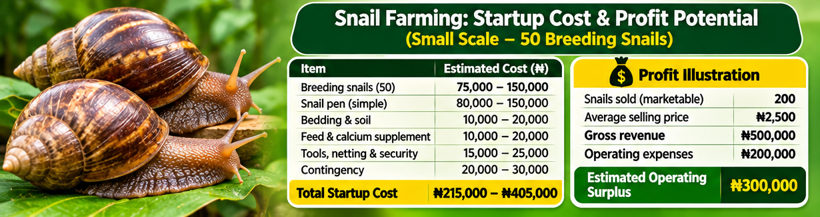
A small-scale snail farming business can be established with an estimated budget of ₦215,000–₦405,000, assuming the entrepreneur already has access to suitable space.
Estimated Startup Cost for 50 Breeding Snails
| Item |
Estimated Cost |
| 50 breeding snails |
₦75,000–₦150,000 |
| Snail pen construction |
₦80,000–₦150,000 |
| Soil preparation and bedding |
₦10,000–₦20,000 |
| Feeding and watering containers |
₦5,000–₦10,000 |
| Calcium supplements and initial feed |
₦10,000–₦20,000 |
| Netting and predator protection |
₦15,000–₦25,000 |
| Contingency |
₦20,000–₦30,000 |
| Total Estimated Cost |
₦215,000–₦405,000 |
These figures are illustrative planning estimates rather than verified nationwide market quotations. Actual costs depend on location, breeding stock prices and construction materials.
The budget excludes land acquisition, rent, paid employees and subsequent operating expenses.
Entrepreneurs with an existing backyard and suitable construction materials may reduce startup costs. However, essential housing and security requirements should not be compromised.
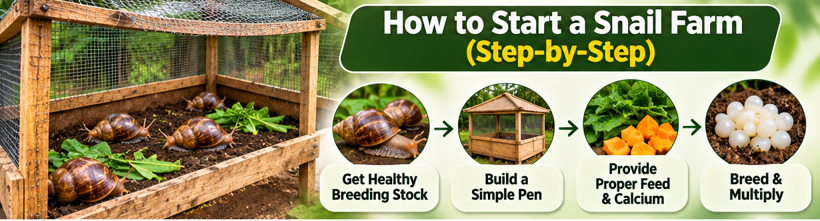
How to Start Snail Farming: Step-by-Step Guide
Step 1: Conduct Market Research
Before purchasing breeding stock, identify potential customers and understand their purchasing preferences.
Visit restaurants, hotels, market traders and food vendors. Find out the snail sizes they prefer, quantities purchased, seasonal demand and prevailing prices.
This information will help you determine your production targets and pricing strategy.
Step 2: Choose a Suitable Location
Snails thrive in humid, shaded environments with suitable soil and adequate ventilation.
A backyard, dedicated agricultural space or properly designed enclosure can accommodate a small snail farm.
Avoid locations exposed to excessive heat, flooding, direct sunlight and heavy pesticide use.
Step 3: Construct a Simple Snail Pen
Common snail housing systems include hutch boxes, trench pens and mini-paddock enclosures.
For beginners, a wooden or mesh-covered pen offers a practical starting point.
A suitable snail pen should provide:
- Adequate shade and ventilation.
- Moist but well-drained soil.
- Secure covers to prevent escape.
- Protection against rats, ants, birds and lizards.
- Sufficient space for feeding and movement.
The practical snail farming manual developed by the Centre for Tropical Agriculture and Rural Development emphasises the importance of soil texture, moisture and calcium availability.
Well-managed loamy soil is generally preferable to excessively sandy or waterlogged soil.
Step 4: Purchase Healthy Breeding Snails
Buy breeding stock from established snail farmers with reliable production records.
Avoid snails with damaged shells, unusual inactivity or visible signs of poor health.
Starting with healthy, mature or near-mature snails may reduce the waiting period before reproduction begins.
Step 5: Establish a Feeding Routine
Snails consume various locally available plant materials. Nevertheless, they require balanced nutrition to support growth, reproduction and shell development.
Provide fresh feed regularly, maintain suitable moisture levels and remove uneaten food to prevent contamination.
Step 6: Monitor Breeding and Farm Performance
Keep records of egg production, hatching, mortality, feeding expenses and sales.
Separate hatchlings, growing snails and breeding stock where practical. This makes feeding, monitoring and population management easier.
What Do Snails Eat for Healthy Growth?
Snails can consume pawpaw leaves and fruits, cocoyam leaves, bananas, sweet potatoes, vegetables and suitable fruit leftovers.
However, vegetables and fruits alone may not provide all the nutrients required for commercial production.
Snails also need protein, minerals and calcium. Calcium is particularly important because their shells consist largely of calcium carbonate.
Suitable calcium sources include ground limestone, crushed oyster shells and properly prepared eggshell powder.
Technical snail farming manuals also describe formulated feeds containing ingredients such as maize, soybean meal, groundnut cake and wheat offal.
Feed snails preferably in the evening, when they are generally more active. Remove leftover food regularly and avoid salty, contaminated, mouldy or pesticide-treated materials.
Balanced nutrition can improve growth and reduce production losses.
How Do Snails Reproduce and Multiply?
Snails possess both male and female reproductive organs. However, many commercially important giant African land snails require mating between individuals for successful reproduction.
Following mating, they deposit eggs in suitable moist soil.
Egg production varies considerably according to species, age, nutrition and environmental conditions.
For instance, Archachatina marginata generally produces smaller egg clutches than Achatina fulica.
Therefore, beginners should avoid developing financial projections based on exaggerated reproduction claims. Actual breeding performance, hatching rates and survival should guide expansion decisions.
How Long Does It Take to Harvest Snails?
Depending on species, nutrition and management, giant African land snails may require approximately one to two years to reach the size preferred by some commercial buyers.
Some snails may begin reproducing earlier. However, breeding maturity does not necessarily mean they have reached the desired market size.
During the early production period, farmers should prioritise survival, growth, reproduction and cost management rather than immediate sales.
Starting with mature breeding stock can help shorten the initial breeding timeline.
How Much Profit Can You Make from Snail Farming?
Snail farming profitability depends on the number of marketable snails, selling prices, mortality rates and operating expenses.
Consider a hypothetical farm that begins with 50 breeding snails and eventually produces enough healthy stock to sell 200 marketable snails.
Illustrative Snail Farming Revenue and Profit Analysis
| Financial Indicator |
Amount |
| Marketable snails sold |
200 |
| Assumed selling price per snail |
₦2,500 |
| Gross sales revenue |
₦500,000 |
| Feeding, labour and other operating expenses |
₦200,000 |
| Estimated operating surplus |
₦300,000 |
This scenario represents an illustrative operating margin of 60%.
However, the ₦300,000 operating surplus is not guaranteed net profit. It excludes initial establishment expenses, depreciation, taxes and financing costs.
Furthermore, the example does not establish how quickly 50 breeding snails will produce 200 marketable offspring.
Farmers should validate selling prices locally and maintain accurate production records before estimating investment returns.
Where Can You Sell Snails in Nigeria?
Potential customers include restaurants, hotels, pepper soup vendors, supermarkets, market traders and individual households.
Farmers can also attract customers through WhatsApp Business, referrals and local food communities.
Initially, selling live snails may require less investment than establishing a processing facility.
As production expands, entrepreneurs can explore cleaned, packaged or frozen snail meat, subject to applicable food safety requirements.
Exporting provides another potential opportunity. However, exporters must investigate Nigeria Agricultural Quarantine Service requirements, destination-country regulations and applicable species-specific restrictions.
Establishing a reliable domestic market should generally precede export expansion.
Common Snail Farming Mistakes Beginners Should Avoid
Overcrowding: Excessive stocking density can reduce growth, reproduction and survival.
Poor moisture management: Dry conditions can slow snail activity, while waterlogged housing creates unsuitable living conditions.
Inadequate nutrition: Insufficient calcium and protein can affect shell development and growth.
Unhealthy breeding stock: Purchasing from unreliable suppliers may increase mortality and production losses.
Poor financial management: Failing to track expenses and sales makes it difficult to determine actual profitability.
Ignoring market demand: Producing snails without identifying reliable buyers can result in delayed sales and additional feeding expenses.
Starting small, monitoring performance and expanding gradually can help reduce these risks.
Get a Professional Snail Farming Business Plan
Turning a small snail farm into a commercially sustainable enterprise requires effective planning, market research and financial management.
At Dayo Adetiloye Business Hub, we support entrepreneurs, farmers and agricultural investors with professional services, including:
- Snail farming business plans and feasibility studies.
- Financial projections and profitability analysis.
- Market research and business advisory.
- Grant writing and BOI loan application preparation.
- Investor pitch decks and funding readiness.
Entrepreneurs preparing for grants and business funding can also explore The Ultimate Grant Readiness System™, a practical toolkit designed to improve funding preparedness.
 Snail Farming for Beginners: How to Start with Low Capital in Nigeria
Contact Dayo Adetiloye Business Hub
Call/WhatsApp: 08105636015, 08076359735, 08113205312
Email: dayohub@gmail.com
Website: www.dayoadetiloye.com
Frequently Asked Questions About Snail Farming in Nigeria
Can I Start Snail Farming in My Backyard?
Yes. A backyard can accommodate a small snail farm if it provides adequate shade, ventilation, drainage, moisture and protection against predators.
Can I Start Snail Farming with ₦100,000?
It may be possible to establish a very small pilot farm with ₦100,000 if you already have suitable housing and purchase fewer breeding snails. However, expansion requires additional capital.
Is Snail Farming Better Than Poultry Farming?
Both businesses have advantages. Snail farming may require less space and infrastructure at a small scale, while poultry typically offers shorter production cycles. Your capital, market access and income expectations should guide your decision.
Conclusion
Snail farming in Nigeria offers an accessible agribusiness opportunity for entrepreneurs with limited capital and suitable space.
However, commercial success depends on healthy breeding stock, proper housing, balanced nutrition, effective management and reliable customers.
Rather than relying on exaggerated profit claims, beginners should establish manageable farms, track production performance and expand based on proven results.
With realistic financial planning and the right technical knowledge, snail farming can become a sustainable source of income and a foundation for a larger agricultural enterprise.
Related