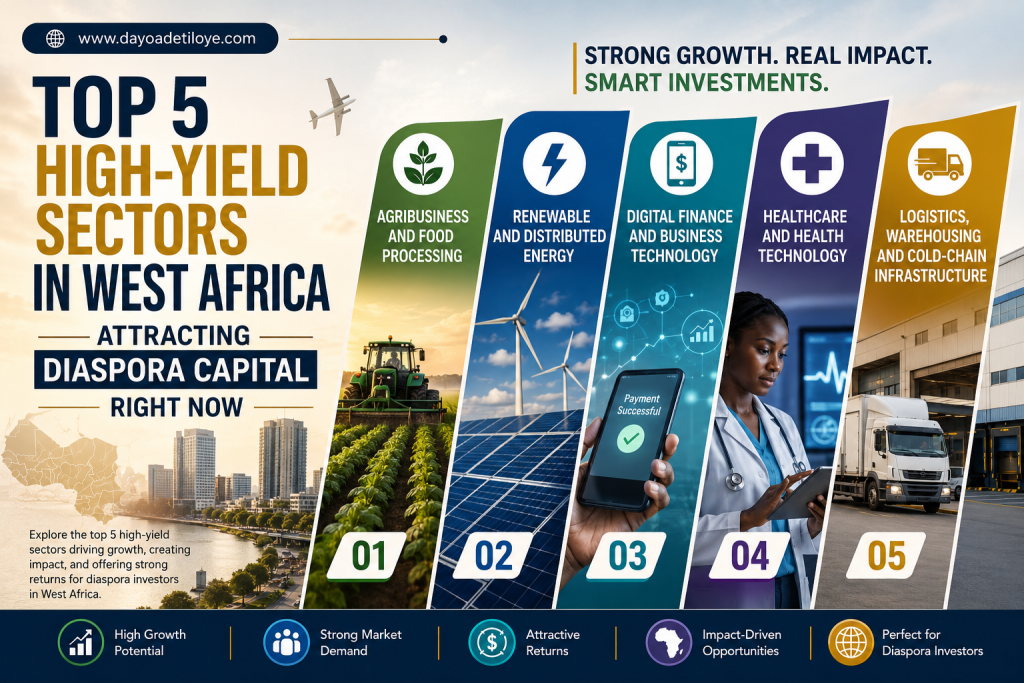
 Top 5 High-Yield Sectors in West Africa Attracting Diaspora Capital Right Now
West Africa’s diaspora sends billions of dollars home every year. Historically, much of that money has funded household consumption, education, healthcare, ceremonies and property construction. Those uses remain important, but a growing number of diaspora professionals are asking a more strategic question:
How can part of the money sent home be converted into productive assets that generate income, create jobs and build long-term wealth?
The opportunity is significant. West Africa’s economy grew by an estimated 4.8% in 2025 and is projected to expand by about 4.7% in 2026. The African Development Bank links this resilience to strong agricultural output, deeper agro-processing value chains and continued investment in energy, logistics and transport infrastructure.
Africa also attracted approximately US$70 billion in foreign direct investment in 2025. Although this was below the unusually high 2024 level, it remained the continent’s third-highest FDI result since 1990 and roughly one-third above its long-term average.
Diaspora capital is different from conventional foreign investment. Diaspora investors often possess cultural knowledge, family networks, professional expertise and a long-term connection to their countries of origin. However, they also face risks arising from remote management, currency movements, informal partnerships, weak reporting and insufficient due diligence.
This guide identifies five sectors currently presenting strong commercial opportunities across West Africa. “High-yield” in this context does not mean guaranteed returns. It refers to sectors with strong demand, structural supply gaps, growth potential and multiple opportunities for value creation.
The five sectors are:
- Agribusiness and food processing
- Renewable and distributed energy
- Digital finance and business technology
- Healthcare and health technology
- Logistics, warehousing and cold-chain infrastructure
Before Investing: Understand the Difference Between a Trend and an Opportunity
A fast-growing sector does not automatically make every business within it profitable.
Renewable energy may be expanding, but an investor can still lose money by importing the wrong equipment. Agriculture may be essential, but a poorly managed farm can consume capital for years. Fintech may attract funding, but regulation and customer-acquisition costs can destroy an otherwise impressive startup.
A viable diaspora investment should have five characteristics:
Real demand: Customers are already paying for the solution or have a clear reason to do so.
Defensible economics: The expected revenue can cover operating costs and produce an acceptable return.
Reliable local execution: A qualified management team can operate the business without depending entirely on the investor’s physical presence.
Transparent reporting: Sales, expenses, inventory and performance can be independently verified.
Scalability: Growth does not depend solely on continuously injecting more personal funds.
These principles should guide the assessment of every sector discussed below.
1. Agribusiness and Food Processing
 Top 5 High-Yield Sectors in West Africa Attracting Diaspora Capital Right Now
Agribusiness remains one of West Africa’s strongest long-term investment opportunities because food demand is unavoidable.
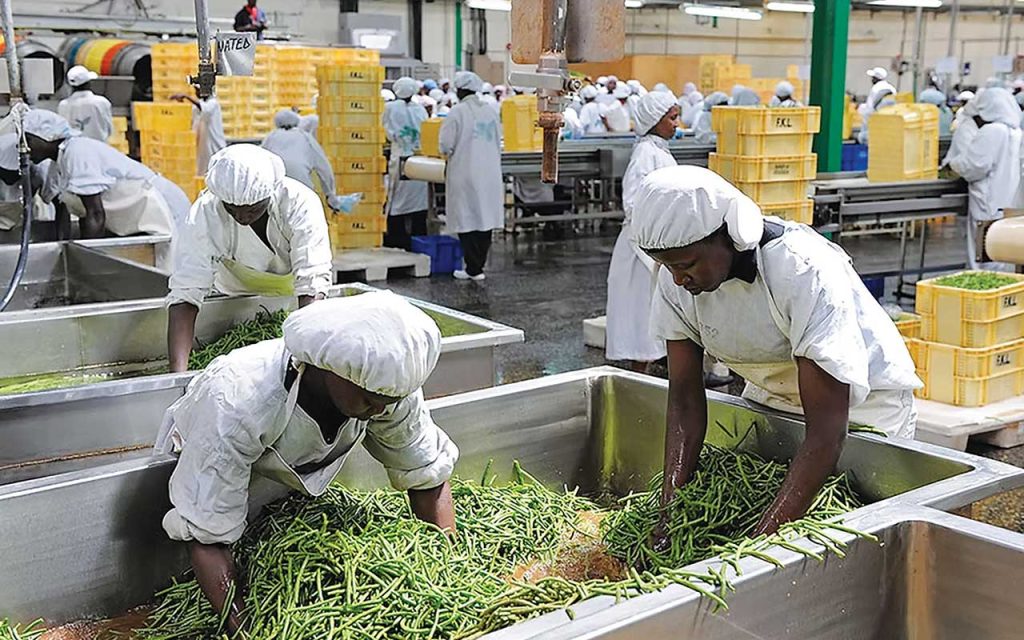
The sector is particularly attractive when investors move beyond primary production into processing, storage, packaging, distribution and market access.
The ECOWAS 2025–2027 Regional Economic Outlook identifies food security as one of West Africa’s most serious development challenges. In 2024, more than 34.7 million people in the region required urgent food assistance, demonstrating major weaknesses in food availability, affordability and supply-chain resilience.
This challenge creates an investment case, but not only for farms. In many cases, the stronger commercial opportunity lies between the farm and the final consumer.
Where the investment opportunities are
Promising agribusiness areas include grain aggregation, livestock production, feed manufacturing, commercial poultry, aquaculture, horticulture, rice milling, cassava processing, dairy, edible oils, packaged foods and cold storage.
Other opportunities exist in seed distribution, irrigation, mechanisation services, produce grading, packaging, traceability and farm-to-market logistics.
The African Development Bank and ECOWAS signed an US$11.78 million agreement in 2025 to strengthen regional rice value chains, reflecting ongoing institutional investment in improving food production and trade.
Regional institutions are also working to improve intra-West African food trade through policy harmonisation, border facilitation and support for private-sector agri-food traders.
Why diaspora investors have an advantage
Diaspora investors can bring capital, quality standards, export-market knowledge and professional management systems into fragmented agricultural value chains.
A UK-based investor, for example, may understand the packaging, traceability and certification standards required to supply diaspora supermarkets. A healthcare professional may identify opportunities in fortified foods. An engineer may invest in solar-powered irrigation or cold storage.
The strongest opportunities are often those combining local production with better processing and distribution.
Attractive business models
Rather than purchasing land and immediately starting a farm, diaspora investors can consider:
- Contract farming with verified producers
- Commodity aggregation linked to identified buyers
- Processing facilities supplied by organised farmers
- Equipment-leasing services
- Solar-powered cold rooms
- Packaged food brands
- Export-oriented agricultural products
- Digital platforms connecting producers with markets
These models can reduce production risk while solving real bottlenecks.
Major risks
The principal risks include land disputes, weather, input inflation, weak farm management, theft, poor road access and price volatility.
Agricultural businesses also frequently fail because they begin production before securing buyers.
A serious investment should therefore include a location-specific feasibility study, production assumptions, off-take strategy, working-capital plan and independent farm-management structure.
Commercial conclusion
Agribusiness is attractive because the underlying demand is structural. But the highest returns are more likely to come from efficient value chains than from simply owning farmland.
2. Renewable and Distributed Energy
 Top 5 High-Yield Sectors in West Africa Attracting Diaspora Capital Right Now
Energy is one of West Africa’s largest commercial constraints and therefore one of its most important investment opportunities.
Businesses, schools, farms, hospitals and households need dependable electricity. Where public supply is unreliable, customers spend money on diesel, petrol generators, batteries and alternative systems.
Across Africa, more than 600 million people lack electricity access, while nearly one billion do not have access to clean cooking. The International Energy Agency estimates that energy spending on the continent needs to more than double by 2030, with over two-thirds directed towards clean energy.
The IEA further estimates that achieving universal electricity access by 2035 could require nearly US$150 billion in cumulative investment, or approximately US$15 billion annually.
Sub-Saharan Africa remains significantly underserved compared with North and Southern Africa, receiving a disproportionately small share of energy investment despite accounting for most of the continent’s population.
Where the opportunities are
Diaspora investors can participate through:
- Commercial and industrial solar installations
- Solar home systems
- Mini-grids
- Battery storage
- Solar-powered cold rooms
- Energy-as-a-service models
- Clean cooking solutions
- Energy-efficient appliances
- Installation and maintenance companies
- Financing platforms for productive-use equipment
The most compelling opportunities often serve customers already spending heavily on unreliable power.
For instance, a factory paying substantial monthly diesel costs may accept a solar and battery solution if the new system produces measurable savings and predictable uptime.
Why diaspora capital fits the sector
Renewable-energy businesses usually require patient capital, technical expertise and credible supplier relationships. Diaspora professionals can contribute all three.
Engineers abroad can help assess equipment quality. Finance professionals can structure leasing or payment plans. Investors can access international suppliers and bring stronger warranties and technical standards into the market.
The importance of recurring revenue
Simply selling solar panels produces one-time revenue. Stronger models may include installation, maintenance contracts, equipment leasing, subscriptions, monitoring and energy payments.
A company that installs systems and maintains a recurring customer relationship may be more valuable than one depending entirely on occasional equipment sales.
Major risks
The sector faces currency exposure because many components are imported. Poor-quality batteries and panels can damage customer confidence. Customers may also struggle to make large upfront payments.
Regulatory requirements vary depending on whether the business is installing private systems, developing mini-grids or generating and distributing electricity.
A bankable project must therefore consider replacement cycles, warranties, maintenance, import costs, financing and customer-payment risk.
Commercial conclusion
Renewable energy is not merely a climate opportunity. It is an infrastructure and productivity opportunity. The strongest investments solve a customer’s power problem while generating predictable, recurring income.
3. Digital Finance and Business Technology
 Top 5 High-Yield Sectors in West Africa Attracting Diaspora Capital Right Now
Technology remains one of Africa’s most visible investment sectors, with West Africa particularly Nigeria and Ghana playing a major role.
African technology companies raised just over US$4 billion in equity and debt funding in 2025, approximately 25% more than in 2024. Debt funding reached a record US$1.6 billion, while equity funding also increased.
Fintech continued to dominate. Fifty-four African fintech startups raised approximately US$693.9 million in 2025, a 41.9% increase from 2024.
At the broader economic level, mobile technologies and services contributed approximately US$240 billion to Africa’s economy in 2025, equivalent to 7.8% of continental GDP.
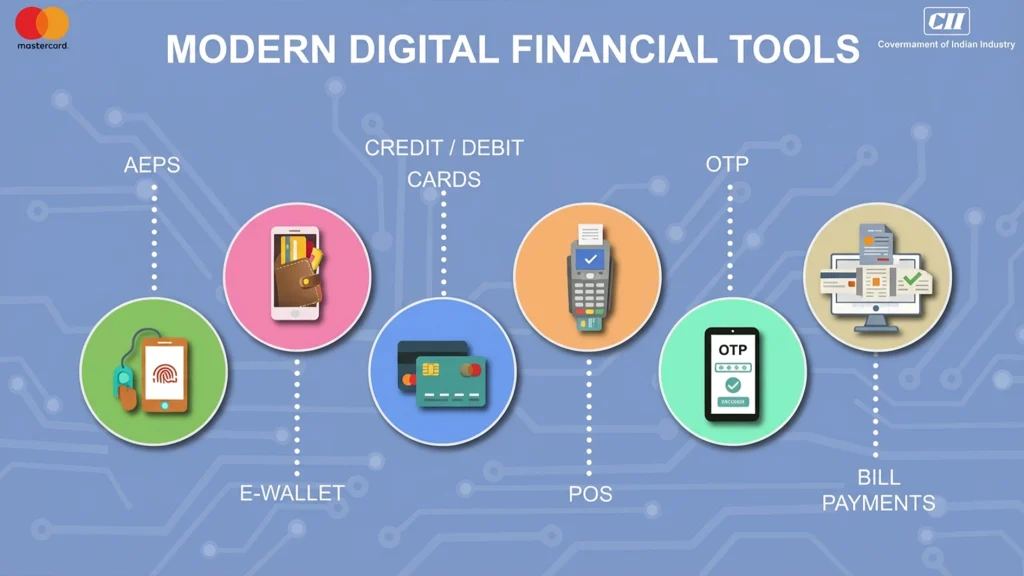
Mobile money also continues to move beyond person-to-person transfers. Merchant-payment value reached US$155 billion in 2025, growing by almost half and becoming the industry’s fastest-growing use case.
Where the next opportunities are
The first generation of major fintechs focused heavily on payments. The next opportunities extend into:
- SME credit and financial management
- Insurance technology
- Cross-border payments
- Digital identity and compliance
- Payroll and human-resource platforms
- Retail inventory systems
- Business-to-business commerce
- Logistics technology
- Agricultural technology
- Health technology
- Cybersecurity
- Artificial intelligence for local businesses
The strongest investment opportunities may not always be consumer applications. Many African SMEs need reliable software for inventory, accounting, procurement, payments, customer management and credit assessment.
Why diaspora investors are relevant
Diaspora investors often understand both developed-market technology and African customer problems.
They may also provide valuable access to product talent, foreign customers, strategic partners and follow-on investors.
Diaspora professionals should not assume, however, that an overseas business model can simply be copied into West Africa. Products must reflect local payment methods, smartphone affordability, connectivity, language and trust.
What investors should examine
Before investing in a startup, examine customer growth, revenue quality, retention, margins, regulatory exposure and the founders’ ability to manage capital.
A startup reporting thousands of downloads may still have very few paying customers.
Important questions include:
- How much does it cost to acquire one customer?
- How long does that customer remain?
- What revenue and gross profit does the customer generate?
- Does growth depend on subsidies or discounts?
- Is the company properly licensed?
- How does the business protect customer data?
- What happens if external funding stops?
Major risks
Technology investments carry high failure risk. Regulations can change, competitors can emerge quickly and startups may overvalue themselves based on unrealistic projections.
Diaspora investors should not invest solely because they know the founder or because the pitch uses impressive technical language.
Independent due diligence, a clear shareholder agreement and proper governance are essential.
Commercial conclusion
Digital finance and business technology remain among the region’s most scalable opportunities. However, investors should focus on businesses solving measurable problems with sustainable economics not simply applications chasing users.
Contact Dayo Adetiloye Business Hub
Call or WhatsApp:
08105636015
08076359735
08113205312
4. Healthcare and Health Technology
 Top 5 High-Yield Sectors in West Africa Attracting Diaspora Capital Right Now
West Africa’s healthcare demand is substantial, but access, affordability and quality remain uneven.
The WHO reports that only eight of the 47 countries in its African Region met the recommended benchmark of at least US$249 in health spending per person on average between 2012 and 2020. In 2020, only five countries reached that level.
Underinvestment creates pressure on public systems, but it also creates opportunities for responsible private-sector participation.
UNCTAD’s 2025 investment report found that health was the only major Sustainable Development Goal-related sector in developing countries to record growth in project numbers and value, although total investment remained below US$15 billion.
Where the opportunities are
Promising healthcare investment areas include:
- Diagnostic laboratories
- Imaging centres
- Specialist clinics
- Primary healthcare networks
- Dialysis services
- Maternal and reproductive health
- Home healthcare
- Mental-health services
- Telemedicine
- Pharmacy distribution
- Medical-device supply
- Electronic medical records
- Health-insurance technology
- Cold-chain logistics for medicines
Not every investor needs to build a full hospital. Smaller specialist businesses may require less capital and can address clearly defined needs.
A diagnostic centre located within a strong referral network may be commercially more manageable than a general hospital attempting to provide every service.
The diaspora advantage
West Africa has a large diaspora of doctors, pharmacists, nurses, health administrators, scientists and technology professionals.
These professionals bring clinical knowledge, patient-safety standards, governance experience and connections to equipment suppliers and training institutions.
A UK-based Nigerian doctor, for example, can invest in a specialist service while appointing a qualified local clinical and operational team.
The investor’s advantage should not only be capital. It should include stronger systems, ethical standards, staff development and quality assurance.
What makes a healthcare investment viable
A feasibility study should assess the local disease burden, target population, referral sources, competing facilities, pricing, equipment utilisation and staffing requirements.
Medical equipment can be expensive. Buying an MRI or CT scanner without enough patient volume can create a financially distressed business.
The investor must calculate:
- Expected procedures per day
- Revenue per procedure
- Consumables and maintenance
- Staff costs
- Equipment downtime
- Insurance and regulatory costs
- Break-even utilisation
Major risks
Healthcare is heavily regulated and reputationally sensitive. Poor clinical outcomes, unqualified staff, counterfeit products or weak data protection can create serious consequences.
Foreign-trained professionals should not assume that overseas practice rights automatically authorise clinical work in a West African country. Local professional and facility approvals remain necessary.
Commercial conclusion
Healthcare offers strong long-term demand and meaningful social impact. The most attractive investments usually combine a clearly defined clinical need with quality management, referral partnerships and disciplined equipment utilisation.
5. Logistics, Warehousing and Cold-Chain Infrastructure
 Top 5 High-Yield Sectors in West Africa Attracting Diaspora Capital Right Now
Trade cannot grow without logistics.
Food, medicines, e-commerce orders, manufacturing inputs and consumer goods must move between farms, factories, ports, warehouses, retailers and customers.
The African Development Bank identifies continued investment in energy, logistics and transportation infrastructure as one of the forces supporting West Africa’s current economic growth.
The World Bank also emphasises the connection between transport connectivity, logistics and food security, particularly the importance of moving food efficiently between surplus and deficit areas.
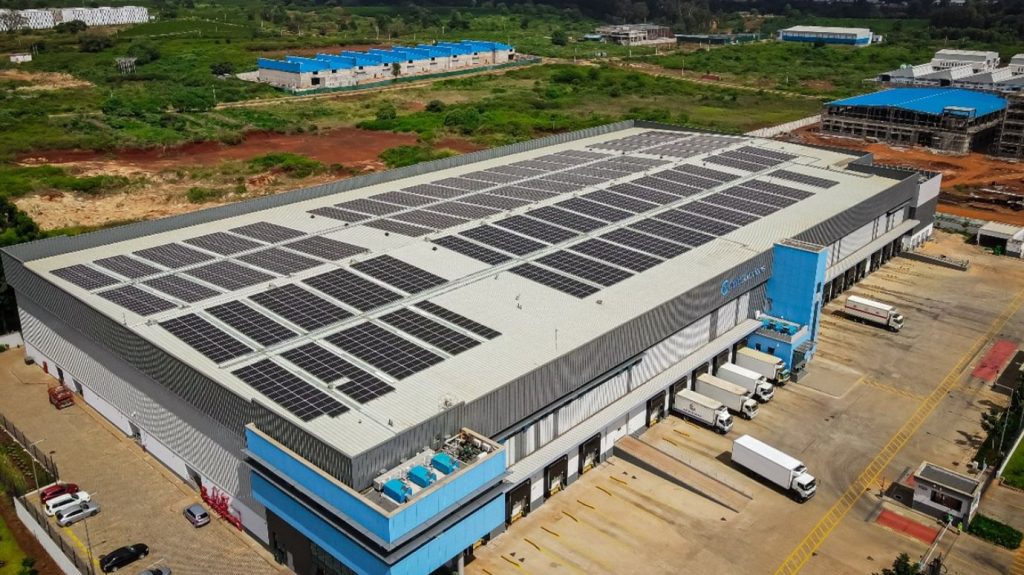
Cold-chain logistics represents a particularly important opportunity. Industry estimates cited by the Global Cold Chain Alliance valued Africa’s cold-chain logistics market at approximately US$10.88 billion in 2024, with projections of US$14.85 billion by 2029.
Where the opportunities are
Diaspora capital can enter the logistics sector through:
- Last-mile delivery
- Business-to-business distribution
- Agricultural transport
- Refrigerated vehicles
- Solar cold rooms
- Warehousing
- E-commerce fulfilment
- Pharmaceutical distribution
- Fleet leasing
- Vehicle-tracking technology
- Cross-border trade logistics
- Packaging and inventory services
The strongest opportunities often serve businesses rather than one-time individual customers.
A logistics company with recurring contracts from supermarkets, manufacturers, pharmacies or food processors may have more predictable revenue than one relying entirely on irregular dispatch requests.
Read Also: Remote Business Ownership: How to Run a Business in Nigeria from Abroad
Why cold chain is especially important
Perishable food and medical products lose value when they are not stored and transported at appropriate temperatures.
Cold-chain investment can therefore create value in agriculture, food processing, pharmaceuticals, healthcare and exports.
Possible business models include renting cold-room space, charging per crate, operating refrigerated transport or providing integrated storage and distribution.
Solar-powered cold storage can be especially relevant where grid electricity is unreliable, although the initial capital and maintenance requirements must be carefully modelled.
What investors should measure
Logistics is not profitable simply because the business owns vehicles.
Important indicators include:
- Revenue per vehicle
- Deliveries per day
- Fleet-utilisation rate
- Fuel cost per kilometre
- Maintenance cost
- Vehicle downtime
- Warehouse occupancy
- Customer concentration
- Cost per delivery
- Cash-collection period
A company can own an impressive fleet and still lose money if the assets remain underutilised.
Major risks
The industry faces fuel-price exposure, road conditions, vehicle breakdown, theft, weak driver management and delayed customer payments.
Corporate customers may pay after 30–60 days, while salaries, fuel and repairs must be paid immediately. The company therefore needs adequate working capital.
Commercial conclusion
Logistics and cold chain are attractive because they support multiple growing industries. Returns depend on contracts, asset utilisation and operational discipline not merely purchasing vehicles or warehouses.
How Should a Diaspora Investor Choose Among These Sectors?
The right sector depends on more than the projected return.
Consider your expertise, available capital, risk tolerance, investment horizon and level of involvement.
A doctor may have a strategic advantage in healthcare. An engineer may understand renewable energy. A technology professional may be better positioned to assess software startups. Someone with agricultural experience may understand commodity and production risks.
You should also decide whether you want to be:
An active founder: Directly involved in strategy and operations.
A strategic investor: Providing capital, expertise and access to markets.
A passive shareholder: Investing in a professionally managed company.
A lender: Providing repayable capital rather than ownership funding.
A project partner: Financing a specific facility, asset or production cycle.
These structures have different risks and return expectations.
A Practical Diaspora Due-Diligence Checklist
Before releasing funds, confirm that the business is legally registered and that ownership is documented.
Review the market study, business model, operating history, bank statements, management accounts, tax records, customer contracts and supplier relationships.
For asset-based investments, verify land, machinery, vehicles and inventory physically and legally.
Investment funds should enter a corporate account under a documented equity or loan arrangement not an individual’s personal account.
The business should also have clear approval limits, accounting systems, monthly reporting and independent verification.
Most importantly, avoid placing complete financial and operational control in one person’s hands.
Diaspora investments fail less often because the sector was wrong than because execution and governance were weak.
Why You Need a Local Business Development Service Provider
The most attractive sector can still become a poor investment if the project is badly structured.
A qualified Business Development Service Provider can help you conduct market research, test financial assumptions, determine capital requirements, assess risks and develop an implementation strategy.
At Dayo Adetiloye Business Hub, we support entrepreneurs, SMEs and diaspora investors with feasibility studies, business plans, financial projections, market research, investor pitch decks, funding applications and investment-readiness advisory.
We help clients answer practical questions before they commit capital:
- Is the proposed opportunity commercially viable?
- How much capital is genuinely required?
- What level of sales is needed to break even?
- What regulatory approvals apply?
- What local management structure is appropriate?
- How should the investor monitor the business remotely?
- Which funding structure best fits the project?
Contact Dayo Adetiloye Business Hub
Call or WhatsApp:
08105636015
08076359735
08113205312
Professional due diligence may appear expensive before an investment is made. It is usually much cheaper than trying to recover money from a poorly planned business.
Related