 Top 7 Elements of a Winning Marketing and Sales Strategy in a Business Plan
Top 7 Elements of a Winning Marketing and Sales Strategy in a Business Plan that helps to convince an investor. A business plan can have an excellent product, realistic financial projections and an impressive growth story, yet still fail to convince an investor or lender if it cannot answer one fundamental question:
How exactly will this business attract customers and turn them into paying customers?
This is where the marketing and sales strategy becomes critical.
For Nigerian businesses, this section should go far beyond statements such as “we will advertise on social media,” “we will use word-of-mouth marketing,” or “we will offer competitive prices.” Those are activities, not strategies.
A strong marketing and sales strategy explains who will buy, why they will buy, how the business will reach them, how much it will cost to acquire them, how they will be converted, and how the business will retain them.
This is particularly important in Nigeria’s highly competitive MSME environment. According to the NBS/SMEDAN MSME survey cited by PwC, MSMEs accounted for 96.9% of businesses and 87.9% of employment in Nigeria, demonstrating just how crowded the marketplace is.
At the same time, customer behaviour is increasingly influenced by digital channels. DataReportal reported 107 million internet users and 38.7 million social-media user identities in Nigeria at the beginning of 2025.
The implication is simple: having a good product is no longer enough. Your business plan must demonstrate a credible route from market awareness to revenue.
Below are the seven elements that should form the foundation of a winning marketing and sales strategy in your business plan.
Top 7 Elements of a Winning Marketing and Sales Strategy in a Business Plan
-
Clearly Define Your Target Market and Ideal Customer
The first mistake many entrepreneurs make is trying to sell to everybody.
Statements such as “our target market is everyone who needs food,” “we target male and female,” or “our customers are all Nigerians” do not demonstrate market understanding.
Your business plan should identify the specific group of people or organizations most likely to buy your product.
For a fashion business, for example, the target market could be:
Women aged 25–45 in Lagos and Ogun States who purchase ready-to-wear and occasion outfits, earn middle to upper-middle incomes and actively shop through Instagram, WhatsApp and physical fashion outlets.
For a business-to-business company, the definition might be:
Small and medium-sized food manufacturers in Lagos and Ogun States requiring reliable packaging materials in quantities of 500–5,000 units per order.
The more specific the target market, the easier it becomes to determine the appropriate pricing, distribution, messaging and promotional channels.
Your business plan should ideally describe:
- Demographics or organisational characteristics
- Location
- Income or purchasing power
- Needs and pain points
- Buying behaviour
- Frequency of purchase
- Preferred channels
- Factors influencing purchase decisions
- Existing alternatives or competitors
You should also distinguish between the market and your ideal customer.
For instance, Nigeria’s population may represent a huge theoretical market for a product, but your actual serviceable market may be customers within three states who can afford the product and whom your distribution system can reach profitably.
That distinction makes your business plan more credible.
 Top 7 Elements of a Winning Marketing and Sales Strategy in a Business Plan
-
Build a Clear Value Proposition and Positioning
Once you know whom you want to sell to, the next question is:
Why should that customer choose you instead of the alternatives?
This is your value proposition.
A weak value proposition says:
“We provide high-quality products at affordable prices.”
Almost every business says this.
A stronger proposition identifies the customer’s problem and explains the specific value your business provides.
For example:
“We supply small food manufacturers with low-minimum-order branded packaging within seven working days, helping emerging brands present professionally without committing to large inventory quantities.”
Now the customer understands the benefit.
Your positioning should also answer four questions:
Who is the product for?
What problem does it solve?
What makes your solution different?
Why should customers believe your claim?
Evidence could include product demonstrations, testimonials, certifications, production capacity, proprietary processes, customer results, partnerships or previous sales.
This is particularly important when preparing a business plan for funding. Investors are not merely interested in whether you believe your product is superior. They want evidence that the market has a reason to choose it.
Your marketing strategy should therefore connect your competitive advantage directly to your customer’s purchasing decision.
-
Choose Marketing Channels Based on Customer Behaviour—not Trends
One of the most common weaknesses in Nigerian business plans is the statement:
“We will market through Facebook, Instagram, TikTok, WhatsApp, radio, television and influencers.”
The problem is not that these channels are bad. The problem is that the business has not explained why those channels are appropriate.
Nigeria’s digital market is substantial. DataReportal recorded 107 million internet users in early 2025, while social-media user identities stood at 38.7 million.
But this does not mean every business should spend heavily on social media.
The right question is:
Where does my target customer actually discover, evaluate and purchase products like mine?
Research from Think with Google found that 85% of surveyed Nigerian consumers in its African consumer research researched products online, highlighting the importance of digital discovery and research in the customer journey.
However, online visibility should complement not automatically replace offline channels.
A Nigerian business may use a combination of:
- WhatsApp
- Search engines and Google Business Profile
- Instagram, Facebook or TikTok
- Email marketing
- Physical retail
- Distributors and wholesalers
- Trade fairs and exhibitions
- Strategic partnerships
- Referrals
- Field sales representatives
- Industry associations
- Corporate procurement
- Radio or outdoor advertising where appropriate
The business plan should explain the role of each channel.
For example:
Instagram → awareness and product demonstration
WhatsApp → enquiries, quotations and order conversion
Physical showroom → product experience
Referral programme → customer acquisition
Sales representatives → B2B account acquisition
This is much stronger than simply listing social-media platforms.
-
Develop a Sales Process That Converts Leads into Revenue
Marketing creates awareness and generates leads. Sales converts those opportunities into revenue.
A business plan should therefore show what happens after someone becomes interested.
Consider a simple sales funnel:
Awareness → Lead → Qualification → Proposal/Offer → Negotiation → Purchase → Repeat Purchase
Suppose a consulting firm generates 200 leads in a month.
If 100 are qualified, 40 receive proposals and 10 eventually purchase, the business has a 5% lead-to-customer conversion rate.
If the average transaction is ₦150,000:
10 customers × ₦150,000 = ₦1.5 million monthly sales
This type of analysis makes the revenue forecast much more believable.
Instead of simply projecting:
“We expect to generate ₦18 million in annual revenue,”
the business can demonstrate the assumptions behind the number.
For example:
10 customers per month × ₦150,000 average transaction × 12 months = ₦18 million annual revenue.
A more sophisticated business plan should go further by considering:
- Lead volume
- Lead qualification rate
- Conversion rate
- Average transaction value
- Sales cycle
- Repeat purchase rate
- Customer retention
- Salesperson productivity
- Monthly sales targets
For B2B businesses, the sales cycle may be several weeks or months. A business plan that assumes every lead immediately becomes a paying customer is unlikely to survive serious investor scrutiny.
-
Set a Pricing and Promotion Strategy That Protects Profitability
Marketing can generate thousands of enquiries and still leave a business financially weak if pricing is poorly structured.
Your marketing and sales strategy should therefore explain how you will price and promote the product without destroying your margins.
Consider a business selling a product for ₦25,000.
If the variable cost per unit is ₦15,000, the contribution margin is:
₦25,000 − ₦15,000 = ₦10,000
If customer acquisition costs average ₦4,000 per customer, the business cannot evaluate profitability using the ₦25,000 selling price alone.
It must consider what remains after direct and acquisition costs.
Promotional strategies should also be carefully designed.
Discounts can stimulate demand, but permanent discounting can train customers to wait for promotions and weaken perceived value.
Instead, businesses can consider:
- Bundling
- Volume discounts
- Limited-time offers
- Loyalty incentives
- Referral rewards
- Cross-selling
- Upselling
- Seasonal campaigns
- Corporate packages
The key is to connect each promotion to a measurable commercial objective.
For example, a 10% discount might be justified if it increases average order size enough to improve contribution profit.
A business plan should therefore avoid presenting discounts simply as a marketing idea. It should explain the expected commercial effect.
-
Define Your Customer Retention and Relationship Strategy
Acquiring a customer is only one part of the sales equation.
A sustainable business must also answer:
How will we get customers to buy again?
Retention is especially important for businesses selling products or services with recurring demand.
Consider two businesses.
Business A acquires 100 customers but only 10 return.
Business B acquires 60 customers but 40 return regularly.
The second business may have a much stronger economic model despite acquiring fewer customers initially.
Your business plan should therefore explain how customers will be retained.
This could involve:
- After-sales service
- Customer follow-up
- Loyalty programmes
- Subscription models
- Maintenance contracts
- Reorder reminders
- Personalised communication
- Customer feedback systems
- Complaint resolution
- Product guarantees
- Membership programmes
For example, a beauty brand could follow up with customers after purchase, recommend complementary products and remind customers when they are likely to need a reorder.
A B2B supplier could assign account managers to major customers and establish regular reorder schedules.
The objective is not simply to “satisfy customers.”
It is to create a system that increases repeat purchases, customer lifetime value and referrals.
 Top 7 Elements of a Winning Marketing and Sales Strategy in a Business Plan
-
Establish Marketing and Sales KPIs With a Realistic Budget
A marketing strategy becomes a business strategy only when it can be measured.
Your business plan should identify the key performance indicators that will be monitored.
Useful metrics include:
Customer Acquisition Cost (CAC)
Total marketing and sales expenditure ÷ Number of new customers acquired
Conversion Rate
Number of customers ÷ Qualified leads × 100
Average Order Value (AOV)
Total sales revenue ÷ Number of orders
Customer Retention Rate
Measures how effectively the business keeps existing customers.
Return on Marketing Investment (ROMI)
Incremental profit attributable to marketing ÷ Marketing investment
You do not necessarily need dozens of metrics.
A small business might track five:
- Leads generated
- Qualified leads
- Conversion rate
- Average order value
- Monthly revenue
The important thing is to establish targets.
For example:
| KPI |
Monthly Target |
| Leads |
200 |
| Qualified leads |
100 |
| Conversion rate |
10% |
| New customers |
10 |
| Average order value |
₦150,000 |
| Monthly sales |
₦1.5 million |
Your marketing budget should then support those targets.
If the business plans to spend ₦300,000 monthly on marketing to generate ₦1.5 million in sales, management should understand whether the resulting gross profit can justify that expenditure.
This is where the marketing plan connects directly to the financial projections in the business plan.
A Critical Nigerian Consideration: Marketing Must Also Be Compliant
A marketing strategy should not be developed separately from regulatory requirements.
The Federal Competition and Consumer Protection Commission states that businesses must provide accurate information and avoid misleading or deceptive representations. It also requires appropriate disclosure of prices and material information to consumers.
The FCCPC also identifies wrongful or deceptive advertising and certain sales promotions among business obligations.
For regulated products, additional requirements may apply. For example, NAFDAC provides specific advertising guidelines for products including food, medicines, cosmetics and other regulated products.
This matters because a marketing strategy that looks commercially attractive on paper can create legal, financial and reputational problems if its claims cannot be substantiated.
Entrepreneurs should therefore avoid unsupported claims such as:
“Nigeria’s number one product.”
“Guaranteed to cure…”
“The cheapest in Nigeria.”
“100% guaranteed results.”
Unless the business has appropriate evidence and the claim is legally permissible, such statements can expose the company to unnecessary risk.
Good marketing is persuasive, but it must also be truthful, supportable and compliant.
Common Mistakes to Avoid in Your Business Plan
The most frequent marketing and sales mistakes we see in business planning include treating social media presence as a marketing strategy, defining the target market too broadly, projecting sales without explaining the assumptions, ignoring competitors, relying entirely on discounts and failing to budget for customer acquisition.
Another major mistake is separating the marketing strategy from the financial model.
If your business plan says you will acquire 1,000 customers in Year One, the financial projections should show the revenue implications, marketing expenditure, staffing requirements, production capacity and working capital required to serve those customers.
Every major marketing assumption should have a financial consequence.
That is what transforms a marketing section from a collection of ideas into a commercially useful strategy.
How DABH Can Help You Build a Fundable Marketing and Sales Strategy
At Dayo Adetiloye Business Hub (DABH), we understand that entrepreneurs often know their products exceptionally well but struggle to translate that knowledge into a structured, investor-ready business strategy.
Our business advisory and business development services can help you develop the commercial logic behind your business plan, including market research, competitor analysis, marketing and sales strategy, business plans, feasibility studies, financial projections, pitch decks, grant applications, BOI loan applications and funding/investment readiness.
We do not believe a business plan should simply look professional.
It should help you make better business decisions.
A strong marketing and sales strategy should help you determine who to target, where to find them, what to offer them, how to convert them, what it will cost and whether the resulting sales can produce sustainable profit.
Preparing Your Business for Funding?
If your business is seeking a grant, loan or investment, having a good idea is only the beginning.
Your business needs to demonstrate that it is market-ready and funding-ready.
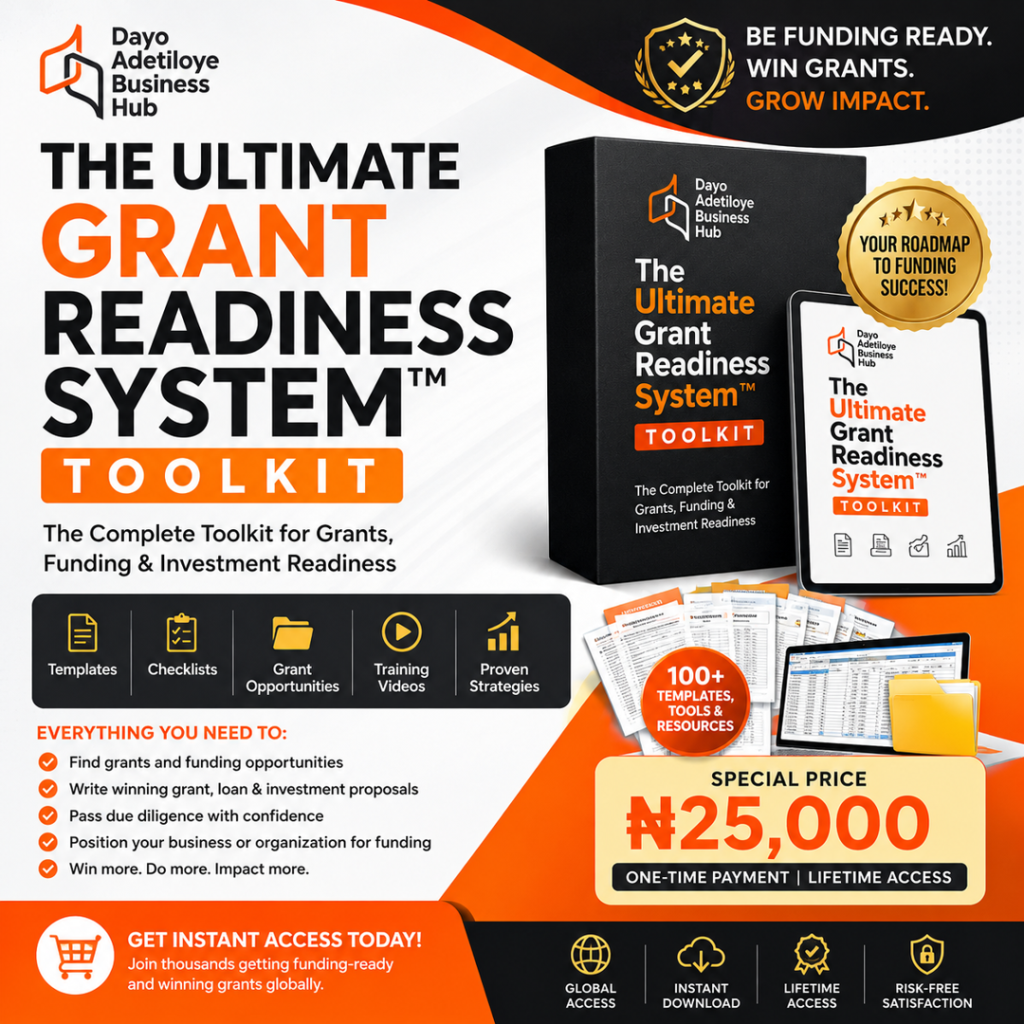
The Ultimate Grant Readiness System™ is designed as a practical toolkit to help entrepreneurs prepare the critical components required to become more competitive for funding opportunities.
 Top 7 Elements of a Winning Marketing and Sales Strategy in a Business Plan
Get the Ultimate Grant Readiness System™:
http://selar.com/38k7agny27?affiliate=kjj9
For professional support with your business plan, feasibility study, financial projections, market research, grant writing, pitch deck, BOI loan application or broader business advisory needs, contact Dayo Adetiloye Business Hub:
Call/WhatsApp: 08105636015 | 08076359735 | 08113205312
Email: dayohub@gmail.com
Related