Business Plan vs. Pitch Deck vs. Feasibility Study: Which One Do You Actually Need? You have a business idea. You believe there is a market for it, you have thought about how the business will make money, and you are ready to seek funding.
Then someone asks you:
“Do you have a business plan?”
Another person says:
“You need a pitch deck.”
Someone else tells you:
“Before you do anything, you need a feasibility study.”
At this point, it is easy to become confused. Are they all the same thing? Do you need all three? Which one should you prepare first?
The truth is that a business plan, pitch deck and feasibility study serve different purposes. Although they can complement one another, they are not interchangeable.
Consider an entrepreneur who wants to establish a ₦50 million poultry farm, what does the person really need? A business plan, A pitch deck or A feasibility Study?
 Business Plan vs. Pitch Deck vs. Feasibility Study: Which One Do You Actually Need?
What Is a Business Plan?
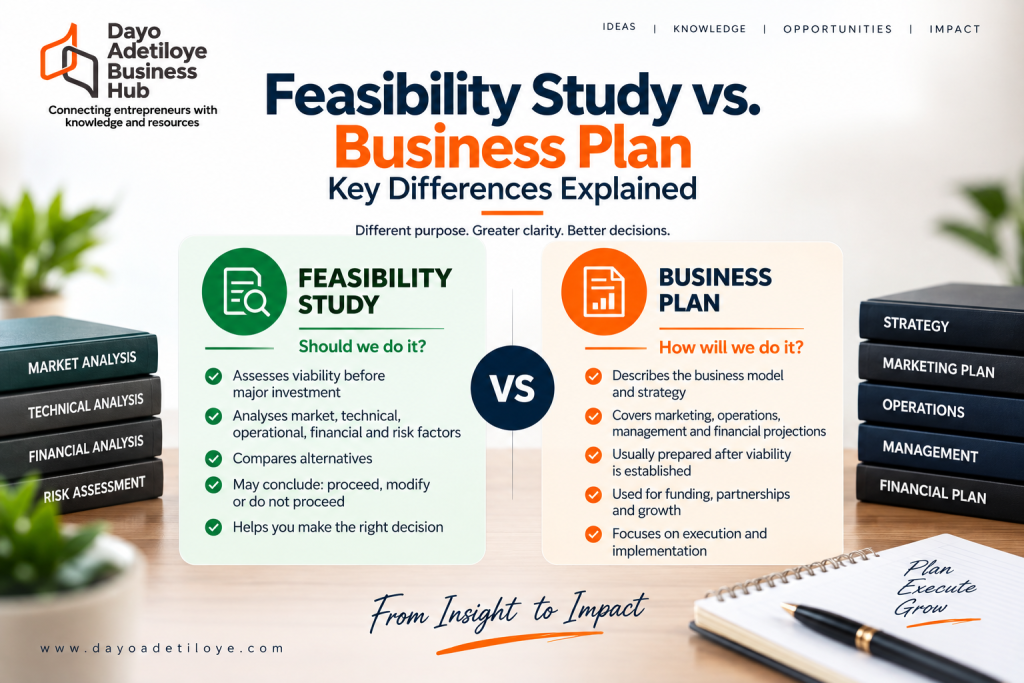
A business plan is a structured document that explains what a business does, who it serves, how it will operate, how it will make money and how it intends to achieve its goals.
It brings the major parts of a business together—such as the market, products or services, marketing strategy, operations, management structure and financial projections—so that the entrepreneur, investors, lenders or other stakeholders can clearly understand how the business is expected to work.
A business plan is therefore more than a description of your business idea. It should show the connection between your market opportunity, strategy and financial performance.
Let’s return to our entrepreneur planning to invest ₦50 million in a poultry farm.
A business plan would explain what type of poultry operation the entrepreneur intends to establish, whether the focus will be on layers, broilers, or both, the target market, expected production capacity, pricing strategy, marketing channels, staffing, feed and other operating requirements.
It would also show the financial side of the business.
For example, if the entrepreneur plans to establish a farm with 5,000 layers, the business plan should not simply state that the farm will generate millions of naira in revenue. It should show the assumptions behind the projection—expected egg production, selling price, operating costs, mortality assumptions, feed costs and other relevant expenses.
If the business expects to generate ₦3 million in monthly sales, the investor or lender should be able to understand how that figure was calculated.
A good business plan also helps the entrepreneur answer important questions before committing significant capital:
Who are my customers?
How will I reach them?
Who are my competitors?
What will it cost to operate the business?
How much capital do I need?
When can the business break even?
What could go wrong, and how will I manage those risks?
This makes a business plan useful even when you are not seeking funding. It can serve as a roadmap for managing the business and making strategic decisions.
However, the purpose of the plan may influence what receives the most attention. A business plan prepared for a bank loan may place significant emphasis on repayment capacity and cash flow, while one prepared for an investor may place greater emphasis on market opportunity, scalability, growth potential and the potential return on investment.
Most importantly, a business plan should be based on realistic information and assumptions. A beautifully formatted document filled with exaggerated sales projections will not make an unprepared business investor-ready.
Think of the business plan as the detailed blueprint of the business. It gives the reader enough information to understand not only what you want to build, but also how you intend to build it and make it financially sustainable.
Read Also: Feasibility study vs business plan key differences explained
 Business Plan vs. Pitch Deck vs. Feasibility Study: Which One Do You Actually Need?
What Is a Pitch Deck?
A pitch deck is a concise presentation used to introduce a business opportunity to potential investors, partners or other stakeholders. Unlike a business plan, which provides detailed information about the business, a pitch deck is designed to communicate the most important points quickly and generate enough interest for a deeper conversation.
A typical pitch deck may cover the problem the business solves, its solution, target market, business model, competitive advantage, traction, management team, financial highlights, funding requirement and growth opportunity.
Let’s return to our entrepreneur planning to establish the ₦50 million poultry farm.
The business plan may contain detailed information about the proposed farm’s production capacity, feed requirements, staffing, market research, operating expenses, five-year financial projections and cash-flow forecasts.
The pitch deck would present the most important parts of that information in a much shorter and more visual format.
For example, one slide might explain:
Problem: Poultry farmers and consumers face inconsistent supply and rising egg prices.
Solution: A professionally managed layer farm supplying eggs consistently to wholesalers, retailers and institutional buyers.
Another slide could show the target market, expected production capacity and projected revenue. A later slide could state:
Funding Required: ₦50 million
Use of Funds: Farm infrastructure, birds, equipment, working capital and market expansion.
The goal is not to put every detail from the business plan into the presentation. Instead, the pitch deck should make the opportunity clear enough to encourage the investor to ask for more information.
This is why a pitch deck is particularly useful when an entrepreneur has an opportunity to present a business to investors, participate in a pitch competition or introduce the company during an initial investment meeting.
A strong pitch deck should therefore be clear, focused and persuasive. It should avoid overcrowding slides with long paragraphs or complicated information.
One important point, however, is that a pitch deck does not replace the business plan in every situation. An investor may become interested after seeing the pitch deck but still request detailed financial projections, market information, supporting documents or a full business plan before making an investment decision.
Think of the pitch deck as the elevator that gets the investor to the next floor, while the business plan provides the deeper information needed when they want to examine the business more closely.
 Business Plan vs. Pitch Deck vs. Feasibility Study: Which One Do You Actually Need?
What Is a Feasibility Study?
A feasibility study is an assessment carried out to determine whether a proposed business idea or project is practical and commercially viable before significant resources are committed to it.
While a business plan explains how you intend to run a business, a feasibility study helps you determine whether the proposed business is actually worth pursuing in the first place.
It examines important factors such as market demand, competition, technical and operational requirements, estimated costs, potential revenue, profitability, risks and other conditions that could affect the success of the proposed venture.
Let’s return to our entrepreneur considering a ₦50 million poultry farm.
Before spending the ₦50 million, the entrepreneur needs to establish whether the proposed farm makes economic sense.
A feasibility study might investigate questions such as:
Is there sufficient demand for the eggs or poultry meat?
Who are the major competitors in the target market?
How much will land, housing, birds, feed, equipment and labour cost?
What selling price can realistically be achieved?
What are the major risks, such as disease outbreaks, feed price increases and market fluctuations?
Can the expected revenue justify the required investment?
Suppose the research shows that the proposed location has strong demand and accessible markets, but the projected operating costs are so high that the farm would struggle to generate an acceptable return.
That finding is valuable.
The entrepreneur may decide to reduce the initial investment, change the production model, choose another location, adjust the target market or even abandon the project before losing ₦50 million.
This is one of the major purposes of a feasibility study: to test the business idea before committing substantial resources.
Key Difference between A business Plan, Pitch deck and Feasibility Study
| Key Area |
Feasibility Study |
Business Plan |
Pitch Deck |
| Main purpose |
Tests whether a business idea is viable |
Explains how the business will operate and grow |
Presents the business opportunity to investors |
| Main question |
Can this business work? |
How will we build and run it? |
Why should you invest in it? |
| Primary focus |
Viability, market, costs, returns and risks |
Strategy, operations, marketing and financial performance |
Opportunity, growth potential and investment case |
| Level of detail |
Detailed analysis |
Comprehensive and detailed |
Brief and focused |
| When it is most useful |
Before committing significant capital |
Starting, managing, expanding or seeking funding |
Approaching investors or pitching an opportunity |
| Typical users |
Entrepreneurs, investors, lenders and decision-makers |
Entrepreneurs, investors, lenders and management |
Investors and potential strategic partners |
| Financial information |
Tests whether the projected returns justify the investment |
Detailed financial projections and cash flow |
Key financial highlights and funding requirement |
| End result |
Helps you decide whether to proceed, modify or abandon the idea |
Provides a roadmap for implementation and growth |
Creates interest and opens the door for further discussion |
Which One Do You Actually Need?
The answer depends on what you are trying to achieve, the stage of your business and who needs the information. You do not automatically need all three documents.
Here is a simple guide:
If You Have a New Business Idea – Start With a Feasibility Study
If You Are Starting, Running or Expanding a Business – You Need a Business Plan
If You Are Approaching Investors – You May Need a Pitch Deck
If You Are Making a Major Investment Decision – Consider a Feasibility Study
If You Are Seeking Serious Funding – You May Need More Than One
Sometimes, the smartest approach is to use all three at different stages.
Feasibility Study → Business Plan → Pitch Deck
The feasibility study tests whether the opportunity makes sense. The business plan develops the roadmap for executing it, while the pitch deck communicates the opportunity to potential investors.
The key is not to prepare documents simply because someone told you that you need them. Prepare the document that answers the question you currently need to answer.
And if you are unsure which one is appropriate for your situation, a professional assessment can help you avoid spending money preparing the wrong document—or committing capital before properly testing your idea.
Read Also: What is a feasibility study and why do banks demand one
How Dayo Adetiloye Business Hub Can Help
Choosing between a feasibility study, business plan and pitch deck is easier when you understand what each document is meant to achieve. However, preparing them properly requires good research, realistic assumptions and a clear understanding of your business and funding goals.
At Dayo Adetiloye Business Hub (DABH), we help entrepreneurs develop the right business documents for their specific needs.
Our services include Feasibility Studies, Business Plan Development, Market Research, Financial Projections, Cash Flow Forecasts, Break-Even Analysis, Investor Pitch Decks, Funding Applications and Business Advisory Services.
For example, if you are considering investing ₦50 million in a poultry business, we can help you first assess whether the proposed project is viable, develop a detailed business plan if the opportunity is worth pursuing, and prepare a professional pitch deck when you are ready to approach investors.
We don’t believe in preparing documents simply to tick a box. The goal is to ensure that your research, strategy and numbers tell a consistent and credible story.
Whether you are testing a new business idea, planning an expansion or preparing to approach investors or lenders, having the right information before making major decisions can save you significant time and money.
Contact Dayo Adetiloye Business Hub
Call or WhatsApp:
08105636015
08076359735
08113205312
Email: dayohub@gmail.com
Get Grant-Ready Before the Next Opportunity
Many organisations miss funding opportunities because they are not prepared when calls for applications open.
That’s why we created:
The Ultimate Grant Readiness System™
The Complete Toolkit for Grants, Funding & Investment Readiness
The toolkit includes:
- Grant Proposal Templates
- Business Plan Templates
- Financial Projection Models
- Investor Pitch Deck Templates
- Due Diligence Checklists
- NGO Proposal Templates
- Funding Readiness Resources
- Proposal Writing Guides
Whether you’re applying for international grants, innovation competitions, accelerator programmes, or investor funding, this toolkit will help you prepare professional applications with confidence.
Get instant access here:
http://selar.com/38k7agny27?affiliate=kjj9
Related