Introduction
How to Calculate Your Total Addressable Market (TAM) for a African Business Venture. Total Addressable Market (TAM) is one of the most important figures an entrepreneur can understand when building a business or seeking funding. It answers a fundamental question: “How large could my market become if my business were able to reach every potential customer for my product or service?”
For an African business venture, understanding your market size is particularly important. Having a good product does not automatically mean there is a large enough market to support the business. Investors, lenders, and other funding providers want to see that you understand who your customers are, how many potential customers exist, and the revenue opportunity available in the market.
Imagine an African fashion brand producing affordable ready-to-wear clothing. Saying “the African fashion market is huge” may sound impressive, but it does not tell an investor much. A stronger business case would estimate the number of potential customers, their expected spending, and the portion of the market the business could realistically target.
This is where TAM calculation becomes useful.
In this article, we will explain how to calculate Total Addressable Market (TAM), the difference between TAM, SAM, and SOM, the two main approaches to calculating market size, and how African entrepreneurs can use these figures in a business plan or pitch deck.
What Is Total Addressable Market (TAM)?
Total Addressable Market (TAM) is the total potential market for a product or service if a business could reach 100% of the customers who need or could buy it.
In simple terms, TAM answers the question:
“If there were no competitors, geographical limitations, production constraints, or other barriers, how much could the entire market potentially spend on this type of product or service?”
For example, imagine an African fashion brand that sells affordable ready-to-wear dresses.
If research shows that there are 2 million potential customers in the markets the business is studying, and each customer could spend an average of ₦30,000 per year on this type of clothing, the estimated TAM would be:
2,000,000 customers × ₦30,000 = ₦60 billion
Therefore, the brand’s estimated TAM is ₦60 billion.
This does not mean the fashion business will generate ₦60 billion in sales. It simply means that, based on the assumptions used, the total potential spending available in that market could be worth approximately ₦60 billion.
This distinction is important when preparing a business plan or pitch deck. Entrepreneurs sometimes make the mistake of presenting a very large market figure as though it represents the revenue their business will automatically earn.
A credible TAM calculation should instead be based on clearly explained assumptions about the number of potential customers, their purchasing behaviour, and the price of the product or service.
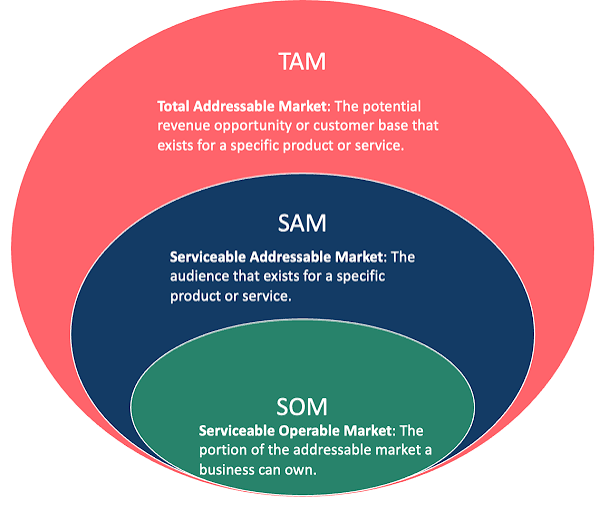
Once you understand TAM, the next step is to narrow the market down to the portion your business can realistically serve. This is where SAM (Serviceable Available Market) and SOM (Serviceable Obtainable Market) become important.
TAM vs. SAM vs. SOM: What’s the Difference?
| Market Measure |
What It Means |
Simple Fashion Example |
| TAM – Total Addressable Market |
The total potential market for your product or service if you could reach every possible customer. |
All potential customers who could buy the type of clothing you sell. |
| SAM – Serviceable Available Market |
The portion of TAM that your business can actually serve based on factors such as location, product type, customer segment, or distribution. |
Customers in the African countries or cities where your fashion brand plans to operate and can deliver. |
| SOM – Serviceable Obtainable Market |
The portion of SAM that your business can realistically capture, considering competition, capacity, pricing, marketing, and available resources. |
The number of customers your fashion brand realistically expects to win within its first few years. |
Think of it this way:
TAM = Everyone you could potentially sell to
SAM = Everyone you can realistically serve
SOM = Everyone you can realistically win
For example, if an African fashion brand estimates its TAM at ₦60 billion, it should not automatically claim that it will generate ₦60 billion in revenue. Perhaps its SAM is ₦15 billion based on its target locations and customer segment, while its realistic SOM may be ₦300 million based on its current production capacity, competition, and growth strategy.
This is why investors pay attention not only to the size of your market, but also to whether your TAM, SAM, and SOM calculations are realistic and supported by clear assumptions.
How to Calculate TAM Step by Step
Knowing what Total Addressable Market (TAM) means is one thing; knowing how to calculate TAM using realistic business assumptions is another.
The good news is that TAM does not have to be complicated. At its simplest, you need to estimate the number of potential customers and how much each customer could spend on your product or service within a given period.
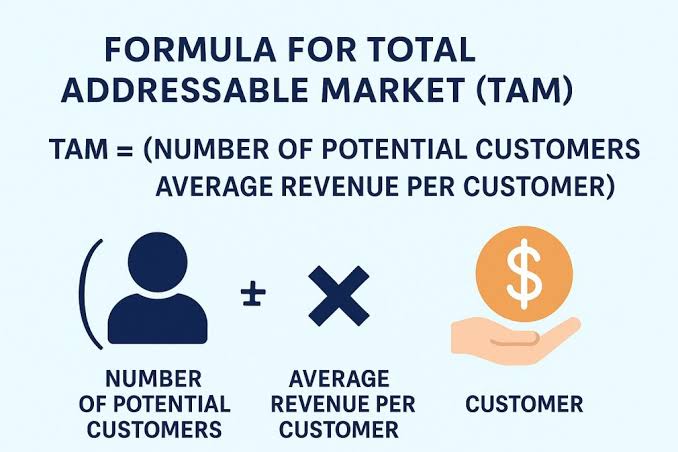
A basic bottom-up TAM formula is:
TAM = Number of Potential Customers × Average Annual Spending per Customer
For example, suppose a business sells affordable ready-to-wear clothing and estimates that its target market contains 500,000 potential customers. If each customer could spend an average of ₦40,000 per year on the type of clothing the business sells:
500,000 × ₦40,000 = ₦20 billion
The estimated TAM would therefore be ₦20 billion annually.
However, calculating a credible TAM involves more than multiplying two numbers. Follow these steps:
Step 1: Define Exactly What You Are Selling
Start by clearly defining the product or service for which you want to calculate the market size.
Avoid using a market that is unnecessarily broad.
For example, if you sell affordable ready-to-wear dresses, do not simply use the entire African fashion market as your TAM. Your calculation should focus on the specific category and customer segment relevant to your business.
Step 2: Define Your Target Customer
Next, determine who could potentially buy your product.
Consider factors such as:
- Age
- Gender
- Income level
- Location
- Occupation
- Lifestyle
- Purchasing behaviour
For example, a fashion business may target women aged 18–45 in urban and semi-urban areas who regularly purchase affordable ready-to-wear clothing.
The more clearly you define your customer, the easier it becomes to estimate the size of the market.
Step 3: Estimate the Number of Potential Customers
Use credible information to estimate how many people fit your target customer profile.
Depending on your industry, useful sources may include government statistics, industry reports, trade associations, market research, surveys, company reports, and reputable research publications.
Suppose your research indicates that there are approximately 500,000 potential customers who fit your target profile.
Your potential customer base is therefore:
500,000 customers
Step 4: Estimate Annual Spending Per Customer
The next question is:
How much could each customer reasonably spend on your product in one year?
This should be based on realistic purchasing behaviour rather than what you hope customers will spend.
For instance, if the average customer buys four dresses per year at an average price of ₦10,000 per dress:
4 × ₦10,000 = ₦40,000 per customer per year
Therefore, the estimated annual spending per customer is ₦40,000.
Step 5: Calculate Your TAM
Now apply the formula:
TAM = Potential Customers × Annual Spending Per Customer
Using our example:
500,000 × ₦40,000 = ₦20,000,000,000
Therefore:
Estimated TAM = ₦20 billion per year
This gives the entrepreneur a measurable estimate of the total annual revenue opportunity within the defined market.
More importantly, the entrepreneur can explain where the ₦20 billion figure came from.
That is what makes a TAM calculation more credible than simply stating that “the fashion industry is worth billions of naira.”
Step 6: Document Your Assumptions
Finally, write down the assumptions behind your calculation.
For example:
| Assumption |
Estimate |
| Potential customers |
500,000 |
| Average purchases per year |
4 |
| Average price per purchase |
₦10,000 |
| Annual spending per customer |
₦40,000 |
| Estimated TAM |
₦20 billion |
If these assumptions change, your TAM will also change. That is perfectly normal.
The goal is not to produce a perfect number. The goal is to produce a reasonable, transparent, evidence-based estimate that helps you understand the opportunity and communicate it confidently to investors, lenders, or grant providers.
For an African business venture, it can also be useful to calculate your TAM using more than one approach where reliable data is available. A bottom-up calculation based on your target customers and their spending can then be compared with top-down industry data to check whether your estimate is reasonable.
Remember: a large TAM is attractive, but a well-supported TAM is more valuable.
Common Mistakes Entrepreneurs Make When Calculating TAM
TAM calculations can easily become misleading when entrepreneurs rely on unrealistic assumptions. Some common mistakes include:
- Using an overly broad market: Saying your TAM is the entire African fashion or food market when your business serves only a specific customer segment.
- Using unsupported figures: Presenting a large market-size number without explaining where the data came from.
- Confusing TAM with expected revenue: A ₦20 billion TAM does not mean your business will make ₦20 billion in sales.
- Overestimating customer spending: Assuming customers will buy more frequently or spend more than they realistically do.
- Ignoring competition and business capacity: TAM represents the total opportunity, while your actual obtainable market will be much smaller.
A good TAM calculation should therefore be specific, evidence-based, realistic, and supported by clear assumptions.
How to Present Your TAM in a Business Plan or Pitch Deck
Calculating your TAM is only half the work. You also need to present it clearly so that investors, lenders, or grant providers can understand the size of the opportunity and how you arrived at the figure.
In your business plan, include your TAM in the market analysis section. Do not simply state a large figure. Briefly explain:
- Who the potential customers are
- How many potential customers you identified
- Their estimated annual spending
- The sources or assumptions behind your estimates
- How your TAM relates to your SAM and SOM
For example:
Our estimated Total Addressable Market (TAM) is ₦20 billion annually, based on approximately 500,000 potential customers spending an average of ₦40,000 per year on affordable ready-to-wear clothing.
In a pitch deck, you can make the information more visual and concise. A simple TAM → SAM → SOM graphic can show investors how you move from the overall market opportunity to the portion your business intends to capture.
Most importantly, avoid presenting an impressive market figure without evidence. Investors are more interested in a realistic and well-supported market opportunity than an exaggerated number.
Read Also: How to calculate customer acquisition cost cac and lifetime value ltv a practical guide for business owners
How DABH Can Help
Calculating your TAM correctly requires more than putting numbers into a formula. You need to understand your target market, research your customers, make realistic assumptions, and present the findings professionally.
At Dayo Adetiloye Business Hub (DABH), we help entrepreneurs turn their business ideas and market information into practical, investor-ready business plans and funding documents.
Whether you are preparing for a grant, loan, investment, or simply planning your business growth, our team can help you with:
- Market research and market-size analysis
- Business plan development
- Financial projections and business modelling
- Funding proposals and pitch decks
- Business strategy and growth planning
The goal is not simply to make your business look attractive on paper, but to help you build a credible business case backed by realistic numbers and clear assumptions.
If you need professional support to prepare your business for funding or growth, DABH is here to help you take the next step.

Get Grant-Ready Before the Next Opportunity
Many organisations miss funding opportunities because they are not prepared when calls for applications open.
That’s why we created:
The Ultimate Grant Readiness System™
The Complete Toolkit for Grants, Funding & Investment Readiness
The toolkit includes:
- Grant Proposal Templates
- Business Plan Templates
- Financial Projection Models
- Investor Pitch Deck Templates
- Due Diligence Checklists
- NGO Proposal Templates
- Funding Readiness Resources
- Proposal Writing Guides
Whether you’re applying for international grants, innovation competitions, accelerator programmes, or investor funding, this toolkit will help you prepare professional applications with confidence.
Get instant access here:
http://selar.com/38k7agny27?affiliate=kjj9
Related