How to Write a Business Proposal for Government Tenders and Supply Contracts
 How to Write a Business Proposal for Government Tenders and Supply Contracts
By Dayo Adetiloye Business Hub
To write a business proposal for government tenders and supply contracts, follow the procurement document, establish your eligibility, explain your delivery approach, prove relevant experience and submit a commercially sustainable financial bid. Complete the prescribed forms and provide documentary evidence for your claims.
For contractors, companies and multinationals operating in Nigeria, successful tendering requires careful attention to compliance, technical capacity and cash flow. A proposal can be persuasive yet fail a mandatory requirement. Equally, a company can win a contract that its finances cannot support.
This guide explains how to prepare a credible submission while protecting your business from avoidable commercial risks.
Understand the Procurement Process Before Writing
Nigeria’s Public Procurement Act 2007 provides the federal procurement framework. Section 16 establishes open competitive bidding as a fundamental principle, subject to permitted exceptions. For goods and works, the Act identifies the winning bid as the lowest evaluated responsive bid meeting the required specifications and standards. Consultancy procurement has separate selection provisions, so the cheapest consulting proposal does not automatically win.
Identify the type of opportunity before drafting:
| Procurement document |
Main purpose |
| Expression of Interest — EOI |
Establish qualifications and relevant capability |
| Request for Quotation — RFQ |
Obtain quotations against defined requirements |
| Invitation to Tender — ITT |
Invite bids using specified instructions and schedules |
| Request for Proposal — RFP |
Obtain detailed proposals under stated evaluation criteria |
The document’s instructions determine what you submit. An EOI may require experience and personnel evidence without a financial offer.
Also check current guidance. The Federal Government announced revised procurement thresholds in May 2025, superseding earlier federal thresholds. Avoid copying figures from an outdated template. State and donor-funded procurements may operate under different frameworks.
1. Assess Whether You Should Bid
Before paying tender fees or committing staff time, determine whether the opportunity fits your company.
Check mandatory qualifications, comparable experience, supplier availability, delivery capacity and financing. If awarded the contract, could you execute it within the required period using resources you can actually access?
For multinational companies, identify the bidding entity and confirm whose experience qualifies. A subsidiary should not assume its parent company’s credentials automatically satisfy the tender requirements.
Where joint ventures or subcontracting are permitted, document responsibilities and resource commitments. Partnerships should close identifiable capability gaps.
Decline opportunities with mandatory conditions you cannot meet. A smaller contract within your capacity may offer a better commercial outcome than a large award requiring unavailable financing.
2. Create a Tender Compliance Matrix
Read the solicitation line by line and convert its requirements into an internal compliance register.
Record each requirement, the supporting evidence, the responsible person and its location in the submission. Separate mandatory eligibility conditions from scored technical criteria.
CREDICORP’s February 2026 procurement notice illustrates the detail involved. It required CAC evidence including a verified company profile, tax clearance, current PenCom, ITF and NSITF certificates, and BPP registration or an Interim Registration Report. It also requested audited accounts, financial-capacity evidence and relevant project documentation. These were requirements of that particular exercise, rather than a universal checklist for every government tender.
Check certificate validity, bidder names and registration details across documents. Request formal clarification where instructions are unclear, and monitor addenda.
A company that writes against the original specifications while overlooking an amendment can submit an unsuitable offer despite considerable preparation.
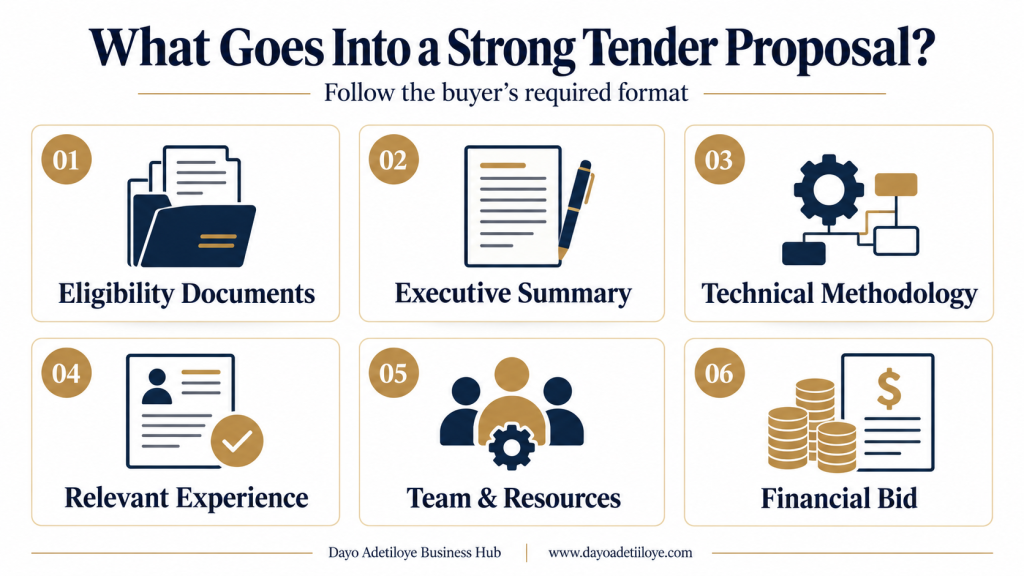
3. Follow the Required Proposal Structure
Use the procuring entity’s prescribed sequence. Where no detailed narrative structure is supplied, organise your submission around the following sections:
| Section |
What it should demonstrate |
| Cover letter and required forms |
Correct project reference, lot number, authorisation and declarations |
| Eligibility documents |
Compliance with the requested corporate and statutory requirements |
| Executive summary |
Understanding of the assignment and credible delivery capacity |
| Technical response |
Specification compliance, methodology, schedule and quality controls |
| Experience and resources |
Relevant contracts, personnel, equipment and supporting evidence |
| Financial submission |
Completed price schedules, tax treatment, validity and required security |
Keep the executive summary concise. Identify the assignment, your relevant capability and your delivery commitment.
For an illustrative laptop supply tender, a useful opening would explain the quantity, delivery locations, configuration requirements and support arrangements. General statements about being “dynamic” or “world-class” give the evaluator little evidence.
Where separate technical and financial submissions are required, keep prices out of the technical package. Complete mandatory forms even when the information appears elsewhere.
 How to Write a Business Proposal for Government Tenders and Supply Contracts
4. Explain Exactly How You Will Deliver
A strong methodology connects activities to measurable outputs.
For an illustrative contract to supply 500 laptops across ten government offices, explain sourcing, specification checks, delivery allocation, configuration, asset tagging, user orientation and warranty support.
Identify who inspects the equipment, how serial numbers are recorded, what constitutes acceptance and how defective units will be replaced. Base your delivery schedule on supplier lead times you have confirmed.
For construction, address site access, mobilisation, materials, safety, testing and handover. For consultancy, connect research and analysis to reports, validation and final deliverables.
Explain dependencies. If installation requires access to government premises or approval of a sample, include that dependency in the programme.
The evaluator should be able to trace a credible route from award to completion.
5. Prove Relevant Experience and Resource Availability
Select previous assignments by relevance, scale and complexity. A large road construction contract does not establish competence to supply laboratory equipment.
For each reference, state the client, year, value, scope and your contractual role. Attach the requested evidence and distinguish work completed as the main contractor from subcontracted work.
CREDICORP’s 2026 notice requested three similar assignments within five years, supported by award letters, contract agreements and completion certificates.
Map proposed personnel to responsibilities and confirm their availability. Describe equipment accurately as owned, leased or committed through a partner.
Never invent project experience, certificates, personnel commitments or financial information. A bid must withstand verification.
6. Price for Sustainable Delivery
Your price should cover procurement, logistics, installation, insurance, financing, allocated overhead, contingency and profit. Present applicable taxes as instructed.
Consider this illustrative supply-contract budget. These figures are assumptions, not current market quotations.
| Cost item |
Amount |
| Equipment procurement |
₦40,000,000 |
| Logistics and installation |
₦7,000,000 |
| Insurance and compliance |
₦1,000,000 |
| Financing and allocated overhead |
₦4,500,000 |
| Contingency |
₦2,500,000 |
| Total estimated cost |
₦55,000,000 |
At a selling price of ₦62 million before applicable taxes, the projected surplus is ₦7 million, approximately 11.3% of revenue.
A 10% increase in equipment cost consumes ₦4 million, leaving ₦3 million before other overruns. This is why an apparently attractive contract needs sensitivity analysis.
Obtain current supplier quotations and check their validity against the required bid-validity period. For imported goods, assess exchange-rate exposure, freight, customs-related costs and delivery uncertainty.
Do not assume you can increase the contract price later to recover costs you overlooked.
7. Model Cash Flow and Check Contract Obligations
Profitability and liquidity are different questions.
If ₦45 million becomes payable before the first customer receipt and your company has ₦15 million available, the initial financing gap is ₦30 million. Later expenditure may increase that gap.
Prepare a monthly forecast showing supplier deposits, delivery, acceptance, invoicing and expected receipts. Test delayed payment and additional financing costs. Account for retention and withholding deductions where applicable, separating cash timing from final tax cost.
Do not assume an advance will fund execution. Section 35 of the 2007 Act provides for mobilisation of no more than 15%, subject to specified security; section 36 addresses the performance guarantee where mobilisation is paid. Check the applicable current rules and contract terms before relying on an advance.
Review warranty obligations, penalties, acceptance procedures and termination provisions. Discuss guarantees, collateral, charges and issuance time with your bank early.
A bank reference expressing willingness to consider credit is not an approved financing facility.
 How to Write a Business Proposal for Government Tenders and Supply Contracts
8. Review and Submit Carefully
Assign someone outside the drafting team to check mandatory documents, signatures, arithmetic, specifications and consistency between submissions.
For electronic bids, verify file formats, size limits and portal requirements. For physical bids, check copies, seals, labels and the submission address.
Submit early and retain acknowledgement. Section 27 of the Act provides that late bids must remain unopened.
Common mistakes include expired certificates, generic company profiles, unsupported experience, unauthorised substitutions and prices based on stale quotations.
Maintain current tender records throughout the year so each opportunity begins with verified documents.
Frequently Asked Questions
Does the lowest price always win?
No. Goods and works evaluation considers responsiveness and the specified evaluation criteria. Consultancy selection may consider technical quality and price under the stated method.
How long should a government tender proposal be?
Follow the stated page limits and forms. Without a limit, provide enough information to demonstrate compliance and delivery capacity. Every additional page should support evaluation.
Can a new company bid?
Check the opportunity’s eligibility and experience requirements. Where permitted, a documented partnership may help build capability, but it cannot replace mandatory qualifications the bidder must hold.
Professional Support for Tender and Funding Preparation
Dayo Adetiloye Business Hub supports contractors and organisations with business proposals, business plans, feasibility studies, financial projections, market research and business advisory.
Before a major bid, a financial model can expose financing gaps and establish a sustainable price. Where expansion requires funding, our support also includes BOI loan applications, grant writing, pitch decks, funding readiness and investment readiness.
 Why Free Business Plan Templates Often Fail to Secure Capital
For businesses preparing for grants alongside contract opportunities, The Ultimate Grant Readiness System™ offers a toolkit for becoming funding-ready. Use it for funding preparation while addressing each tender’s separate requirements.
Get The Ultimate Grant Readiness System™.
Call/WhatsApp: 08105636015, 08076359735, 08113205312
Email: dayohub@gmail.com
Website: www.dayoadetiloye.com
Conclusion
A strong government tender proposal makes your eligibility, delivery capacity and price easy to verify. Start with the procurement document, support your claims with relevant evidence and test the cash requirements before committing.
Winning should strengthen your business. Pursue contracts your company can finance, execute reliably and complete with a sustainable profit.
Related