How Long Should an Investor-Ready Business Plan Actually Be?
 How Long Should an Investor-Ready Business Plan Be?
One of the most common questions entrepreneurs ask when preparing to raise capital is: “How many pages should my business plan be?”
Some founders believe a 50-page document will impress investors. Others have been told that investors no longer read business plans and that a 10-slide pitch deck is all they need.
Both positions can be misleading.
An investor-ready business plan is not judged primarily by its number of pages. It is judged by whether an investor can understand the opportunity, assess the risks, test the assumptions and determine whether the potential return justifies putting money into the business.
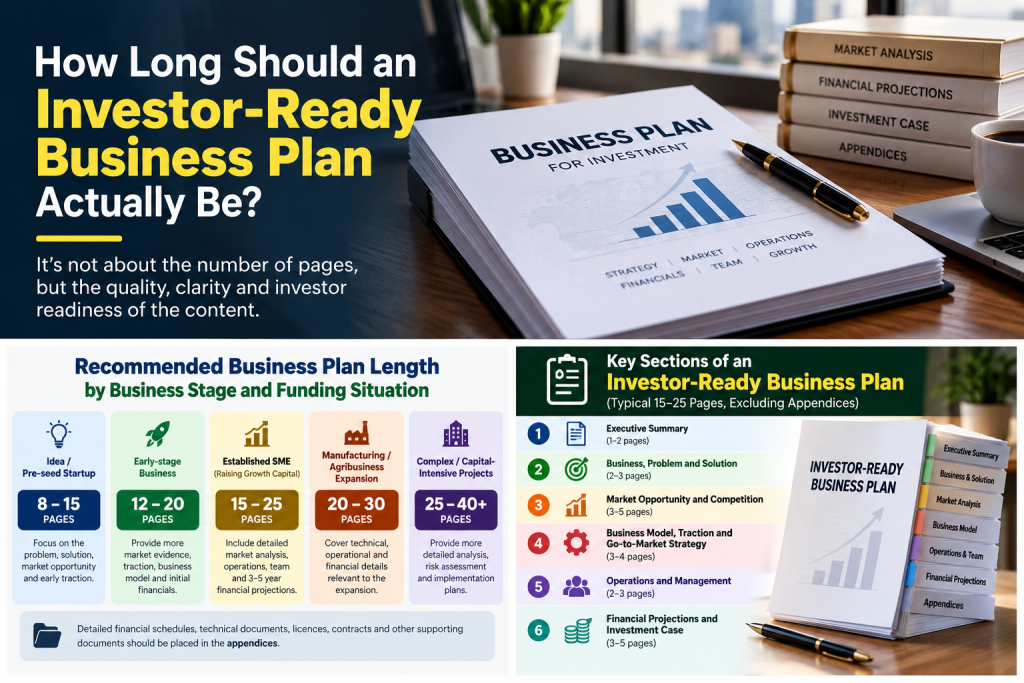
For most SMEs and growth businesses, a strong investor-ready business plan will typically be about 15–25 pages of core content, excluding detailed financial schedules and supporting appendices. But that is a practical benchmark, not an investment rule.
The right length depends on the stage of the business, complexity of the opportunity, amount being raised and type of investor being approached.
As a Business Development Service Provider working with entrepreneurs and SMEs in Nigeria, I would advise founders to stop asking only, “How long should my business plan be?” and start asking a more important question:
“Does this document contain enough evidence for an investor to make an informed investment decision?”
That distinction changes everything.
Is There an Official Length for an Investor-Ready Business Plan?
No.
There is no globally accepted rule saying an investment business plan must contain 10, 20 or 30 pages.
The U.S. Small Business Administration (SBA), for example, distinguishes between traditional and lean business plans. It notes that traditional plans are detailed and can run to dozens of pages, while lean startup plans may be only one page. Importantly, the SBA says lenders and investors commonly request the more comprehensive traditional format.
That tells us something important:
Purpose determines length.
A document being used internally to clarify a new business idea does not require the same depth as a plan seeking ₦500 million from an investor.
Similarly, a technology startup seeking pre-seed funding may communicate much of its investment case through a concise pitch deck, financial model and data room. An established manufacturing company seeking substantial expansion capital may need detailed market analysis, historical performance, operational plans and five-year projections.
Therefore, an investor-ready business plan should not be written to achieve a predetermined page count. It should be designed to answer the questions that determine whether capital will be invested.
So, How Long Should an Investor-Ready Business Plan Actually Be?
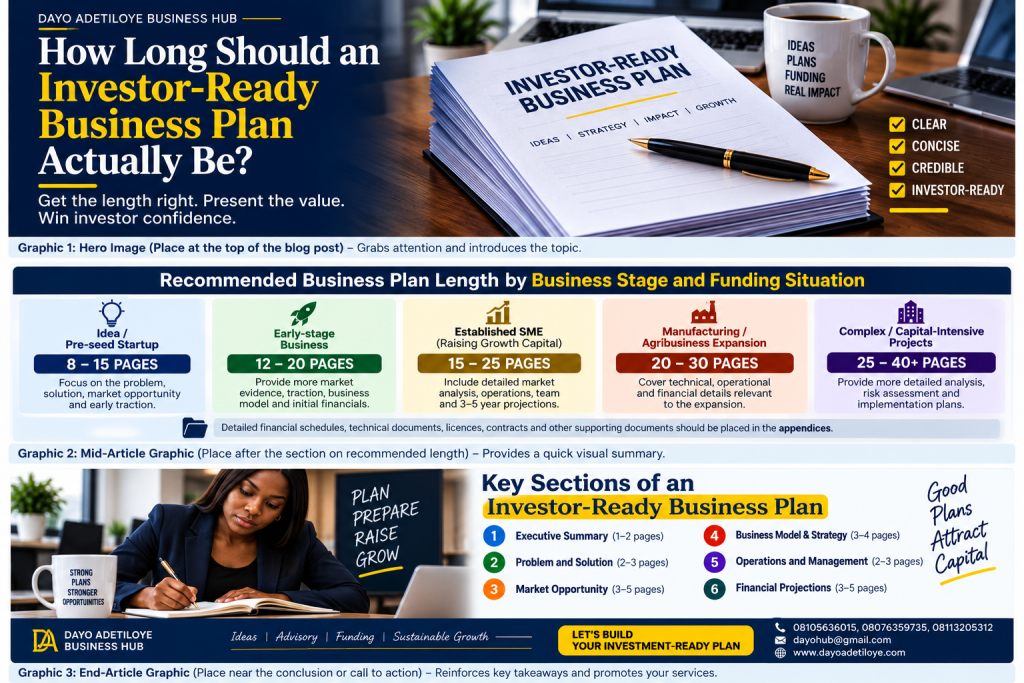
As a practical guide, I recommend the following:
| Business/Funding Situation |
Suggested Core Business Plan Length |
| Idea/pre-seed startup |
8–15 pages |
| Early-stage business with initial traction |
12–20 pages |
| Established SME raising growth capital |
15–25 pages |
| Manufacturing/agribusiness expansion |
20–30 pages |
| Complex infrastructure or capital-intensive project |
25–40+ pages |
| Detailed financial schedules/supporting documents |
Put in appendices |
These are professional guidelines rather than mandatory investor standards.
A 17-page plan containing credible market evidence, demonstrated traction and defensible financial projections can be significantly more investment-ready than a 60-page plan filled with generic industry information.
 How Long Should an Investor-Ready Business Plan Be?
What Should Fit Inside Those 15–25 Pages?
The strongest investor-ready plans generally concentrate their space on the issues that determine commercial viability.
1. Executive Summary: 1–2 Pages
This may be the most important part of the entire document.
An investor should quickly understand:
- what the company does;
- the problem and commercial opportunity;
- target market;
- current traction;
- business model;
- competitive advantage;
- amount being raised;
- proposed use of funds;
- financial outlook; and
- investment proposition.
Do not turn the executive summary into a company history.
If you are raising ₦150 million, say so. Annual revenue increased from ₦80 million to ₦140 million, show it. ₦90 million of the investment will purchase equipment that increases production capacity by 250%, explain that.
Investors need decision-useful information.
2. Business, Problem and Solution: 2–3 Pages
Explain exactly what the business does and why customers will pay for it.
A common mistake is spending several pages describing the product without adequately establishing the problem.
Strong investment propositions connect:
Problem → Customer → Solution → Revenue.
For example, an agribusiness should not simply say:
“Nigeria has a large agricultural sector.”
That does little for an investor.
It could instead establish a specific supply-chain problem, quantify demand, explain the company’s solution and show how solving that problem generates revenue and margin.
3. Market Opportunity and Competition: 3–5 Pages
This is an area where many Nigerian business plans become unnecessarily long.
Twenty pages of general information about Nigeria’s population, unemployment, GDP and agriculture will rarely make an investment case stronger.
Investors need to understand the addressable commercial opportunity.
Define your:
TAM – Total Addressable Market
SAM – Serviceable Available Market
SOM – Serviceable Obtainable Market
More importantly, explain how you calculated them.
A statement such as “Nigeria’s food market is worth billions of dollars” is less useful than evidence showing the number of realistic customers in your geographical market, their average annual spending and the percentage you can credibly acquire.
Competitive analysis should also address alternatives. Sequoia Capital’s business-plan guidance specifically includes the problem, solution, market potential, competition/alternatives, business model, team, financials and long-term vision among the fundamental issues founders should communicate.
4. Business Model, Traction and Go-to-Market Strategy: 3–4 Pages
Investors want to know how the company converts its opportunity into cash.
Explain pricing, customer acquisition, distribution, sales channels, recurring revenue where applicable, unit economics and existing commercial traction.
For an operating business, evidence becomes especially important.
Instead of writing:
“Our marketing strategy will include social media, referrals and partnerships.”
Show what is already happening.
For example:
- 1,800 paying customers;
- ₦210 million revenue in FY2025;
- 72% repeat purchase rate;
- average customer value of ₦185,000;
- 35 active distributors;
- 28% gross margin.
Those figures tell an investor far more than three pages of marketing terminology.
This is particularly important because investors have limited attention. Stripe’s startup guidance, developed with input from Y Combinator, notes that reviewers at leading accelerators and early-stage VC firms may see hundreds of pitches and initially spend only a short time on each.
Clarity therefore has economic value.
5. Operations and Management: 2–3 Pages
The question here is not simply who the directors are.
The investor is evaluating execution capacity.
Explain the operating model, facilities, technology, suppliers, production capacity, regulatory requirements, critical partnerships and management responsibilities.
Management profiles should emphasise experience directly relevant to executing the proposed growth strategy.
An impressive biography that does not explain why that individual can execute the business model adds little value.
6. Financial Projections and Investment Case: 3–5 Pages
This is where an investor-ready business plan separates itself from an ordinary business plan.
Your financial section should typically cover three to five years and include:
- revenue assumptions;
- cost assumptions;
- projected profit and loss;
- cash-flow projections;
- balance sheet where appropriate;
- capital expenditure;
- working-capital requirements;
- break-even analysis;
- key ratios;
- scenario or sensitivity analysis; and
- funding requirement and use of funds.
The important word is assumptions.
Suppose an entrepreneur projects:
Year 1 revenue: ₦120 million
Year 2: ₦300 million
Year 3: ₦600 million
The investor will not simply admire the growth.
The investor will ask:
How will you get from ₦120 million to ₦300 million?
If the company sells a product for ₦20,000, generating ₦300 million means selling 15,000 units.
The business plan must demonstrate whether the company has the production capacity, customers, distribution network, working capital and marketing resources required to sell those 15,000 units.
That is investor readiness.
Techstars similarly describes the financial model as the detailed numerical foundation behind the fundraising narrative, allowing investors to examine assumptions, growth trajectories and risks during due diligence.
 How Long Should an Investor-Ready Business Plan Be?
Pitch Deck vs. Business Plan: Do You Need Both?
Frequently, yes.
They perform different jobs.
Pitch deck opens the conversation.
Business plan develops the investment case.
Financial model tests the economics.
Data room provides evidence during due diligence.
This distinction is particularly important for entrepreneurs who hear that “investors don’t read business plans.”
Some venture capital investors may indeed prefer a short deck for the initial approach. Stripe’s current VC pitching guidance explicitly advises founders to keep their decks short, while Sequoia’s framework focuses on communicating the company’s purpose, problem, solution, market, competition, business model, team, financials and vision clearly.
But once an investor becomes interested, the requirement for evidence does not disappear. It increases.
Expect questions about financial assumptions, contracts, ownership, customer concentration, intellectual property, liabilities, tax, management accounts and growth projections.
Shortening the presentation does not eliminate due diligence.
What About Nigerian Banks, BOI and Development Finance?
Equity investors and lenders assess businesses differently, so entrepreneurs should not send exactly the same document to everyone.
For example, a Bank of Industry checklist for certain loans of ₦25 million and below specifically requires a simplified business plan containing information such as the business profile, activity, and sources and costs of raw materials.
Another current BOI-linked funding programme requires a business plan or loan-utilisation proposal alongside evidence such as business registration, bank statements and financial accounts.
This demonstrates why copying one generic 40-page business plan and submitting it to every funder is poor funding strategy.
A lender is particularly interested in repayment capacity, cash flow, security, creditworthiness and use of funds.
An equity investor is more concerned with growth, valuation, scalability, competitive advantage, management capability and potential investment returns or exit.
Your document must reflect the capital provider.
Why Quality Matters More Than Page Count in Nigeria
Access to finance remains a serious constraint for Nigerian businesses.
The World Bank reported in December 2025 that fewer than one in twenty Nigerian MSMEs had access to bank credit. It consequently approved a $500 million FINCLUDE financing package intended to expand MSME finance in Nigeria.
Earlier IFC research estimated unmet credit demand among Nigerian MSMEs at approximately ₦13 trillion ($32.2 billion).
The lesson is not simply that Nigerian businesses need more funding.
It is that when capital is scarce, businesses must present themselves professionally enough for funders to distinguish a credible opportunity from an inadequately prepared one.
A longer document cannot compensate for weak numbers.
Seven Mistakes That Make Business Plans Unnecessarily Long
In reviewing and developing business plans over the years, I repeatedly see entrepreneurs adding pages without adding investment value.
Common problems include:
- Five pages explaining the history of an industry.
- Long biographies of every employee.
- Generic SWOT analyses.
- Repeating the same market statistics in multiple sections.
- Describing every product feature.
- Putting detailed financial schedules inside the main document.
- Using large volumes of AI-generated text without validating the facts, numbers or commercial assumptions.
Move supporting material into an appendix.
Your appendix can contain detailed financial statements, licences, quotations, technical specifications, survey results, contracts, management CVs and other due-diligence evidence.
The main document should tell the investment story. The appendix should prove it.
The “Investor Question Test”
Before submitting your business plan, test every major section against one question:
What investment question does this section answer?
If three pages of text do not answer an important investor question, those pages may not belong in the plan.
A serious investor should finish reading with reasonable answers to six fundamental questions:
Is there a real opportunity?
Can this company capture it?
Can this team execute?
Do the economics work?
What could go wrong?
How does my capital generate an attractive return?
If your 20-page document answers those questions convincingly, adding another 30 pages may make it worse rather than better.
When You Need Professional Business Plan and Investment-Readiness Support
Preparing a business plan for investment is different from simply documenting a business idea.
At Dayo Adetiloye Business Hub, we help entrepreneurs, SMEs and organisations translate their businesses into commercially credible funding propositions through:
business plan development, feasibility studies, market research, financial modelling and projections, pitch decks, investment-readiness advisory, funding-readiness support, grant writing and BOI loan application support.
The objective is not to produce the longest document.
It is to produce a document whose strategy, market evidence and numbers can withstand scrutiny.
Call/WhatsApp: 08105636015, 08076359735, 08113205312
Email: dayohub@gmail.com
Website: Dayo Adetiloye Business Hub
Become Funding-Ready Before the Opportunity Arrives
Many entrepreneurs begin preparing their financials, documents and funding narrative only after discovering a grant, loan or investment opportunity.
By then, deadlines are often too close.
 How Long Should an Investor-Ready Business Plan Be?
The Ultimate Grant Readiness System™ is designed to help entrepreneurs and organisations build the systems, documentation and preparation required to become more funding-ready before opportunities arise.
Get The Ultimate Grant Readiness System™
Funding readiness is broader than writing applications. Your financial records, business model, supporting documents, impact evidence and ability to explain how capital will be deployed all influence your credibility.
Conclusion: Stop Counting Pages and Start Building the Investment Case
So, how long should an investor-ready business plan actually be?
For many SMEs and established businesses, 15–25 well-developed core pages plus supporting appendices is a sensible benchmark. An early-stage startup may communicate its case in considerably fewer pages, while manufacturing, infrastructure, agribusiness and other capital-intensive projects may legitimately require 25–40 pages or more.
But page count should never become the objective.
An investor does not fund pages.
Investors fund credible opportunities, capable teams, attractive economics and sufficiently understood risks.
Your business plan therefore needs to be long enough to establish those facts and short enough for the investment case to remain clear.
If you have 50 pages, ask whether 20 can make the case more powerfully.
If you have eight pages, ask whether the market evidence, operating strategy, financial assumptions, risks and funding proposition are sufficiently developed.
The best investor-ready business plan is not the longest.
It is the one that makes a credible investor understand the opportunity, trust the numbers, see the risks and want to continue the conversation.
Related