 Step-by-Step Modern Catfish Farming Business Plan in Nigeria (2026 Guide)
Catfish farming in Nigeria has evolved from a small-scale agricultural activity into a commercially significant agribusiness opportunity. However, establishing a profitable fish farm requires more than constructing ponds, purchasing fingerlings and feeding fish until harvest. Successful operators must understand production economics, market demand, feed management, water quality, financial planning and risk management.
A well-prepared catfish farming business plan in Nigeria helps entrepreneurs estimate startup capital, manage operational expenses, evaluate profitability and attract financing.
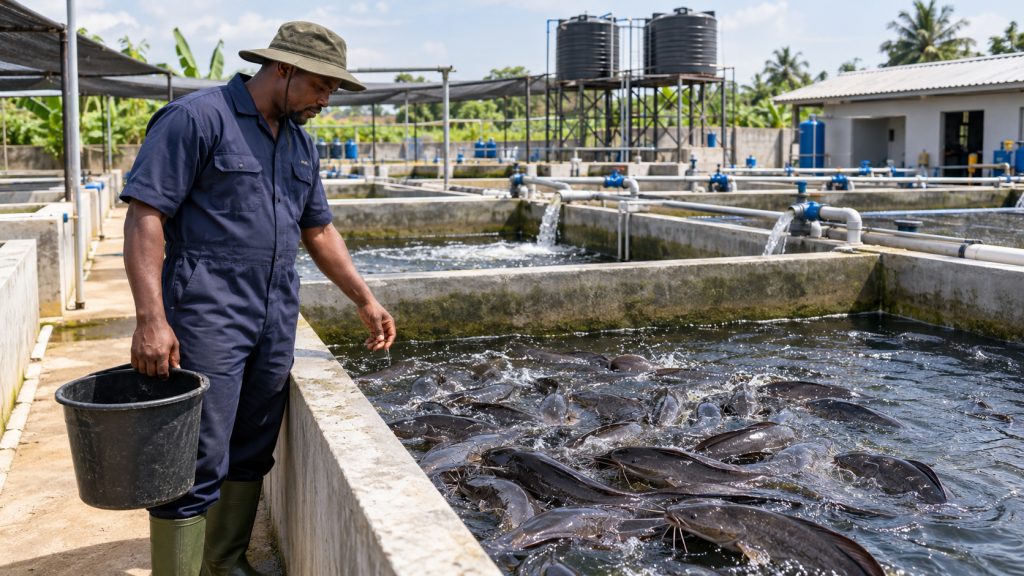
According to the Food and Agriculture Organization (FAO), Nigeria is the world’s largest producer of African catfish. FAO’s June 2026 FISH4ACP report estimates that approximately 300,000 grow-out producers collectively produce around one million tonnes of catfish annually. This demonstrates the industry’s commercial importance while highlighting the need for better farm management.
This guide explains how to develop a modern catfish farming business plan, including practical startup considerations, production strategies, financial projections and opportunities for business expansion.
 Step-by-Step Modern Catfish Farming Business Plan in Nigeria (2026 Guide)
What Is a Catfish Farming Business Plan?
A catfish farming business plan is a comprehensive document explaining how a fish farming enterprise will be established, operated, financed and managed profitably.
It typically covers the business model, target market, pond infrastructure, stocking capacity, feeding programme, production costs, marketing strategy, risk management and financial projections.
For investors and lenders, the plan demonstrates whether the proposed business is commercially viable and capable of generating sufficient cash flow to sustain operations and repay financing.
Step 1: Conduct Market Research and Feasibility Studies
Before investing in catfish farming, determine whether sufficient demand exists within your proposed market.
In Nigeria, catfish is commonly purchased by restaurants, hotels, pepper-soup outlets, fish processors, households and market distributors.
FAO’s 2025 FISH4ACP reporting indicated that Nigeria required approximately 3.2 million metric tonnes of fish annually, against reported domestic production of about 1.2 million tonnes. Although this figure covers fish generally rather than catfish alone, it illustrates the broader opportunity for domestic aquaculture.
Nevertheless, national demand does not guarantee profitability for an individual farmer.
A proper feasibility study should investigate local selling prices, preferred fish sizes, competing suppliers, seasonal demand, transportation costs and potential buyers.
For example, an entrepreneur establishing a catfish farm in Ogun State could target restaurants and fish distributors serving Lagos while evaluating transportation expenses and the prices buyers are willing to pay.
Business recommendation: Obtain price quotations and purchasing commitments from potential customers before constructing ponds.
Step 2: Choose the Right Catfish Farming Business Model
Modern catfish farming businesses can operate under several production models.
Grow-out farming: Purchasing juveniles and raising them to marketable sizes. This is often the most straightforward model for beginners.
Hatchery operations: Producing fingerlings and juveniles for other farmers. This requires specialised breeding knowledge and equipment.
Integrated catfish farming: Combining hatchery operations, grow-out production, processing and distribution.
Catfish processing: Purchasing or producing fish for smoking, drying, packaging and wholesale distribution.
For a first-time investor, grow-out production may offer a manageable starting point. However, the final choice should reflect available capital, technical expertise and market opportunities.
Step 3: Select a Suitable Farm Location
Location significantly influences production costs and operational efficiency.
A suitable catfish farm should have dependable access to clean water, adequate drainage, electricity or alternative power, road accessibility and reasonable proximity to buyers.
Water availability deserves particular attention because intensive fish production requires consistent water management.
Before acquiring land, assess groundwater reliability, flooding risks, security, environmental considerations and the cost of transporting fish to customers.
Avoid selecting a location simply because land is inexpensive. A cheap site with unreliable water or difficult transportation can become considerably more expensive over time.
Step 4: Select the Appropriate Pond System
Modern catfish farms commonly use three infrastructure options.
Concrete Ponds
Concrete ponds provide durable structures, convenient drainage and relatively easy cleaning. However, construction costs can be substantial.
Tarpaulin or Mobile Ponds
Tarpaulin ponds generally require less initial construction work and may suit small farms or pilot projects. Their durability depends on material quality, installation and maintenance.
Earthen Ponds
Earthen ponds can support larger-scale production where suitable land and soil conditions exist. They require careful management of drainage, seepage, predators and harvesting.
More advanced operations may consider recirculating aquaculture systems (RAS), which treat and reuse water. However, RAS requires greater technical expertise, reliable electricity and higher capital investment.
Important: Stocking capacity should be calculated from usable water volume, fish biomass, oxygen availability, filtration and water-exchange capacity—not simply pond dimensions.
Step 5: Purchase Healthy Juveniles and Establish a Stocking Plan
The quality of fish stocked can determine the profitability of an entire production cycle.
African catfish (Clarias gariepinus) is widely cultivated in Nigeria because of its market acceptance and suitability for aquaculture.
Purchase healthy, relatively uniform juveniles from reputable hatcheries with traceable production records.
A beginner might plan around 1,000 juveniles, subject to available pond capacity and technical assessment.
Before stocking, acclimatise fish to the new water conditions and monitor them closely for signs of stress.
Avoid excessive stocking density. Overcrowding can increase competition, deteriorate water quality and encourage disease outbreaks.
Nigeria’s 2026 National Aquaculture Biosecurity Guidelines emphasise appropriate stocking densities, farm hygiene, quality feed and responsible disease prevention.
Step 6: Develop an Effective Feeding and Water Management Programme
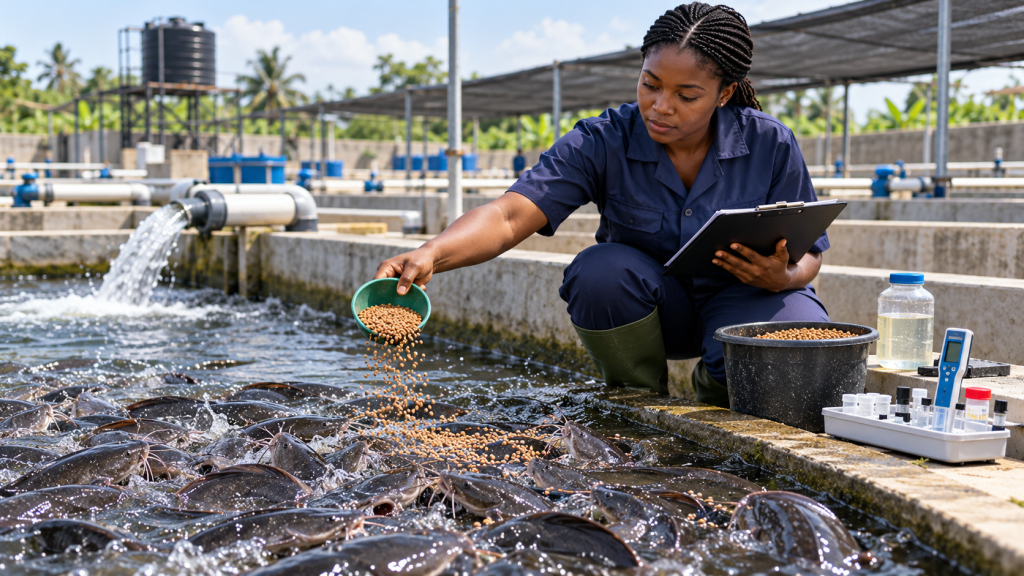
Feed management is one of the most important determinants of catfish farm profitability.
According to FAO’s June 2026 investment report, feed accounts for approximately 78–85% of operational costs on many Nigerian catfish farms.
This means that poor feeding decisions can quickly eliminate expected profits.
A modern feeding programme should consider fish weight, growth stage, nutritional requirements, water conditions and feeding response.
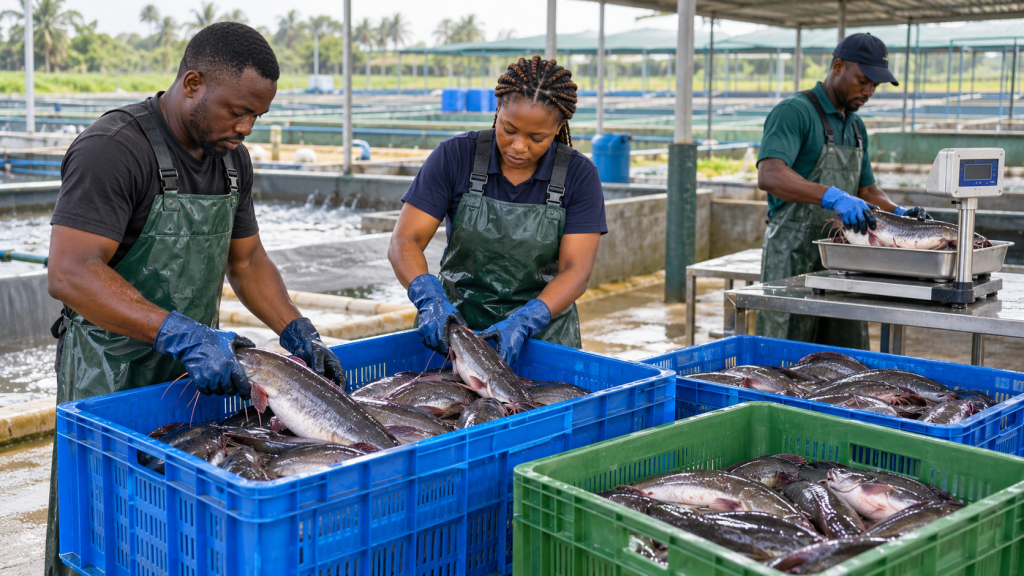
Farmers should periodically sample and weigh fish to adjust feed quantities.
A particularly useful performance indicator is the Feed Conversion Ratio (FCR).
FCR = Total Feed Consumed ÷ Total Fish Weight Gained
For example, if fish consume 1,200kg of feed and gain 1,000kg in total weight, the FCR is 1.2.
A lower FCR generally indicates more efficient feed utilisation, provided fish growth and health remain satisfactory.
Water quality must also be monitored. Important parameters include dissolved oxygen, temperature, pH and ammonia.
Daily observation, appropriate water exchange, regular pond cleaning and professional health management help minimise avoidable losses.
Step 7: Prepare a Catfish Farming Startup Cost and Financial Plan
Financial planning should distinguish between initial infrastructure investment and recurring production expenses.
The following illustration considers a small Nigerian catfish farm stocking 1,000 juveniles for one production cycle.
Illustrative Startup Investment
| Capital Item |
Estimated Cost |
| Pond infrastructure and installation |
₦500,000 |
| Water storage and plumbing |
₦180,000 |
| Pumping and basic equipment |
₦120,000 |
| Nets, weighing scale and testing tools |
₦70,000 |
| Total Fixed Investment |
₦870,000 |
Land acquisition, borehole drilling and major power infrastructure are excluded.
Illustrative Operating Costs Per Cycle
| Expense |
Estimated Cost |
| 1,000 juveniles at ₦150 |
₦150,000 |
| 1,200kg feed at ₦850/kg |
₦1,020,000 |
| Water, electricity and fuel |
₦90,000 |
| Labour and routine maintenance |
₦120,000 |
| Health management and miscellaneous |
₦40,000 |
| Transportation and marketing |
₦60,000 |
| Total Operating Cost |
₦1,480,000 |
These figures are planning assumptions, not verified October 2026 market quotations. Actual prices vary by location, supplier, feed formulation and production scale.
Revenue and Profitability Projection
Assume the farm achieves:
- 90% survival rate: 900 fish harvested.
- Average harvest weight: 1.2kg.
- Total marketable production: 1,080kg.
- Selling price: ₦1,800 per kilogram.
Estimated Revenue: 1,080kg × ₦1,800 = ₦1,944,000.
Estimated Operating Surplus: ₦1,944,000 − ₦1,480,000 = ₦464,000.
This represents approximately 23.9% of revenue before depreciation, financing costs and tax.
The operating break-even selling price is approximately ₦1,370 per kilogram.
At ₦1,600/kg, the projected operating surplus falls to ₦248,000. At ₦1,400/kg, it declines to just ₦32,000.
This sensitivity demonstrates why farmers must validate selling prices and feed costs before investing.
The initial capital expenditure is not deducted from the operating surplus, and actual cash recovery depends on multiple production cycles.
 Step-by-Step Modern Catfish Farming Business Plan in Nigeria (2026 Guide)
Step 8: Establish Marketing and Distribution Channels
A modern catfish farm should secure customers before harvest.
Potential distribution channels include wholesalers, restaurants, hotels, fish markets, processors and direct household customers.
Farmers can also use WhatsApp Business, social media and digital ordering systems to maintain customer relationships.
For larger farms, supply agreements with restaurants and processors can improve sales predictability.
However, contracts should clearly specify fish sizes, pricing arrangements, delivery responsibilities and payment terms.
Where processing is involved, evaluate additional costs for smoking equipment, packaging, food safety compliance and distribution.
Step 9: Manage Business Risks Professionally
Catfish farming involves biological, financial and market risks.
Common challenges include disease outbreaks, poor-quality juveniles, feed inflation, water shortages, theft, electricity interruptions and unpredictable market prices.
Farmers should maintain emergency water and power arrangements, practise biosecurity, avoid overcrowding and keep accurate financial records.
FAO’s 2026 FISH4ACP assessment found that improved management practices and data-led decision-making helped participating farmers reduce costs and improve financial performance.
The practical lesson is that profitability depends not only on production volume but also on management efficiency.
Step 10: Prepare for Financing and Business Expansion
Entrepreneurs seeking agricultural loans, grants or investment should prepare a credible business plan supported by realistic financial projections.
Important documents include a feasibility study, startup budget, projected cash flow, farm implementation schedule, market assessment and risk management plan.
Depending on eligibility and prevailing programmes, entrepreneurs may explore commercial bank agricultural financing, Bank of Industry opportunities, development finance initiatives and relevant agribusiness grants.
Funding should support a commercially viable operation rather than compensate for an untested business model.
Professional Catfish Farming Business Plan and Funding Support
Dayo Adetiloye Business Hub supports entrepreneurs and agribusiness investors with professionally developed business plans, feasibility studies, financial projections, market research, funding applications and investment-readiness advisory.
For entrepreneurs preparing to approach funders, The Ultimate Grant Readiness System™ provides a practical toolkit for strengthening funding preparation.
Access the toolkit here: https://selar.com/38k7agny27?affiliate=kjj9
Conclusion: Build a Profitable Catfish Farm Through Proper Planning
Modern catfish farming in Nigeria offers opportunities for entrepreneurs who approach aquaculture as a structured commercial enterprise.
However, profitability depends on market research, appropriate infrastructure, healthy juveniles, efficient feeding, water quality management and disciplined financial planning.
Before investing, prepare a realistic business plan that accounts for production risks, operating costs, customer demand and expected cash flow.
Need a professional catfish farming business plan, feasibility study or funding-ready financial projection?
Contact Dayo Adetiloye Business Hub for business planning and agribusiness advisory services.
Call/WhatsApp: 08105636015, 08076359735, 08113205312
Email: dayohub@gmail.com
Website: https://www.dayoadetiloye.com
Related