Introduction

How will you Document Unit Economics in Your Business Plan to Prove Profitability? A business plan can project ₦50 million in annual revenue and still fail to convince an investor.
Why? Because revenue does not tell the whole story.
A serious investor, lender or funding organisation wants to know what happens each time you make a sale. How much does it cost to produce the product or deliver the service? How much does the customer pay? What remains after the direct cost? How many units must you sell before the business covers its fixed expenses?
These are the questions unit economics answers.
Unit economics is the financial picture of one sale, one customer, one product or one service. When properly documented in a business plan, it provides evidence that your business model can generate sustainable margins rather than simply high sales.
The good news is that you do not need a complicated financial model to present it. A clear table, realistic assumptions and a few calculations can make your profitability argument much stronger.
Start by Defining Your “Unit”
The first mistake entrepreneurs make is calculating unit economics without deciding what their unit actually is.
For a fashion brand, one unit may be one dress.
As for a restaurant, it could be one meal.
A poultry business, it could be one broiler sold.
Cleaning company, it could be one cleaning service.
Consulting firm, it might be one consulting engagement.
Subscription business, it could be one paying customer per month.
Choose the unit that best represents how your business earns money. If you sell several products with significantly different costs and prices, calculate the economics for your major products rather than forcing everything into one average figure.
The Numbers Your Business Plan Should Show
At minimum, your unit economics should establish:
- Selling price per unit
- Variable cost per unit
- Contribution margin
- Contribution margin percentage
- Expected sales volume
- Break-even point
For customer-driven businesses, you may also need customer acquisition cost (CAC) and customer lifetime value.
The objective is not to fill your business plan with financial jargon. The objective is to make your profitability assumptions easy to test.
-
Start With the Selling Price
Your selling price is the amount you expect the customer to pay for one unit.
Suppose a Nigerian fashion business sells a particular dress for ₦50,000.
That ₦50,000 should not be an arbitrary figure.
Your business plan should be able to justify it through competitor pricing, customer research, product positioning, quality and your cost structure.
For example, if similar products sell for ₦35,000–₦45,000, pricing yours at ₦50,000 may require a clear reason—better fabric, customisation, premium finishing, stronger brand positioning or another measurable value.
The price is important because every other unit-economic calculation depends on it.
-
Calculate the Variable Cost Per Unit
Next, determine what it actually costs to produce or deliver one unit.
Variable costs are costs that generally increase as you produce or sell more. The SBA’s break-even guidance specifically distinguishes variable costs from fixed costs and recommends identifying the variable cost associated with each unit.
For our fashion example:
| Cost per dress |
Amount |
| Fabric |
₦14,000 |
| Lining/interfacing |
₦3,000 |
| Tailoring labour |
₦7,000 |
| Embellishment |
₦2,000 |
| Packaging |
₦1,000 |
| Delivery allowance |
₦2,000 |
| Total variable cost |
₦29,000 |
Therefore:
Selling price = ₦50,000
Variable cost = ₦29,000
This immediately tells us that ₦29,000 of every ₦50,000 sale goes towards the direct cost of that dress.
Do not make the common mistake of counting only raw materials.
Depending on the business, variable costs may include production labour, packaging, transaction charges, sales commissions, delivery, direct electricity or fuel, wastage and other costs directly linked to each sale.
If these costs are omitted, your projected margin may look better on paper than it actually is.
SMEDAN’s guidance similarly distinguishes direct production costs from broader operating expenses when calculating profit.
-
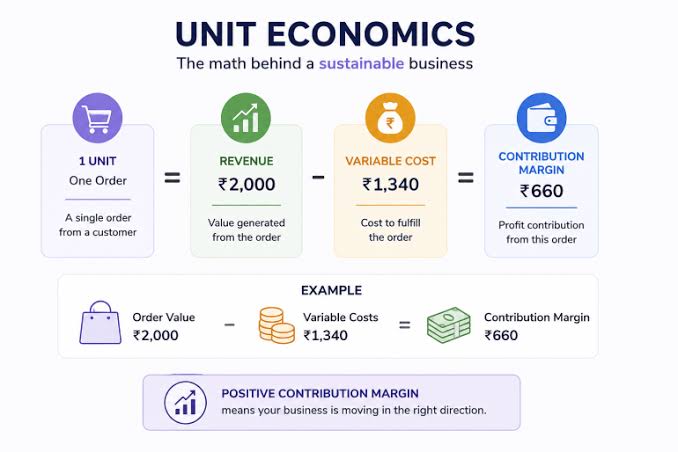
Calculate Your Contribution Margin
This is where unit economics becomes useful.
Contribution Margin = Selling Price − Variable Cost
Using our example:
₦50,000 − ₦29,000 = ₦21,000
The business therefore has a ₦21,000 contribution margin per dress.
But do not call the ₦21,000 your net profit.
That ₦21,000 still has to contribute towards expenses such as rent, salaries, electricity, marketing, administration and other operating costs.
You can also express the contribution margin as a percentage:
Contribution Margin % = Contribution Margin ÷ Selling Price × 100
₦21,000 ÷ ₦50,000 × 100 = 42%
So the business has:
Contribution margin per unit: ₦21,000
Contribution margin: 42%
This is much more useful to a reader than simply saying, “Our business will make a profit.”
-
Connect Unit Economics to Break-Even
Now take the calculation one step further.
Assume the business has monthly fixed costs of ₦700,000.
These could include:
| Fixed operating costs |
Monthly amount |
| Rent |
₦150,000 |
| Salaries |
₦300,000 |
| Utilities |
₦100,000 |
| Marketing |
₦100,000 |
| Administration |
₦50,000 |
| Total |
₦700,000 |
The business can now calculate how many dresses it needs to sell before covering these costs.
Break-even units = Fixed Costs ÷ Contribution Margin per Unit
₦700,000 ÷ ₦21,000 = 33.3 units
Therefore, the business needs to sell approximately 34 dresses per month to break even under these assumptions.
This is a powerful number to include in a business plan.
It tells the reader that the business does not need to sell thousands of dresses before becoming viable. It also gives the entrepreneur a practical monthly sales target.
The SBA identifies break-even analysis as an important part of business planning because it helps businesses determine the sales volume required to cover costs and assess profitability.
-
Show What Happens at Your Projected Sales Volume
Your unit economics should then connect directly to your sales forecast.
Suppose the business expects to sell 100 dresses per month.
Monthly calculation
Revenue:
100 × ₦50,000 = ₦5,000,000
Variable costs:
100 × ₦29,000 = ₦2,900,000
Contribution:
₦5,000,000 − ₦2,900,000 = ₦2,100,000
Fixed costs:
₦700,000
Estimated operating profit:
₦2,100,000 − ₦700,000 = ₦1,400,000
Now the business plan has a clear financial story:
At an average selling price of ₦50,000 and variable cost of ₦29,000 per unit, the business generates ₦21,000 contribution per unit. At 100 units monthly, estimated contribution is ₦2.1 million, sufficient to cover projected fixed operating expenses of ₦700,000 and produce an estimated operating profit of ₦1.4 million before other applicable costs.
That is considerably stronger than writing:
“We expect to generate ₦60 million in annual revenue.”
The second statement gives a target. The first explains how the target can generate profit.
Put the Unit Economics in a Simple Table
You do not need three pages of calculations in the main body of your business plan.
A table like this is often enough:
| Unit Economics |
Amount |
| Selling price per unit |
₦50,000 |
| Variable cost per unit |
₦29,000 |
| Contribution per unit |
₦21,000 |
| Contribution margin |
42% |
| Expected monthly sales |
100 units |
| Monthly contribution |
₦2.1 million |
| Monthly fixed costs |
₦700,000 |
| Break-even volume |
34 units |
| Estimated operating profit |
₦1.4 million |
Then briefly explain the assumptions below the table.
This makes the financial section easier for an investor, lender or grant evaluator to understand.
The SEC Nigeria also emphasises that businesses seeking capital should clearly define their funding needs and support their capital-raising case with business plans and financial projections.
What About Customer Acquisition Cost?
For some businesses, production cost is only part of the story.
If you spend heavily to acquire customers, include Customer Acquisition Cost (CAC).
The basic calculation is:
CAC = Sales and Marketing Cost ÷ Number of New Customers
Suppose an online business spends ₦300,000 on marketing in one month and acquires 60 new paying customers.
CAC = ₦300,000 ÷ 60 = ₦5,000
Now compare this with the contribution generated by an average customer.
If a customer makes one purchase and contributes only ₦3,000, spending ₦5,000 to acquire that customer is unsustainable.
But if that customer repeatedly purchases and generates ₦20,000 in contribution over time, the economics become much more attractive.
This is particularly important for e-commerce, subscription businesses, restaurants, beauty businesses and other businesses that depend heavily on repeat purchases.
Your Numbers Must Be Defensible
The biggest problem with unit economics in many business plans is not the mathematics. It is the assumptions.
Do not simply choose a 50% margin because it makes your business look attractive.
Your selling price should have evidence behind it.
Ensure your material costs are based on current supplier prices or reasonable estimates.
Likewise, your projected sales volume should be connected to market size, production capacity, historical sales or a realistic customer acquisition strategy.
And your costs should reflect the reality of operating the business.
For example, if you say your business can produce 1,000 units every month but your current equipment and staff can only produce 300, an investor will question the projection.
If growth requires additional equipment, workers, inventory or working capital, show that in the business plan.
Financial projections are most useful when their assumptions are documented and can be compared with actual performance over time.
Avoid These Unit Economics Mistakes
- Calling contribution margin profit
Contribution margin is not the same as net profit.
- Leaving out small costs
Packaging, transaction fees, delivery and wastage may look insignificant individually but become substantial at scale.
- Using unrealistic sales volumes
A high selling price means little if the business cannot realistically acquire enough customers.
- Using one margin for different products
If Product A has a 45% margin and Product B has a 15% margin, calculate them separately where necessary.
- Ignoring price changes
In Nigeria, input costs can change significantly. Your projections should therefore be tested against reasonable increases in major costs.
- Forgetting capacity
Profitability calculations are meaningless if the business cannot physically produce or deliver the projected volume.
Use Unit Economics to Test Your Business Before Seeking Funding
One of the best uses of unit economics is not actually writing the business plan. It is testing the business before asking someone else to fund it.
Ask:
- What happens if material costs rise by 10%?
- What if we have to reduce our selling price?
- What if sales are 20% below target?
- How many units must we sell to cover our monthly expenses?
- How much additional working capital is required as sales increase?
- Which product generates the strongest contribution margin?
These questions can expose weaknesses before an investor or lender does.
For example, if a 10% increase in production costs turns a healthy contribution margin into a very thin one, the business may need to renegotiate supplier prices, increase selling prices, redesign the product or improve operational efficiency.
That is the real value of unit economics: it helps you make better business decisions, not just produce impressive numbers.
How DABH Can Help
At Dayo Adetiloye Business Hub (DABH), we help entrepreneurs turn business ideas and existing operations into commercially realistic business plans.
Our services include business plans, feasibility studies, market research, financial projections, grant writing, BOI loan applications, pitch decks, funding readiness, investment readiness and business advisory.
If you are preparing for grants, loans or investment, your financial projections should be built from realistic operating assumptions—not figures created simply to make the business appear attractive.

You can also get the Ultimate Grant Readiness System™ to help organise your business and funding-readiness process:
Call/WhatsApp: 08105636015, 08076359735, 08113205312
Email: dayohub@gmail.com
Website: www.dayoadetiloye.com
Ultimate Grant Readiness System™: https://selar.com/38k7agny27?affiliate=j2uk
Conclusion
A strong business plan should not merely tell investors that your business will be profitable. It should show them why.
Unit economics provides that evidence.
When you clearly show your selling price, variable cost, contribution margin, expected sales volume and break-even point, the reader can see how individual sales translate into business-level profitability.
The key is to keep the numbers realistic.
A business selling 10,000 units with a weak margin may be less attractive than one selling 2,000 units with strong, sustainable unit economics.
Before you write a large revenue projection, start smaller:
What does one sale earn? One sale cost? What remains? And how many sales are required to cover the business’s fixed costs?
If you can answer those questions with credible numbers, your business plan has a much stronger financial foundation.
Related