How to Pitch a High-Risk Business Concept to Conservative Lenders
 How to Pitch a High-Risk Business Concept to Conservative Lenders
A high-risk business is not automatically an unfinanceable business. But if you are seeking a loan from a conservative lender, enthusiasm about your opportunity will not be enough.
Banks and development finance institutions think differently from equity investors. An investor may accept substantial risk because of the possibility of exceptional returns. A lender is primarily concerned with one question:
How will this business repay the loan, even if things do not go according to plan?
That distinction should shape your entire funding pitch.
This is particularly important in Nigeria’s current credit environment. In September 2026, the Central Bank of Nigeria (CBN) reset the Monetary Policy Rate to 23%, while the Nigerian Overnight Financing Rate was around 20% in early October.
For businesses operating in sectors such as agriculture, technology, renewable energy, manufacturing, logistics, export, construction or other volatile industries, getting financed therefore requires more than proving that an opportunity exists. You must make the risk understandable, measurable and manageable.
What Makes a Business “High Risk” to a Lender?
Lenders do not necessarily classify businesses as risky simply because they are new or innovative.
Risk usually increases when there is uncertainty around:
- predictable revenue and cash flow;
- management experience;
- collateral or recoverable assets;
- customer demand;
- regulation and licensing;
- foreign exchange exposure;
- technology or operational execution;
- dependence on one customer or supplier; or
- the borrower’s existing debt obligations.
For example, a ₦50 million agricultural processing project may have an attractive market but still appear risky if the business depends on seasonal raw materials, has no signed off-take arrangements and expects repayment to begin before production generates sufficient cash.
The entrepreneur sees market opportunity.
The lender sees repayment uncertainty.
Your pitch must bridge that gap.
 How to Pitch a High-Risk Business Concept to Conservative Lenders
1. Pitch Repayment, Not Just the Business Idea
One of the biggest mistakes entrepreneurs make is spending most of their presentation explaining how revolutionary their idea is.
A conservative lender wants to understand the repayment mechanism.
Your financial model should clearly show:
Loan amount → use of funds → additional capacity → sales → operating cash flow → debt repayment.
Suppose a food-processing company requests ₦30 million to purchase processing equipment.
Instead of saying:
“The Nigerian food market is huge and demand is increasing.”
Present the commercial logic:
The ₦30 million equipment investment will increase monthly production capacity from 10,000 to 25,000 units. At an average selling price of ₦2,500 and projected utilisation of 60% in Year One, the business expects monthly revenue of approximately ₦37.5 million.
Then show production costs, overheads, taxes, working-capital requirements and the amount remaining for debt service.
A lender needs to see that repayment comes from realistic operating cash flow rather than optimistic revenue projections.
 How to Pitch a High-Risk Business Concept to Conservative Lenders
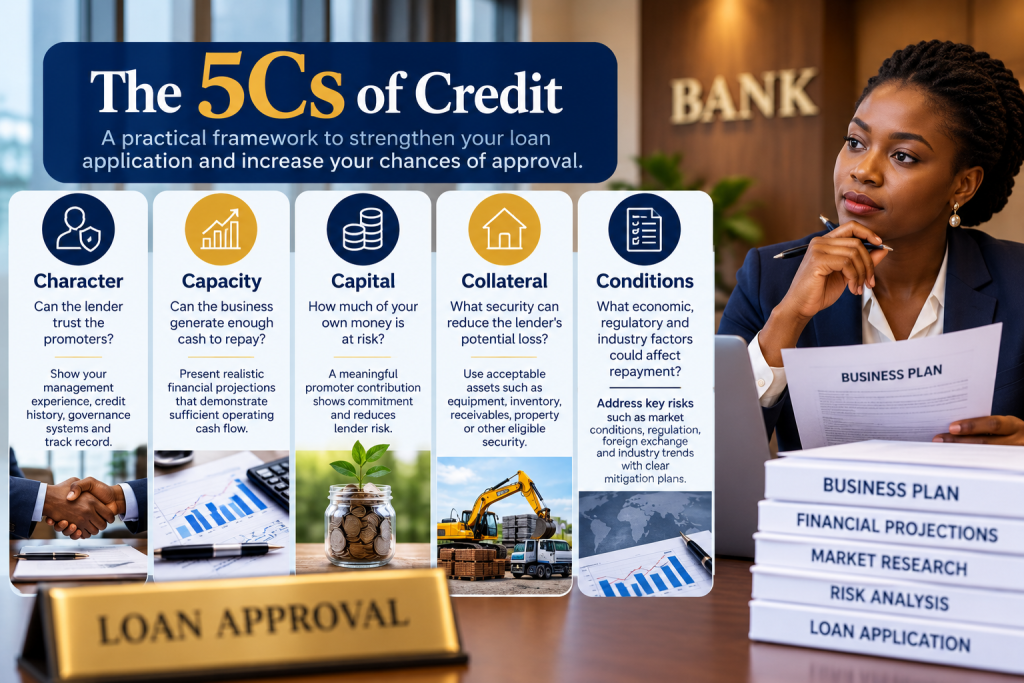
2. Build Your Pitch Around the 5Cs of Credit
A useful framework is the 5Cs of Credit: Character, Capacity, Capital, Collateral and Conditions.
This is not merely textbook terminology. The Bank of Industry (BOI), for example, states that its credit appraisal assesses creditworthiness and repayment capacity using these five factors.
Character
Can the lender trust the promoters?
Demonstrate your management experience, credit history, governance systems and track record.
Capacity
Can the business generate enough cash to repay?
Your projections should demonstrate sufficient operating cash flow under realistic assumptions.
Capital
How much of your own money is at risk?
A promoter asking a lender to finance 100% of a speculative project is usually harder to finance than one committing meaningful equity.
Collateral
What security can reduce the lender’s potential loss?
Nigeria’s National Collateral Registry allows movable assets including equipment, inventory, receivables, bank accounts, livestock and certain farm products to support secured financing.
Conditions
What economic, regulatory and industry factors could affect repayment?
Address them instead of pretending they do not exist.
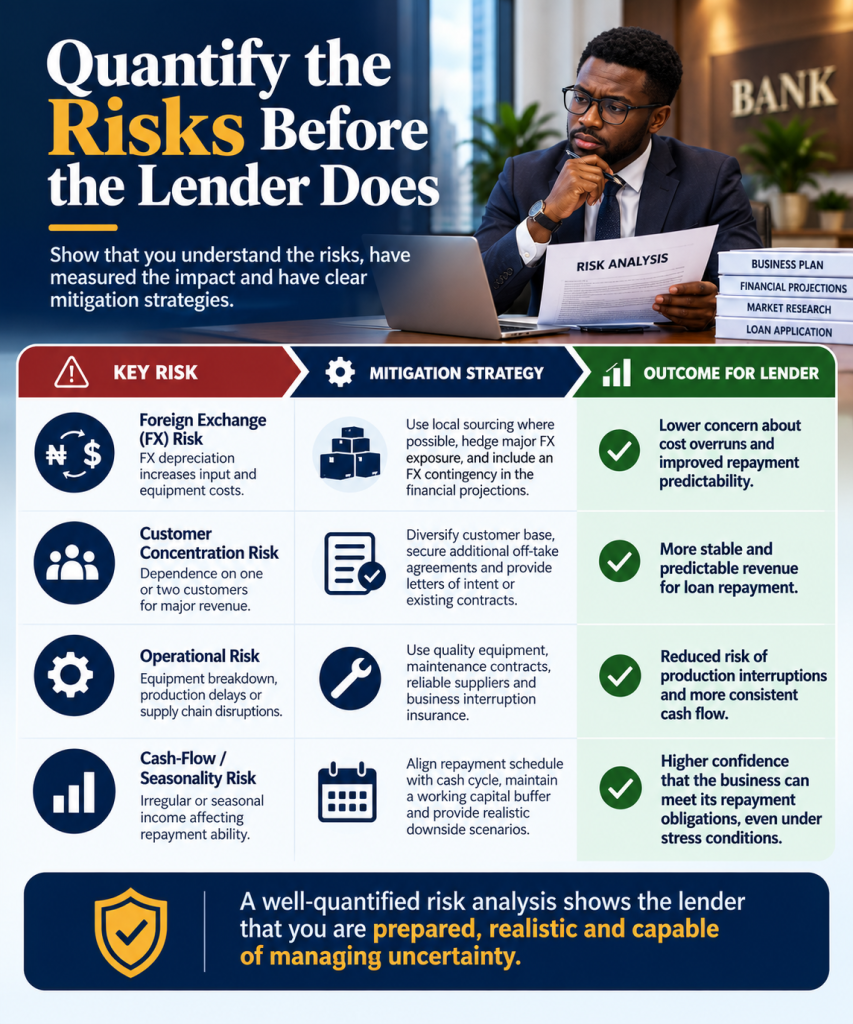
3. Quantify the Risks Before the Lender Does
Never tell a credit officer that your business has “little or no risk.”
That statement can reduce your credibility.
Create a simple risk-and-mitigation matrix.
| Risk |
Possible Impact |
Mitigation |
| Raw-material price increase |
Lower margin |
Multiple suppliers and forward purchasing |
| FX depreciation |
Higher equipment/input costs |
Local sourcing and FX contingency |
| Customer concentration |
Revenue disruption |
Diversified customer pipeline |
| Equipment failure |
Production interruption |
Insurance and maintenance contract |
| Seasonal sales |
Cash-flow pressure |
Repayment schedule aligned with cash cycle |
The purpose is not to prove that risks have disappeared. It is to demonstrate that management understands them and has credible responses.
4. Stress-Test Your Financial Projections
A serious lender should not receive only your best-case scenario.
Prepare at least three cases:
Base case: your most realistic forecast.
Downside case: sales below expectations or costs above forecast.
Severe case: multiple negative assumptions occurring together.
For example, if projected annual revenue is ₦180 million, test what happens if revenue is only ₦140 million while operating costs increase by 10%.
Can the company still service its debt?
If not, what contingency exists?
This type of analysis makes a financial projection far more credible than presenting five years of perfectly rising revenue and profit.
BOI’s current application guidance illustrates the level of financial preparation lenders can expect. Its checklist includes project cost and financing sources, production-cost analysis, and cash-flow and balance-sheet projections for qualifying applications.
5. Put Evidence Behind Your Revenue Assumptions
Projected sales are not evidence of demand.
Where possible, strengthen your application with:
- signed customer contracts;
- purchase orders;
- letters of intent;
- historical invoices;
- bank statements showing previous sales;
- distributor agreements;
- credible market research; and
- existing customer retention data.
For an early-stage manufacturing business, three credible distributors expressing documented demand may be more persuasive than claiming there are “millions of potential customers.”
Conservative lenders respond better to evidence than adjectives.
6. Structure the Loan Around the Business Cash Cycle
Sometimes the problem is not the business. It is the proposed financing structure.
A five-year productive asset should generally not be financed using a loan whose repayment structure creates severe pressure before the asset can generate sufficient cash.
Likewise, agricultural businesses should consider whether repayments match planting, harvesting and sales cycles.
Your proposal should therefore address:
Facility size + tenor + moratorium/grace period where applicable + repayment frequency + cash-conversion cycle.
The objective is not simply to obtain approval. It is to obtain financing that the business can realistically repay.
7. Strengthen Security and Risk Sharing
When business risk is high, strengthen the lender’s secondary repayment protection.
Depending on the facility, this could include equipment, inventory, receivables, guarantees, insurance, property or other acceptable security.
Nigeria’s National Collateral Registry exists specifically to facilitate secured lending using movable property. It allows security interests over assets such as machinery, inventory, receivables and agricultural assets to be registered.
Risk-sharing mechanisms can also make financing more attractive. For example, BOI’s 2026 partnership with the National Credit Guarantee Company provides 25% credit-guarantee cover on eligible loans under its women-focused GLOW programme, reducing lender exposure.
Entrepreneurs should therefore investigate applicable guarantee and intervention programmes instead of assuming conventional commercial lending is their only option.
8. Clean Up Your Credit and Documentation Before Applying
A beautiful pitch deck cannot compensate for poor financial records.
The CBN’s Credit Risk Management System provides participating financial institutions with borrower credit information to support lending decisions.
For individual borrowing, the CBN’s Global Standing Instruction framework also supports recovery of qualifying overdue obligations from funded accounts across participating financial institutions.
Before approaching a lender, therefore, review your:
CAC documentation, tax compliance, bank statements, existing liabilities, management accounts, audited accounts where applicable, licences, contracts, insurance and credit history.
BOI currently states that audited financial statements are not mandatory for micro facilities below ₦10 million, while facilities above ₦10 million require recent audited accounts.
Your records must tell the same story as your proposal.
9. Do Not Ask for More Debt Than the Business Can Carry
An entrepreneur may need ₦100 million to execute an expansion but that does not automatically mean the entire amount should be borrowed.
Consider combining:
Promoter equity + retained earnings + customer advances + supplier credit + grants + guarantees + appropriate debt.
If projected cash flow can comfortably support only ₦50 million of debt, forcing ₦100 million into the capital structure can turn a promising business into a distressed one.
This is where professional financial modelling becomes essential.
Common Mistakes When Pitching Conservative Lenders
The applications we see entrepreneurs struggle with often share similar weaknesses: unrealistic projections, insufficient promoter contribution, unexplained existing debts, weak documentation, excessive dependence on collateral, no downside scenario and requesting a loan before demonstrating the underlying commercial model.
Another mistake is using an investor-style pitch for a bank.
Investors ask, “How big could this become?”
Lenders ask, “How reliably will my money come back?”
Your proposal must answer the second question first.
Become Funding-Ready Before You Apply
Businesses pursuing loans, grants and other funding opportunities should build a proper funding-readiness system rather than preparing documents only when an opportunity appears.
 How to Pitch a High-Risk Business Concept to Conservative Lenders
The Ultimate Grant Readiness System™ provides practical tools and resources designed to help entrepreneurs improve their funding preparation and application readiness.
Access The Ultimate Grant Readiness System™
For debt funding specifically, combine grant readiness with lender-ready financial projections, credit documentation and a properly structured financing request.
Need Professional Help Preparing Your Loan Proposal?
At Dayo Adetiloye Business Hub, we help Nigerian entrepreneurs and organisations turn business opportunities into credible, financeable proposals. Our services include business plans, feasibility studies, financial projections, market research, BOI loan applications, pitch decks, grant writing, funding readiness, investment readiness and business advisory.
For a high-risk project, our job is not to hide the risks. It is to demonstrate commercially how those risks can be measured, mitigated and financed.
Call/WhatsApp: 08105636015, 08076359735, 08113205312
Email: dayohub@gmail.com
Website: www.dayoadetiloye.com
Conclusion
Getting a conservative lender to finance a high-risk business concept is not primarily about becoming better at persuasion.
It is about reducing uncertainty.
Demonstrate genuine market demand. Show exactly where repayment will come from. Commit your own capital. Stress-test the numbers. Identify risks openly. Provide appropriate security. Clean up your documentation. Then structure the facility around the actual cash-generation cycle of the business.
The strongest loan proposal does not tell a lender, “Trust us; this will succeed.”
It demonstrates:
“We understand what could go wrong, we have designed controls around those risks, and even under reasonable downside conditions, this business has a credible path to repay your money.”
That is the language conservative lenders understand.
Related