SWOT Analysis Done Right: How to Position Your Business Against Competitors
 SWOT Analysis Done Right: How to Position Your Business Against Competitors
Many business owners have completed a SWOT analysis at some point. They draw four boxes, list a few strengths, weaknesses, opportunities and threats, and then move on.
That is precisely why many SWOT analyses produce little commercial value.
A properly conducted SWOT analysis should help a business owner answer much harder questions: Why should customers choose us instead of competitors? Where are competitors stronger than us? Which opportunities are actually worth pursuing? What could destroy our margins? And where can we build an advantage that competitors will find difficult to copy?
For Nigerian businesses operating in an environment characterised by changing customer behaviour, currency pressures, rising operating costs, digital disruption and aggressive competition, these questions are not academic.
They affect revenue, profitability, funding readiness and survival.
This guide explains how business owners can conduct a SWOT analysis properly and convert the findings into a practical competitive positioning strategy.
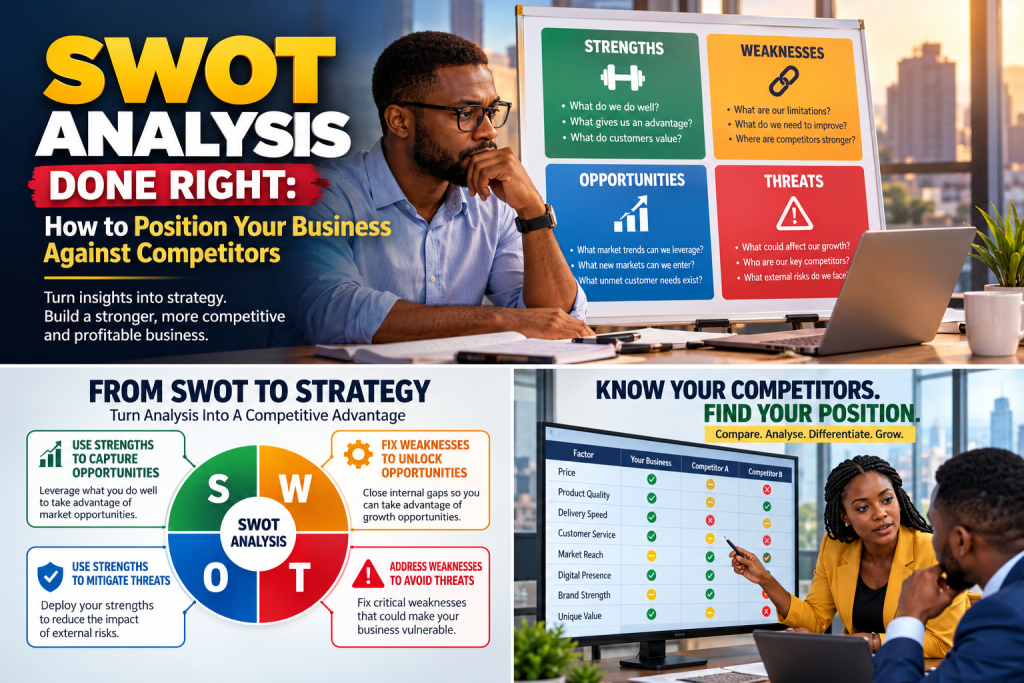
What Is a SWOT Analysis?
SWOT stands for:
Strengths – internal capabilities that give your business an advantage.
Weaknesses – internal limitations that reduce your ability to compete.
Opportunities – external developments your business can exploit commercially.
Threats – external developments that could negatively affect revenue, profitability or growth.
The most important distinction is between internal and external factors.
Strengths and weaknesses generally exist inside the business and can often be influenced by management. Opportunities and threats exist primarily outside the business and must therefore be anticipated, exploited or managed.
For example, a Nigerian food-processing company may have an established distribution network as a strength, inadequate working capital as a weakness, increasing supermarket demand for locally packaged foods as an opportunity, and rising raw-material costs as a threat.
But identifying these four factors is only the beginning.
The real value comes from deciding what the business should do because of them.
Why SWOT Analysis Matters for Competitive Positioning
Competition is broader than simply asking, “Who sells the same product as me?”
Michael Porter’s competitive strategy framework demonstrates that profitability can also be affected by customers, suppliers, potential new entrants and substitute products—not merely existing rivals.
This is particularly important for Nigerian SMEs.
A restaurant is not competing only against restaurants. It may compete against home cooking, food delivery vendors, supermarket ready-meals and office caterers.
A training company does not compete only against another physical training centre. It competes with YouTube, Udemy-style courses, free webinars, AI learning tools and employers’ internal training programmes.
A poultry farmer may compete with other poultry producers, but profitability may simultaneously be threatened by feed prices, customer purchasing power, imported alternatives, logistics costs and distributor bargaining power.
Your SWOT analysis should therefore examine the entire competitive environment, not simply businesses that look like yours.
 SWOT Analysis Done Right: How to Position Your Business Against Competitors
How to Conduct a SWOT Analysis Properly
1. Start With Evidence, Not Assumptions
One of the biggest mistakes business owners make is conducting SWOT analysis entirely from memory.
Statements such as:
“Our customer service is excellent.”
or
“Our brand is strong.”
are not particularly useful without evidence.
Ask instead:
- What percentage of customers return?
- Why do customers choose us?
- What complaints occur repeatedly?
- What is our average gross margin?
- How quickly do we deliver compared with competitors?
- Which products generate most of our profit?
- What percentage of enquiries become paying customers?
- How dependent are we on one supplier or customer?
- How do our prices compare with major competitors?
This turns SWOT analysis from an opinion exercise into a commercial diagnostic tool.
2. Identify Strengths Competitors Actually Care About
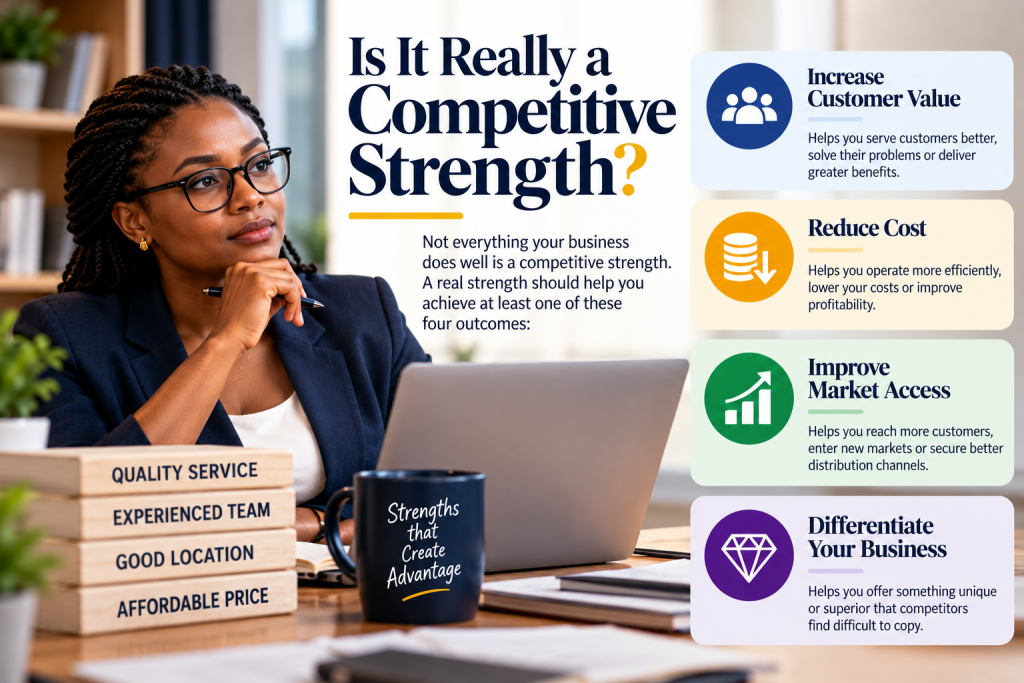
Not everything your business does well is a competitive strength.
A genuine strength should ideally help you achieve at least one of four outcomes:
increase customer value, reduce cost, improve market access or create differentiation.
For example, genuine strengths might include:
- exclusive distribution relationships;
- significantly lower production costs;
- proprietary technology or processes;
- experienced management;
- strong customer retention;
- strategic location;
- regulatory licences that create barriers to entry;
- reliable supplier relationships;
- recognised intellectual property;
- strong cash flow;
- specialised expertise;
- an established database or distribution network.
Suppose two Lagos logistics companies offer similar delivery services.
One Company (A) says:
“We have experienced staff.”
Another Company (B) can demonstrate:
“Our route optimisation system allows 92% of Lagos deliveries to be completed within 24 hours, compared with the 48-hour standard offered by several competitors.”
Company B has identified something that can potentially become a market position.
Strategy requires more than simply being operationally efficient. Competitive strategy involves deliberately choosing activities that create a distinctive mix of value for customers.
3. Be Uncomfortable About Your Weaknesses
A useful SWOT analysis should expose problems management may prefer not to discuss.
Typical weaknesses among growing SMEs include:
poor bookkeeping, dependence on the founder, inadequate working capital, weak corporate governance, inconsistent product quality, poor customer retention, inadequate digital presence, limited distribution, concentration of revenue among a few customers, obsolete equipment and absence of reliable management information.
Consider a business generating ₦120 million annual revenue.
At first glance, that sounds impressive.
But suppose ₦72 million—60% of total revenue—comes from only two customers.
That is a significant strategic weakness.
If one customer responsible for ₦40 million leaves, annual revenue could immediately decline by one-third.
The appropriate response may therefore not be “increase sales.”
It could be:
Reduce customer concentration so that no single customer contributes more than 15% of annual revenue within 18 months.
That is what happens when SWOT analysis becomes strategy.
4. Separate Real Opportunities From Attractive Distractions
Entrepreneurs frequently label almost every positive market development as an opportunity.
It is not.
An opportunity is valuable only when your business has—or can realistically build—the capability to exploit it profitably.
Suppose a furniture manufacturer discovers increasing demand for hotel furniture.
Before putting “hospitality sector expansion” under Opportunities, management should investigate:
Market attractiveness: How much realistic demand exists?
Customer access: Can we reach hotel owners, developers and procurement managers?
Capability: Can we manufacture at the required quality and volume?
Capital: Can we finance production before customers pay?
Margins: Will the contracts actually be profitable?
Competition: Who already supplies this segment?
Entry requirements: Are certifications, tender documentation or previous experience required?
A market can be attractive without being attractive for your company.
This distinction prevents businesses from wasting scarce capital chasing every apparent opportunity.
5. Analyse Threats Financially
Threats should not be written as vague phrases such as:
“competition”, “inflation” or “government policy.”
Ask instead:
What happens financially if this threat materialises?
Imagine a bakery currently operates with the following economics:
Selling price per loaf: ₦1,500
Variable production cost: ₦1,050
Gross contribution: ₦450
Contribution margin: 30%
If input and packaging costs increase by 15%, variable cost rises approximately from ₦1,050 to ₦1,208.
If the bakery cannot increase its selling price, contribution falls from approximately ₦450 to ₦292 per loaf.
That represents a decline of about 35% in contribution per loaf.
Now “rising input cost” is no longer a generic threat.
Management can respond strategically through supplier negotiations, product resizing, waste reduction, bulk procurement, selective price increases or higher-margin product development.
SWOT Analysis Example: A Nigerian Digital Skills Training Company
Consider a fictional training company operating in Ogun State and targeting students, job seekers, SME owners and young professionals.
Strengths
It has experienced facilitators, an accessible physical location, practical training rather than theory, existing SME relationships and relatively affordable fees.
Weaknesses
Its brand awareness outside its immediate community is low. Marketing depends heavily on Facebook and WhatsApp. Training capacity is constrained by the number of computers available, and revenue is concentrated in physical classes.
Opportunities
There is demand for employability-oriented digital skills, corporate staff training, SME digitalisation support and hybrid learning. Partnerships with schools, employers and community organisations could also create new customer-acquisition channels.
Threats
Free online courses create substitutes. Competitors can undercut pricing. Internet and electricity costs affect delivery. Technology changes quickly, making some course content obsolete.
A weak SWOT exercise ends here.
A strategic SWOT asks:
What competitive position should this company build?
Instead of competing as another “computer school”, the business might position itself as:
A practical digital workplace-skills centre helping students, job seekers and SME employees become work-ready through instructor-led training, real business assignments and measurable competency assessments.
Notice the difference.
The SWOT has produced a positioning decision.
Turn Your SWOT Into Four Types of Strategic Action
One useful approach is to convert the SWOT matrix into four combinations.
Strength–Opportunity Strategies
Ask:
Which strengths can we use to capture the best opportunities?
If you already have strong corporate relationships and companies increasingly need staff data-analysis training, develop a structured corporate training package rather than starting an unrelated new business.
Weakness–Opportunity Strategies
Ask:
Which weaknesses must we fix before we can capture important opportunities?
A manufacturer may see export opportunities but lack appropriate packaging, certification and production capacity.
The opportunity exists, but the company must first close its readiness gaps.
Strength–Threat Strategies
Ask:
Which strengths can protect us from major threats?
A business facing aggressive price competition might use superior service, stronger distribution or faster fulfilment rather than joining a destructive price war.
Weakness–Threat Strategies
This is usually the most defensive area.
Ask:
Which combination of weakness and threat could seriously damage the business?
For example:
Weakness: dependence on one foreign supplier.
Threat: exchange-rate volatility and supply disruption.
Management may need to qualify alternative local suppliers, increase inventory buffers or redesign products around locally available inputs.
This is risk management derived directly from SWOT.
 SWOT Analysis Done Right: How to Position Your Business Against Competitors
Compare Yourself With Competitors, Not With Yourself
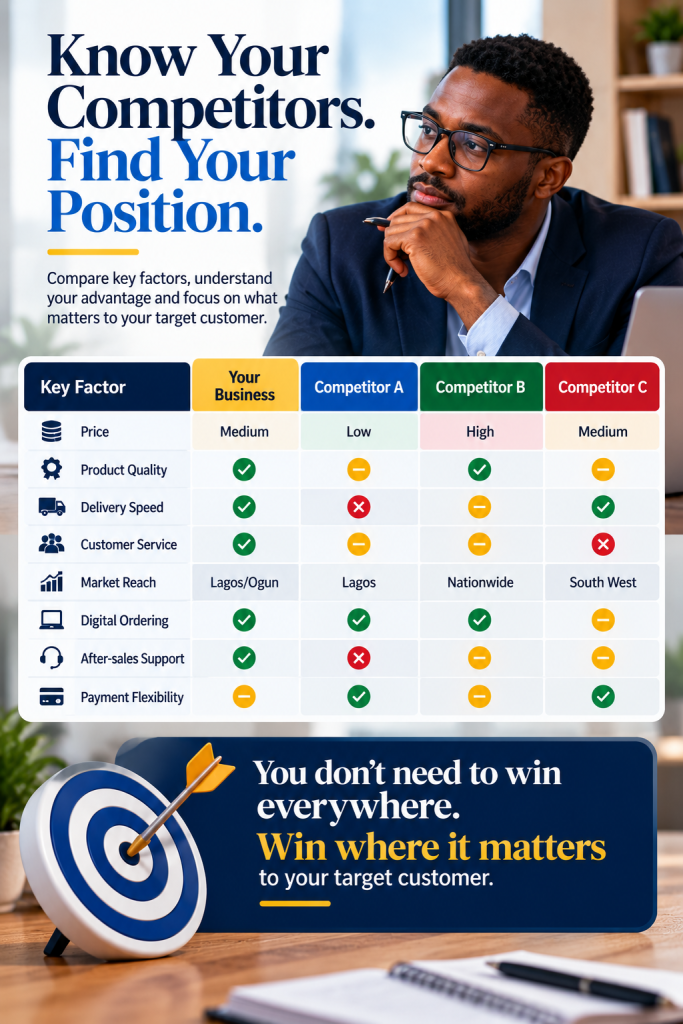
SWOT becomes far more powerful when combined with a competitor benchmarking table.
Select three to five serious competitors and compare factors such as:
| Factor |
Your Business |
Competitor A |
Competitor B |
| Price |
Medium |
Low |
High |
| Product quality |
High |
Medium |
High |
| Delivery speed |
24 hours |
48 hours |
Same day |
| Geographic reach |
Lagos/Ogun |
Lagos |
Nationwide |
| Digital ordering |
Yes |
Yes |
Yes |
| After-sales service |
Strong |
Limited |
Moderate |
| Payment flexibility |
Limited |
Strong |
Moderate |
Do not try to win every column.
Competitive advantage does not mean being the best at everything.
A sustainable strategic position normally involves choices and trade-offs. Trying to serve every customer, at every price point, with every possible feature can weaken rather than strengthen positioning.
The important question is:
Which combination of advantages matters most to our chosen customer segment?
Common SWOT Analysis Mistakes Business Owners Should Avoid
Several errors repeatedly reduce the usefulness of SWOT analysis.
Confusing strengths with opportunities. Your experienced employees are a strength; increasing market demand is an opportunity.
Listing generic statements. “Good quality”, “competition” and “economic situation” provide little decision-making value.
Ignoring competitors. SWOT conducted without competitor research can become an exercise in self-congratulation.
Ignoring financial implications. A threat affecting 40% of your revenue deserves more attention than one affecting 2%.
Having too many factors. A SWOT containing 25 items under each heading creates noise. Prioritise the factors capable of materially affecting competitive advantage, revenue, margins or survival.
Failing to assign actions. Every major SWOT finding should eventually lead to an action, responsible person, deadline and measurable outcome.
How Often Should a Business Update Its SWOT Analysis?
For most SMEs, a comprehensive SWOT review should form part of the annual strategic planning process.
However, businesses in fast-changing industries should review important assumptions quarterly.
A new competitor, regulatory change, major customer loss, technology disruption, currency movement or significant funding opportunity may justify an immediate review.
Nigeria’s SME competitive environment is increasingly influenced by technology and digitalisation. SMEDAN’s 2025 National MSME Conference, for example, specifically included discussions around competing in the digital era, AI and technology adoption by MSMEs.
The implication is straightforward: a SWOT analysis completed two years ago should not be treated as a permanent description of your business.
SWOT Analysis for Business Plans, Investors, Loans and Grants
SWOT analysis is particularly valuable when preparing a business plan, feasibility study, investor pitch, loan application or grant proposal.
Funders do not expect businesses to have no weaknesses or threats.
They expect management to understand them and demonstrate credible mitigation strategies.
For example, writing:
“A major threat is foreign exchange volatility.”
is weaker than explaining:
“Approximately 35% of production inputs are currently imported. Management plans to reduce imported-input exposure to below 20% within 24 months by qualifying two Nigerian suppliers and redesigning selected components.”
The second statement demonstrates management competence.
Funding opportunities can also require businesses to present evidence of their business model and investment case. For example, SMEDAN’s 2026 Zero to 100 Pitch Competition requires applicants to submit a pitch deck, alongside other application requirements, with a ₦50 million grant pool available across three winning businesses.
That illustrates why competitive analysis should not be treated merely as a classroom exercise. It can strengthen the strategic argument behind a pitch deck, business plan or funding application.
Becoming Funding-Ready
If your SWOT analysis reveals weaknesses in areas such as documentation, financial projections, business planning, competitive analysis or funding strategy, these should ideally be addressed before an important grant, loan or investor opportunity appears.
The Ultimate Grant Readiness System™ was developed as a practical toolkit to help entrepreneurs and organisations improve their funding readiness, organise important business information and approach grant opportunities more systematically.
Access The Ultimate Grant Readiness System™
From SWOT Analysis to Competitive Strategy
Your completed SWOT should ultimately answer five questions:
- Where can we realistically win?
- Which customers should we prioritise?
- Why should those customers choose us?
- Which weaknesses must we fix to compete effectively?
- Which opportunities deserve our capital, management attention and time?
This is where SWOT becomes useful.
Do not finish your strategy meeting with four colourful boxes.
Finish it with decisions.
For example:
“Over the next 12 months, we will focus on mid-sized corporate customers rather than individual consumers because our technical expertise and service capacity give us a stronger advantage in this segment.”
Or:
“We will not compete on lowest price. We will compete on 24-hour fulfilment, product reliability and after-sales support.”
Or:
“We will postpone geographic expansion until our working-capital cycle and distribution capacity improve.”
These are strategic choices.
Need Professional Business and Competitive Analysis?
Many businesses struggle with SWOT analysis because management is too close to the organisation to evaluate it objectively.
Dayo Adetiloye Business Hub supports entrepreneurs, SMEs and organisations with professional business development services including:
business plans, feasibility studies, market research, financial projections, competitor and industry analysis, grant writing, BOI loan applications, pitch decks, funding readiness, investment readiness and strategic business advisory.
A strong business plan should not simply describe your company. It should demonstrate that you understand your market, competitors, financial model, risks and strategy for building a commercially sustainable position.
For professional support:
Call/WhatsApp: 08105636015, 08076359735, 08113205312
Email: dayohub@gmail.com
Website: Dayo Adetiloye Business Hub
Conclusion
SWOT analysis is simple to understand but surprisingly easy to misuse.
Its purpose is not to produce four lists for inclusion in a business plan. Its purpose is to help management understand where the business has an advantage, where it is vulnerable, which market developments it can profitably exploit and which external forces could undermine performance.
The best SWOT analysis combines internal business data, customer feedback, competitor research, market intelligence and financial analysis.
Most importantly, it leads to choices.
A business cannot be everything to everybody. Sustainable competitive positioning requires deciding which customers to serve, what value to offer them, which capabilities to strengthen, which risks to manage and—in some cases—which opportunities to deliberately reject.
When your SWOT analysis begins influencing your pricing, target market, product development, investment decisions, marketing strategy and resource allocation, you are no longer simply completing a management exercise.
You are using SWOT the way it was meant to be used: to make better strategic decisions and build a stronger competitive position.
Related