How to Protect Your Intellectual Property and Trade Secrets in a Business Proposal
 How to Protect Your Intellectual Property and Trade Secrets in a Business Proposal
SEO Slug: how-to-protect-intellectual-property-trade-secrets-business-proposal
A strong business proposal often has to reveal enough information to convince a potential client, investor, government agency, partner or prime contractor that your company can deliver. That creates a commercial dilemma: how do you prove your capability without giving away the very intellectual property, methodology, pricing intelligence or trade secrets that give your business an advantage?
For Nigerian contractors, consulting firms, technology companies, manufacturers, professional service providers and SMEs, this is not merely a legal question. It is a business risk-management issue.
A proposal may contain your proprietary methodology, supplier relationships, technical drawings, software architecture, pricing model, customer acquisition strategy, operating processes, financial assumptions or an innovative solution to a client’s problem. If such information is unnecessarily disclosed, a prospective customer could potentially use your ideas internally, pass them to another contractor or incorporate elements into a subsequent tender.
The objective should therefore not be to hide everything. The objective is controlled disclosure: reveal enough to win the opportunity while retaining control over commercially sensitive knowledge.
Nigeria’s intellectual-property environment is also evolving. In November 2025, the Federal Executive Council approved Nigeria’s first unified National Intellectual Property Policy and Strategy, designed to strengthen the protection, administration and commercialisation of intellectual-property assets.
Here is how businesses can protect themselves.
What Intellectual Property Can Be Exposed in a Business Proposal?
Intellectual property is broader than a company name or logo.
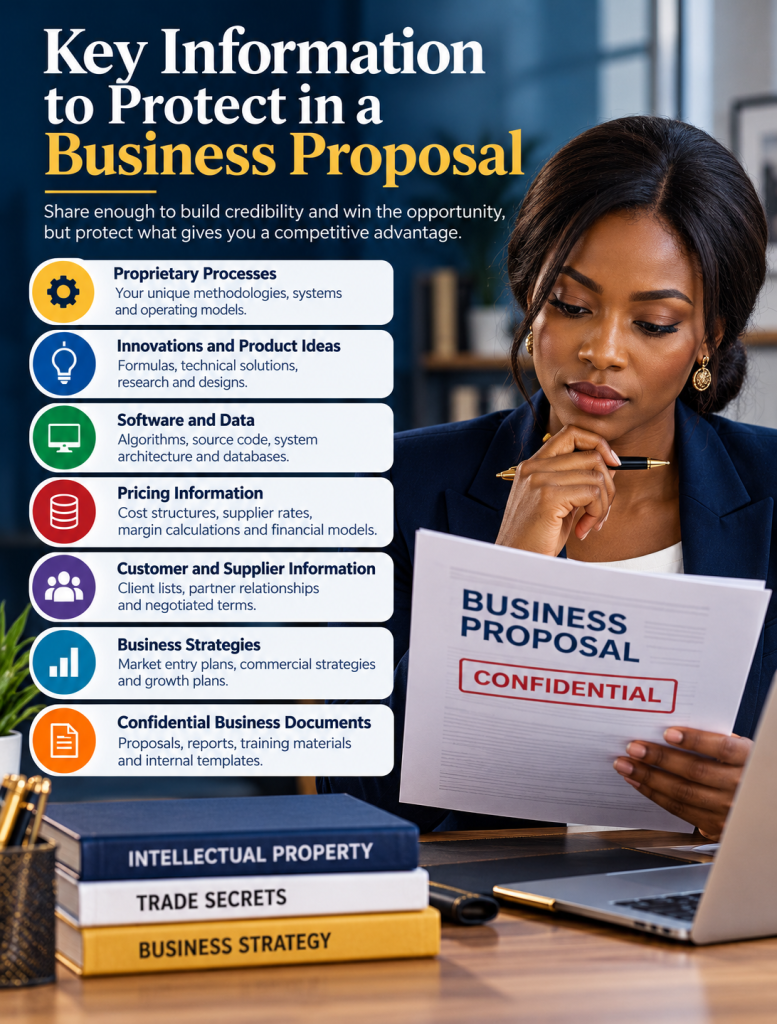
Depending on the nature of your company and proposal, valuable IP may include:
- proprietary processes and operating methodologies;
- technical specifications, engineering drawings and product designs;
- software, algorithms and system architecture;
- formulas, recipes and manufacturing processes;
- training materials and proprietary frameworks;
- databases and research;
- pricing methodologies and cost structures;
- customer and supplier information;
- market-entry strategies;
- financial models;
- business methods and implementation systems; and
- inventions and product innovations.
Not all these assets should be protected in the same way.
For example, trademarks are primarily relevant to distinctive brand identifiers, while patents may protect qualifying inventions and industrial-design protection can apply to certain aesthetic features of products. Copyright can protect qualifying original works, while commercially valuable confidential information may be managed as a trade secret.
Nigeria’s current copyright framework is governed by the Copyright Act 2022, administered by the Nigerian Copyright Commission.
The commercial lesson is simple: do not assume that putting © or “Confidential” on every page gives you complete protection.
You first need to understand what you own and determine the appropriate protection strategy.
 How to Protect Your Intellectual Property and Trade Secrets in a Business Proposal
What Exactly Is a Trade Secret?
A trade secret is not simply information that a business owner would prefer other people not to know.
The World Intellectual Property Organization (WIPO) explains that information generally qualifies as a trade secret where it is commercially valuable because it is secret, is known only to a limited group and has been subjected to reasonable steps by its holder to keep it secret.
For a Nigerian company, examples could include:
A construction contractor: its subcontractor pricing database and proprietary project-costing model.
A food processor: a formulation, processing technique or sourcing arrangement.
A logistics company: its route-optimisation process, customer database and negotiated supplier rates.
A consulting company: its diagnostic framework, assessment methodology and proprietary implementation templates.
A technology company: source code, algorithms, system architecture or proprietary technical processes.
The important phrase is “reasonable steps.”
If your company freely circulates supposedly confidential information through unrestricted email attachments, allows every employee access to it and sends complete proprietary processes to potential customers without confidentiality controls, it becomes harder to argue that the information was being seriously treated as secret.
WIPO recommends measures such as confidentiality agreements, marking confidential documents, restricting physical and electronic access, monitoring access and periodically reviewing who genuinely needs access.
1. Conduct an IP Audit Before Writing the Proposal
One of the most effective protections happens before the proposal is written.
Separate the information available to your proposal team into three categories:
Public information: company profile, completed projects, published case studies, general capabilities and information already on your website.
Confidential information: detailed financial information, customer data, supplier arrangements, internal pricing and operational information.
Highly restricted/proprietary information: formulas, source code, proprietary algorithms, detailed production processes, unpublished inventions and commercially critical methodologies.
Your proposal writer should know which category each piece of information falls into.
This prevents the common mistake of treating proposal preparation as simply “put everything we know into the document.”
2. Disclose the Outcome, Not Necessarily the Entire Secret
Suppose your company has developed a proprietary system that reduces project turnaround time by 25%.
The buyer may need evidence that the system works. The buyer does not necessarily need every step required to reproduce it.
Instead of submitting the entire methodology, the proposal could explain:
“Our proprietary six-stage project-delivery methodology integrates resource planning, quality-control checkpoints and real-time performance monitoring to reduce implementation delays.”
You can then provide evidence from previous projects.
This demonstrates competence without effectively handing over your operating manual.
This principle is especially important for consultancy proposals, technology bids, manufacturing partnerships and technical tenders.
3. Use NDAs Before Disclosing Highly Sensitive Information
A Non-Disclosure Agreement (NDA) can establish contractual restrictions around the disclosure and use of confidential information.
WIPO describes NDAs as legally binding agreements under which parties agree not to disclose confidential information or use it for purposes outside those specified in the agreement.
A properly drafted NDA should normally address matters such as:
- what constitutes confidential information;
- why the information is being disclosed;
- who may access it;
- permitted and prohibited uses;
- permitted disclosures;
- exclusions from confidentiality;
- duration of the obligation;
- treatment of documents after negotiations end; and
- applicable remedies and dispute provisions.
WIPO particularly recommends establishing confidentiality arrangements before confidential information is exchanged rather than attempting to impose restrictions after disclosure.
However, there is a commercial reality.
A multinational, government ministry, major corporation or procurement organisation may refuse to sign your NDA simply to receive a tender submission.
In that situation, the solution is not necessarily to abandon the opportunity. Instead, use staged disclosure.
Provide enough information to satisfy the tender requirement and reserve sensitive technical information for due diligence, negotiation or contract mobilisation where appropriate.
4. Put a Clear Confidentiality and IP Notice in the Proposal
A proposal containing proprietary information should have an appropriately drafted confidentiality statement.
For example:
CONFIDENTIAL AND PROPRIETARY
This proposal contains confidential and proprietary information belonging to [Company Name]. It is supplied solely for evaluating the proposed transaction/project and should not be reproduced, distributed, disclosed or used for another purpose without prior written authorisation, subject to applicable law and procurement requirements.
The wording should be adapted to the transaction.
Do not rely on the statement alone, however. It is one layer of a broader protection strategy rather than a substitute for contractual, technical and operational safeguards.
5. Mark Sensitive Sections, Not Just the Cover Page
Another practical mistake is putting “CONFIDENTIAL” on the cover and nowhere else.
If Annexure 4 contains proprietary technical drawings, identify it appropriately.
Also, If Appendix B contains your proprietary implementation framework, mark it.
Likewise, If a spreadsheet contains commercially sensitive pricing calculations, control and label that file separately.
WIPO specifically identifies marking confidential information as one of the measures companies can use when protecting trade secrets.
This also makes internal information management easier.
6. Control Your Pricing Intelligence
For contractors, pricing is particularly sensitive.
Consider a hypothetical engineering contractor bidding ₦180 million for a project.
The buyer needs to know what the project will cost and may require a detailed bill or pricing schedule. But unless required by the procurement process, the buyer may not need unrestricted visibility into:
- confidential supplier discounts;
- internal salary structures;
- proprietary productivity assumptions;
- negotiated subcontractor margins;
- your target profit calculation; or
- confidential commercial arrangements with suppliers.
Suppose:
Direct project cost: ₦130 million
Overheads and contingencies: ₦20 million
Target margin: ₦30 million
Proposal value: ₦180 million
If the tender requires the total commercial offer plus prescribed cost categories, provide exactly what is required.
Do not automatically submit every internal costing worksheet used to arrive at ₦180 million.
Your client-facing quotation and your internal financial model should not automatically be the same document.
7. Understand the Special Case of Government Tenders
Government procurement requires additional care because disclosure rules, audit requirements and statutory procedures can affect confidentiality.
Nigeria’s Public Procurement Act contains confidentiality provisions in certain procurement processes. For example, in relation to selection procedures involving consultants, the Act provides that the procuring entity should treat proposals and negotiations as confidential and avoid disclosing their contents to competing consultants.
That is useful protection, but contractors should still not interpret it as permission to disclose unlimited commercially sensitive information.
Follow the tender instructions precisely.
Where the procurement authority requires specific technical details, provide them. Where it does not, consider whether revealing additional proprietary information actually strengthens your bid.
More information does not automatically mean a stronger proposal. Relevant evidence does.
8. Protect IP Before the Proposal Is Submitted
Proposal confidentiality should sit within a wider IP strategy.
If your proposal relies heavily on your brand, technology, product design, original content or invention, consider whether appropriate IP registration or other protection should be completed before broad commercial disclosure.
This is particularly important for inventions.
An entrepreneur seeking a major distribution partner, for example, may be tempted to explain every technical detail of an innovative product during the first meeting.
That can be commercially dangerous.
Businesses should obtain specialist IP/legal advice before publicly disclosing potentially patentable inventions because disclosure can have consequences for patent strategy.
Nigeria’s IP framework recognises different mechanisms for patents, trademarks, industrial designs, copyright and confidential commercial information; businesses therefore need to match the asset with the correct protection mechanism rather than relying on a single approach.
 How to Protect Your Intellectual Property and Trade Secrets in a Business Proposal
9. Control the Digital Copy of Your Proposal
Most proposals are now exchanged electronically.
Your information-security practices therefore matter almost as much as the wording inside the document.
At minimum, businesses should consider:
PDF rather than editable Word documents for final external submissions unless the recipient requires another format.
Restricted cloud folders rather than open-access links for particularly sensitive documents.
Access permissions so only authorised people can view confidential information.
Version control to identify which proposal was sent to whom.
Password protection or secure data rooms for highly sensitive due-diligence documents where appropriate.
Document identification or watermarking for copies circulated to specific recipients.
WIPO recommends technological restrictions, access controls and secure databases that can track access to shared information as components of trade-secret management.
10. Protect Yourself From Your Own Proposal Team
External recipients are not the only risk.
Employees, freelance writers, consultants, designers, accountants and technical specialists may all participate in preparing a major proposal.
They may consequently see confidential pricing, client information, supplier agreements, financial forecasts and proprietary processes.
Your internal protection framework should therefore include appropriate:
- employment confidentiality provisions;
- contractor confidentiality agreements;
- information-access controls;
- ownership-of-work provisions;
- document-handling policies; and
- exit procedures.
WIPO recommends confidentiality arrangements not only with potential business partners but also with employees and other parties who have access to commercially sensitive information.
11. Be Careful With Personal Data Inside Proposals
Some proposals contain CVs, telephone numbers, identification information, customer information, employee records or other personal data.
Nigeria’s Data Protection Act 2023 provides the country’s statutory framework for processing personal data.
This means proposal management is not solely an IP issue.
Companies should avoid inserting unnecessary personal information simply because it is available. When tender requirements demand employee or expert information, businesses should have an appropriate process for collecting, processing, storing and sharing it.
12. Define IP Ownership in the Final Contract
Winning the proposal does not end the IP discussion.
In many consulting, technology, design, engineering and research contracts, a crucial negotiation is:
Who owns what after the project is completed?
Distinguish between:
Background IP: intellectual property your company owned before the engagement.
Project IP: intellectual property specifically developed during the project.
Client materials: information and IP supplied by the client.
Third-party IP: technology, data, software or materials licensed from someone else.
Imagine your consulting company developed a proprietary diagnostic framework five years before winning a corporate assignment.
You subsequently use that framework to analyse the client’s business.
The client may reasonably own the report and agreed deliverables created specifically for it. That does not automatically mean it should own your entire pre-existing methodology.
That distinction should be addressed contractually.
WIPO notes that licensing IP and assigning it are fundamentally different: licensing permits use under agreed conditions, whereas assignment transfers ownership.
That distinction can have enormous financial consequences.
Common Mistakes Businesses Make
Several proposal-related IP mistakes appear repeatedly in the SME and contracting environment.
The first is oversharing. Businesses disclose entire operating processes simply because they want to impress the client.
The second is depending entirely on a confidentiality notice without having access controls or contractual protections.
The third is using generic NDAs downloaded from the internet without adapting them to the transaction or obtaining appropriate legal advice.
The fourth is failing to protect IP before approaching multiple prospective partners.
The fifth is sending editable source files unnecessarily.
The sixth is failing to distinguish between client deliverables and pre-existing intellectual property in the final contract.
And perhaps the most expensive mistake is waiting until someone copies the idea before thinking about IP protection.
At that stage, the commercial damage may already have occurred.
A Practical Proposal Protection Framework
Before sending an important proposal, ask seven questions:
- What commercially valuable information does this proposal contain?
- Does the recipient genuinely need all of it?
- Which information should be withheld until due diligence or negotiation?
- What IP rights or registrations are relevant?
- Should an NDA or confidentiality agreement be signed first?
- Is the document technically controlled and appropriately labelled?
- Does the eventual contract clearly address IP ownership and permitted use?
If your team cannot confidently answer those questions, reconsider the proposal before pressing “Send.”
Protecting IP When Seeking Grants, Loans or Investment
Funding applications create a similar dilemma.
A grant assessor or investor needs enough information to understand your innovation, market opportunity, financial viability and competitive advantage. But an applicant should still avoid unnecessarily exposing proprietary technical details.
For example, an agritech startup may explain that its proprietary model combines farm-production data, weather variables and historical performance to improve farm planning. Unless specifically required during technical due diligence, it may not need to include the complete algorithm or source code in the initial funding application.
Funding readiness therefore includes more than having financial projections. Businesses should have organised corporate records, financial information, intellectual-property documentation, market evidence and due-diligence materials.
 How to Protect Your Intellectual Property and Trade Secrets in a Business Proposal
Entrepreneurs preparing for grants and other funding opportunities can also use The Ultimate Grant Readiness System™, a practical toolkit designed to help businesses become more structured and funding-ready.
Access The Ultimate Grant Readiness System™
Need Professional Help Preparing a High-Stakes Business Proposal?
Protecting confidential information should not result in a vague proposal.
A professionally prepared proposal should achieve both objectives: communicate enough evidence to make a compelling commercial case while avoiding unnecessary disclosure of proprietary information.
Dayo Adetiloye Business Hub supports entrepreneurs, contractors, companies and organisations with:
business proposals, business plans, feasibility studies, financial projections, market research, grant writing, BOI loan applications, pitch decks, funding readiness, investment readiness and strategic business advisory.
For proposals involving significant intellectual-property rights or complex confidentiality arrangements, businesses should also obtain advice from a qualified Nigerian IP/legal practitioner.
Call/WhatsApp: 08105636015, 08076359735, 08113205312
Email: dayohub@gmail.com
Website: www.dayoadetiloye.com
Conclusion
Your business proposal should demonstrate your competitive advantage—not give that advantage away.
For Nigerian contractors and companies, protecting intellectual property requires more than stamping “CONFIDENTIAL” across a proposal. It requires knowing which information has commercial value, identifying the appropriate IP protection, controlling disclosure, using confidentiality agreements where appropriate, limiting access to sensitive information and negotiating ownership carefully in the final contract.
The most useful principle is simple:
Disclose what is necessary to establish credibility and win the opportunity, but protect the information that allows competitors to reproduce your advantage.
A strong proposal tells the client why your solution works, what results it can deliver and why your company can execute it. It does not necessarily need to teach the recipient how to recreate your business.
Treat intellectual property as a commercial asset before you submit the proposal—not after it has been copied.
Related