 How to Write a Business Plan for Franchising Your Business Model
How to Write a Business Plan for Franchising Your Business Model
A Practical Guide for Nigerian Business Owners and SMEs Planning Franchise Expansion
Building a successful business is one achievement. Developing a business model that other entrepreneurs can operate profitably under your brand is another.
Many Nigerian entrepreneurs dream of expanding their restaurants, supermarkets, laundries, schools, beauty salons and service businesses across multiple locations. However, opening additional company-owned branches requires significant capital, management capacity and operational supervision.
Franchising offers an alternative expansion strategy. Instead of financing every outlet independently, a business owner can grant qualified entrepreneurs the right to operate under an established brand and business system in exchange for agreed fees and ongoing obligations.
But franchising requires more than a recognisable brand or a profitable outlet. It demands a structured, commercially viable and legally sound expansion model.
A professionally developed franchise business plan helps determine whether the business is ready for franchising, how franchisees will generate returns, what support the franchisor must provide and how the network can expand sustainably.
This guide explains how to write a business plan for franchising your business model in Nigeria, including financial projections, franchise fees, legal considerations and operational requirements.
What Is a Franchise Business Plan?
A franchise business plan is a strategic document explaining how an existing business intends to expand by allowing independent operators, known as franchisees, to use its brand, operating systems and intellectual property under agreed conditions.
Unlike a conventional business plan, which primarily examines one company’s operations, a franchise business plan must evaluate two interconnected businesses:
- The franchisor: The original business that owns the brand, develops operating standards and supports franchisees.
- The franchisee: The independent business operator who invests in and manages an authorised franchise location.
The International Franchise Association explains that franchise arrangements typically involve initial fees, ongoing royalties, operational guidance and support from the franchisor.
A successful franchise business plan must therefore demonstrate that both parties can benefit financially while maintaining consistent service quality.
1. Assess Whether Your Business Is Ready for Franchising
Before writing the plan, evaluate whether your existing business can operate successfully without depending entirely on your personal involvement.
A restaurant generating ₦15 million monthly revenue may appear attractive. However, if its success depends exclusively on the founder’s cooking skills, relationships or daily supervision, the business may not yet be franchise-ready.
Examine the following:
- Evidence of consistent profitability and reliable financial records.
- Documented processes that employees can replicate.
- A recognisable brand with demonstrable customer demand.
- Reliable suppliers and consistent product or service quality.
- Management systems that function without constant founder intervention.
Ideally, test the model through an additional company-owned or pilot outlet before selling franchises.
Consultant’s recommendation: Do not franchise a business simply because it is popular. Franchise a business whose operating systems and economics can be reproduced successfully.
2. Develop a Clear Franchise Business Model
Your business plan must explain exactly what franchisees are purchasing and how the commercial relationship will operate.
Three common expansion arrangements include:
Single-unit franchising: An entrepreneur receives permission to operate one outlet within an agreed location.
Multi-unit franchising: A franchisee receives rights to establish several outlets, usually subject to development milestones.
Area development or master franchising: An operator receives broader territorial development rights, potentially including sub-franchising where expressly permitted.
For many Nigerian SMEs entering franchising for the first time, a carefully managed single-unit pilot offers a practical starting point.
Your plan should define the initial franchise fee, ongoing royalties, agreement duration, renewal conditions, territorial rights, training obligations and permitted use of the brand.
It should also distinguish franchise fees from other payments, such as equipment purchases, inventory costs, advertising contributions and technology subscriptions.
The objective is to create a transparent commercial structure that franchisees can evaluate before investing.
3. Conduct Market Research and Identify Expansion Locations
A profitable business in Lagos will not automatically succeed in Abuja, Ibadan, Port Harcourt or Abeokuta.
Consumer purchasing power, rental costs, competition, logistics and operating conditions vary significantly across Nigerian markets.
Your franchise business plan should therefore contain location-specific market research.
For example, a fast-food business expanding from Ikeja to Ibadan should investigate local customer spending patterns, competing restaurants, delivery demand, commercial rents and suitable catchment areas.
Evaluate each proposed location using:
- Target customer demographics and purchasing power.
- Competitor pricing and market positioning.
- Commercial property costs and accessibility.
- Supply-chain availability and distribution expenses.
- Expected sales volume and break-even potential.
Rather than claiming that the Nigerian market is large, demonstrate the actual demand available within each proposed franchise territory.
Practical example: A laundry franchise targeting working professionals may perform better in a densely populated residential-commercial corridor than in a location with high foot traffic but limited demand for outsourced laundry services.
 How to Write a Business Plan for Franchising Your Business Model
4. Design the Franchise Fee and Revenue Structure
One of the most important decisions in franchise development is determining how the franchisor earns revenue without making franchise ownership financially unattractive.
Common revenue sources include initial franchise fees, ongoing royalties, approved supply-chain margins and agreed marketing or technology contributions.
Consider a hypothetical Nigerian quick-service restaurant franchise:
| Revenue Component |
Illustrative Amount |
| Initial franchise fee |
₦5,000,000 |
| Monthly franchisee sales |
₦12,000,000 |
| Ongoing royalty |
5% of sales |
| Monthly royalty income |
₦600,000 |
| Marketing contribution |
2% of sales |
| Monthly marketing contribution |
₦240,000 |
These figures are illustrative assumptions, not established Nigerian industry averages.
The ₦240,000 marketing contribution should be treated as an earmarked marketing fund where the agreement requires it, rather than automatically classified as franchisor profit.
Similarly, the initial franchise fee should not be regarded as pure profit. It may need to cover recruitment, training, documentation, site approval and launch support.
Your plan must explain what franchisees receive in exchange for every payment.
5. Prepare Realistic Franchise Financial Projections
Financial projections determine whether your proposed franchise model is commercially sustainable.
A complete franchise business plan should contain separate financial forecasts for franchisees and the franchisor.
Illustrative Franchisee Investment Budget
| Investment Item |
Estimated Cost |
| Franchise fee |
₦5,000,000 |
| Shop renovation and branding |
₦6,000,000 |
| Equipment and furniture |
₦8,000,000 |
| Initial inventory |
₦2,000,000 |
| Training and pre-opening expenses |
₦1,000,000 |
| Working capital reserve |
₦3,000,000 |
| Total Initial Investment |
₦25,000,000 |
Assume the outlet generates ₦12 million monthly revenue and incurs ₦10 million in operating expenses, including royalties, marketing contributions and routine operating costs.
Its illustrative monthly operating surplus would be ₦2 million before interest, tax, depreciation and exceptional expenditure.
Dividing ₦25 million by ₦2 million gives a simple payback estimate of approximately 12.5 months.
However, this is not a guaranteed investment recovery period. It assumes immediate achievement of projected sales, stable operating costs and consistent monthly surplus.
A responsible financial model should incorporate a sales ramp-up period, seasonal fluctuations, equipment replacement, taxation and cash-flow constraints.
It should also test what happens if revenue falls by 20% or operating costs increase by 15%.
For the franchisor, forecast franchise recruitment income, recurring royalties, training costs, field supervision, technology investment and central administration expenses.
Important: A franchise can be profitable for its franchisor while remaining unattractive to individual franchisees. Both financial models must work.
6. Document Your Operations and Quality-Control Systems
Franchising involves transferring a proven operating system, not simply granting permission to use a business name.
Your franchise business plan should describe the systems franchisees will receive and how operational consistency will be maintained.
These systems should include standard operating procedures, employee training manuals, customer service standards, procurement guidelines, inventory management, reporting procedures and quality-control requirements.
For a restaurant franchise, documented processes may cover recipes, food safety, preparation times, hygiene inspections, portion sizes and approved suppliers.
For a laundry franchise, they may include garment identification, stain-treatment procedures, turnaround times, customer complaints and damage-handling policies.
The International Franchise Association identifies operational manuals, training and ongoing support as important mechanisms for maintaining brand consistency.
Without documented processes, every franchisee may develop different standards, gradually weakening the brand.
7. Address Legal Requirements and Intellectual Property Protection
Franchising exposes business owners to legal, contractual and reputational risks.
In Nigeria, franchise arrangements must be assessed under relevant contract, intellectual property, company, tax and sector-specific laws.
Before offering franchises, protect your brand through appropriate trademark searches and registration with the Nigerian Industrial Property Office.
Your franchise agreement should address intellectual property rights, fees, confidentiality, territory, operating standards, dispute resolution, termination and post-termination obligations.
Where a franchise arrangement involves foreign technology, trademarks or know-how, obtain specialist advice on whether registration with the National Office for Technology Acquisition and Promotion (NOTAP) is required.
Foreign-invested franchise structures may also involve Nigerian Investment Promotion Commission requirements.
Do not assume that US franchise disclosure rules automatically apply in Nigeria. Local legal requirements and the particular transaction structure must be assessed independently.
A franchise business plan supports commercial decisions, but it does not replace a professionally drafted franchise agreement.
8. Develop a Franchisee Recruitment and Support Strategy
Your expansion plan should identify the type of entrepreneurs capable of operating your franchise successfully.
Financial capacity alone is insufficient.
An ideal franchisee should demonstrate management competence, business discipline, local market knowledge and willingness to comply with established operating standards.
Explain how prospective franchisees will be screened, trained and supported.
Your franchise support structure may include initial operational training, site-selection assistance, launch marketing, technology systems, performance reviews and periodic quality audits.
Budget for these activities before setting franchise fees.
For example, expanding to ten locations without adequate field supervision may increase royalty income temporarily while creating serious quality-control problems.
A credible plan should match franchise growth targets with available support capacity.
 How to Write a Business Plan for Franchising Your Business Model
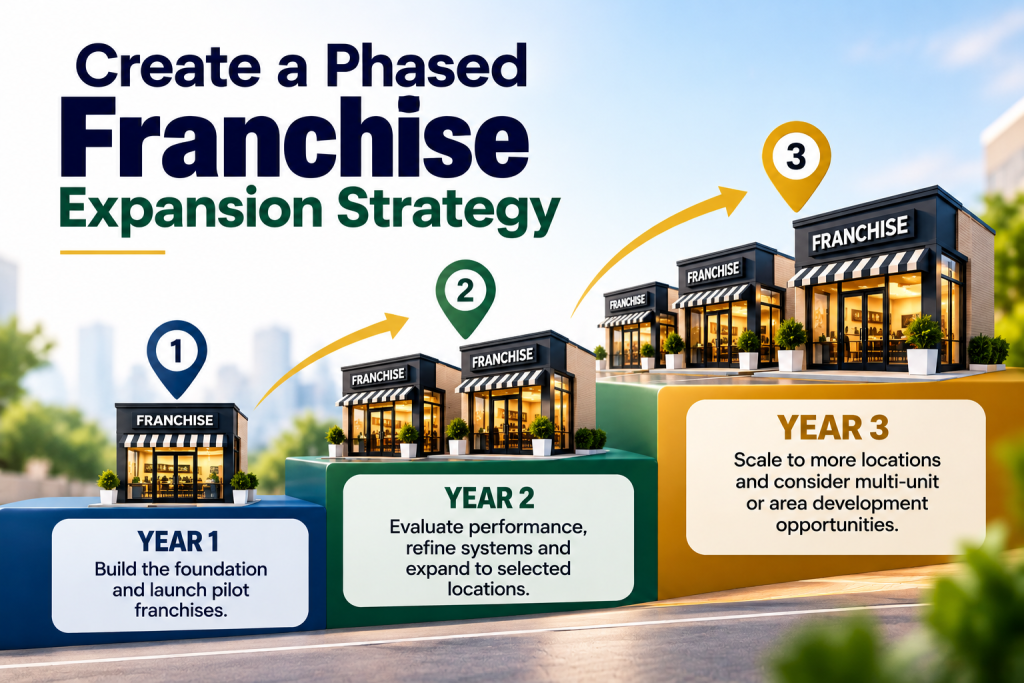
9. Create a Phased Franchise Expansion Strategy
Avoid projecting nationwide expansion without demonstrating how the business will manage growth.
A more credible approach is to develop a phased rollout.
1st Year: Complete franchise documentation, validate financial assumptions, strengthen operating systems and launch one or two pilot franchises.
2nd Year: Evaluate pilot performance, improve support systems and expand into selected locations with demonstrated demand.
3rd Year: Consider additional territories or multi-unit agreements where operational and financial performance supports further growth.
Your business plan should specify measurable performance indicators, including outlet sales, gross margins, customer satisfaction, franchisee profitability, royalty collection and compliance with brand standards.
Expansion should depend on demonstrated performance rather than the number of entrepreneurs willing to pay franchise fees.
10. Identify Franchise Risks and Mitigation Strategies
Every franchise business plan should address risks that could undermine profitability or damage the brand.
In Nigeria, important considerations include inflation, exchange-rate volatility, electricity costs, inconsistent supply chains, franchisee underperformance and regulatory compliance.
For example, a food franchise dependent on imported ingredients may face significant cost increases when exchange rates change.
A practical mitigation strategy could involve approved local substitutes, multiple qualified suppliers, periodic menu pricing reviews and defined inventory controls.
Other important safeguards include franchisee due diligence, financial reporting requirements, insurance, operational audits and clearly documented dispute-resolution procedures.
A well-prepared plan does not pretend risks are absent. It demonstrates how management intends to control them.
Common Mistakes When Writing a Franchise Business Plan
Several mistakes repeatedly weaken franchise expansion proposals.
The first is using a conventional business plan without developing separate franchisee and franchisor financial models.
Another is charging franchise fees based on what competitors appear to charge rather than calculating the actual cost of franchise development and support.
Business owners also underestimate working capital, fail to document operational processes and pursue expansion before validating their business model.
Perhaps the most serious mistake is promising franchisees unrealistic returns.
A credible franchise business plan should prioritise transparent assumptions, defensible financial projections and sustainable long-term relationships.
How Dayo Adetiloye Business Hub Can Help You Develop a Franchise Business Plan
Converting an established business into a franchise requires careful financial analysis, market research, operational planning and investment preparation.
At Dayo Adetiloye Business Hub, we help Nigerian entrepreneurs, SMEs and growing businesses develop professional business plans and commercially grounded expansion strategies.
Our relevant business development services include:
- Franchise business plans and business model development.
- Feasibility studies and location-specific market research.
- Financial projections and franchise investment analysis.
- Business expansion strategies and investor-ready pitch decks.
- Funding readiness, loan application support and business advisory.
We can help you assess whether franchising is appropriate for your business, evaluate its financial viability and prepare the strategic documentation needed to engage potential franchisees, investors or financing institutions.
 How to Write a Business Plan for Franchising Your Business Model
Where external financing is required, The Ultimate Grant Readiness System™ also provides practical tools to help entrepreneurs strengthen their funding preparation.
Explore the toolkit: https://selar.com/38k7agny27?affiliate=kjj9
For professional assistance with your franchise business plan:
Call/WhatsApp: 08105636015, 08076359735, 08113205312
Email: dayohub@gmail.com
Website: www.dayoadetiloye.com
Frequently Asked Questions About Franchise Business Plans
Can I franchise my business in Nigeria?
Yes. Nigerian businesses can structure franchise arrangements, subject to applicable legal, intellectual property, contractual and sector-specific requirements. Professional legal advice is advisable before offering franchise rights.
How much does it cost to franchise a business in Nigeria?
There is no universal amount. Costs depend on the industry, trademark protection, documentation, operational systems, legal advice, training infrastructure and pilot development. A feasibility study and detailed budget are necessary to establish realistic costs.
What is the difference between a franchise business plan and a regular business plan?
A regular business plan primarily evaluates one business. A franchise business plan additionally explains how independent operators will replicate the business, what they will pay, what support they will receive and whether both franchisor and franchisee can operate profitably.
Does my business need multiple branches before franchising?
Not necessarily. However, evidence that the model can operate successfully beyond its original location substantially strengthens franchise readiness. A pilot outlet can help validate assumptions before wider expansion.
Can I obtain funding to expand my franchise business?
Potentially. Banks, investors and other financing institutions may consider commercially viable expansion proposals. However, eligibility, collateral requirements, financial performance and funding terms vary. A credible business plan improves preparation but does not guarantee approval.
Conclusion: Build a Franchise System, Not Just More Branches
Franchising can help Nigerian entrepreneurs expand their businesses, enter new markets and build stronger brands without independently financing every outlet.
However, successful franchising depends on more than collecting franchise fees.
It requires a profitable and replicable business model, realistic financial projections, strong operating systems, protected intellectual property and a reliable franchisee support structure.
A professionally developed franchise business plan brings these elements together, allowing entrepreneurs to evaluate expansion opportunities before committing significant resources.
If your business is performing well and you are considering franchising, start by determining whether your business model can deliver sustainable returns for both you and your future franchisees.
Dayo Adetiloye Business Hub can help you develop a practical, investor-ready franchise business plan that supports informed expansion decisions.
Contact us today to discuss your franchise business plan and expansion strategy.
Related