 Why Business Plans Fail to Convert into Capital and How Consultants Fix Them
Why Business Plans Fail to Convert into Capital and How Consultants Fix Them
A business plan can be professionally written, beautifully formatted and still fail to attract investors or secure a bank loan. This is a frustrating experience for many Nigerian entrepreneurs who invest time and money in preparing business plans but receive repeated funding rejections.
The problem is often not the business idea itself. It is the inability of the business plan to demonstrate commercial viability, financial credibility, manageable risks and a convincing return on investment.
The International Finance Corporation (IFC), in its 2025 MSME Banking in the Digital Era handbook, estimates Nigeria’s unmet MSME financing demand at approximately $32.2 billion. Despite this substantial financing gap, many businesses struggle to access available capital because they cannot satisfy the requirements of lenders and investors.
A good business plan must do more than describe an opportunity. It must demonstrate why that opportunity deserves funding.
Understanding why business plans fail to convert into capital, and how professional business development consultants address these weaknesses, is essential for entrepreneurs seeking loans, grants and investment financing.
1. The Business Plan Describes an Idea Instead of Proving a Market Opportunity
One major weakness in unsuccessful business plans is excessive emphasis on the entrepreneur’s vision without sufficient evidence of market demand.
A business owner may claim that Nigeria’s growing population guarantees demand for a proposed product. However, investors want to understand the specific customers being targeted, their purchasing power, existing competitors and the company’s realistic market share.
Consider an entrepreneur proposing a ₦50 million food-processing facility in Ogun State. A convincing business plan should identify potential institutional buyers, assess raw-material availability, establish realistic production capacity and demonstrate demand through customer enquiries, purchase commitments or verified sales.
How consultants fix it: Experienced business development consultants conduct market research, competitor assessments, customer segmentation and feasibility studies. They replace unsupported assumptions with verifiable commercial evidence.
The objective is to establish not merely that a market exists, but that the proposed business can compete profitably within it.
2. Financial Projections Are Unrealistic or Unsupported
Financial projections are among the most important sections of a funding proposal, yet they are frequently prepared without adequate consideration of operating costs, market conditions or cash-flow requirements.
For example, an entrepreneur may project annual revenue of ₦200 million without explaining the production capacity, selling price, distribution channels or customer acquisition strategy required to achieve that figure.
Other common weaknesses include excluding equipment maintenance, underestimating logistics expenses and assuming that every sale will generate immediate cash.
A competent consultant builds an integrated financial model covering revenue, operating expenditure, profitability, working capital and cash flow.
Consider this illustrative financing assessment:
| Financial Indicator |
Annual Estimate |
| Revenue |
₦120 million |
| Cost of Goods Sold |
₦72 million |
| Operating Expenses |
₦24 million |
| EBITDA |
₦24 million |
| Annual Loan Debt Service |
₦15 million |
| Simplified Debt Service Coverage Ratio |
1.60× |
The debt service coverage ratio measures cash available for debt repayment relative to scheduled principal and interest payments.
In this simplified illustration, EBITDA is used as a proxy for cash available for debt service. An actual lender assessment should adjust for taxes, working-capital movements and other relevant cash requirements.
A consultant would also test whether the business can sustain repayment if sales decline by 15% or production costs increase.
The lesson: Investors do not finance attractive spreadsheets. They finance businesses whose underlying assumptions and financial performance can withstand scrutiny.
3. The Funding Request Is Poorly Defined
Many business plans request capital without clearly explaining how the money will be deployed.
A statement such as “We need ₦30 million to expand our business” is insufficient.
A credible funding request should connect each expenditure to measurable operational and financial outcomes.
For instance, a manufacturing company requesting ₦30 million might allocate ₦16 million to machinery, ₦8 million to working capital, ₦4 million to distribution expansion and ₦2 million to installation and contingency costs.
The plan should explain how these investments increase productive capacity, improve efficiency or support additional sales.
How consultants fix it: Professional business plan consultants develop detailed use-of-funds schedules, implementation milestones and financing structures that demonstrate accountability.
They also assess whether the amount requested is appropriate. Excessive borrowing increases repayment pressure, while inadequate funding may leave a project unfinished.
 Why Business Plans Fail to Convert into Capital and How Consultants Fix Them
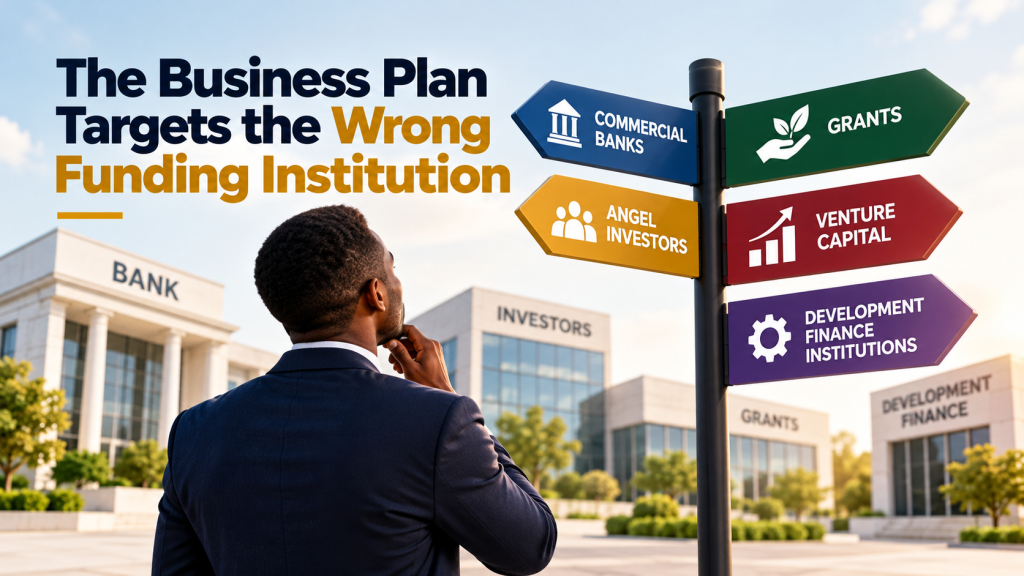
4. The Business Plan Targets the Wrong Funding Institution
Not every business is suitable for venture capital, commercial bank lending or grant financing.
A profitable neighbourhood supermarket may qualify for certain SME loans but remain unattractive to venture capital investors seeking scalable businesses with significant growth potential.
Similarly, a commercial expansion proposal may be unsuitable for a grant programme focused on social impact, innovation or environmental sustainability.
A professional consultant begins by identifying the appropriate financing instrument.
| Funding Source |
Primary Assessment Focus |
| Commercial Banks |
Repayment capacity, creditworthiness and security |
| Development Finance Institutions |
Viability, eligibility, development impact and repayment |
| Angel Investors |
Growth potential, management capability and investment returns |
| Venture Capital Firms |
Scalability, market opportunity and potential exit |
| Grant Providers |
Programme alignment, measurable outcomes and implementation capacity |
How consultants fix it: Consultants evaluate funding eligibility, financing requirements and the commercial characteristics of the business before recommending suitable funding institutions.
Matching the business to the appropriate funding source prevents wasted applications and improves the quality of funding engagement.
5. Poor Documentation Creates Doubts About Business Credibility
A compelling business plan cannot compensate for missing financial statements, inconsistent bank records or incomplete corporate documentation.
The Bank of Industry (BOI), for example, specifies different documentation requirements according to business category and facility size.
Its published application checklist includes business plans, bank statements, company registration documents, equipment quotations and, for certain larger facilities, feasibility studies and environmental, social and governance documentation.
Entrepreneurs should therefore understand that preparing a business plan is only one component of becoming funding-ready.
How consultants fix it: Business development consultants conduct documentation audits before entrepreneurs approach funding institutions.
This involves reconciling financial records, identifying missing documents, reviewing regulatory compliance and establishing a structured due-diligence folder.
Importantly, professional consultants should never fabricate financial statements or create misleading evidence to strengthen an application.
6. Business Risks Are Ignored Instead of Managed
Every investment carries risk. A business plan that presents an opportunity without acknowledging potential difficulties may actually weaken investor confidence.
Nigerian businesses face operational uncertainties involving exchange rates, electricity costs, inflation, supply chains and customer payment delays.
For example, an agro-processing company dependent on imported machinery should explain how currency depreciation could affect equipment acquisition and maintenance costs.
A credible risk assessment identifies potential disruptions, evaluates their financial consequences and proposes realistic mitigation strategies.
How consultants fix it: Consultants strengthen business plans through sensitivity analysis, alternative sourcing strategies, contingency budgeting and operational risk assessments.
The objective is not to promise that risks will disappear, but to demonstrate management’s capacity to respond effectively.
7. The Business Plan Does Not Demonstrate Management Capacity
Investors frequently evaluate the people responsible for executing a business opportunity as carefully as the opportunity itself.
A promising business model can fail when the management team lacks the necessary technical expertise, financial discipline or operational experience.
A professionally prepared business plan should therefore establish management responsibilities, relevant experience, governance arrangements and recruitment requirements.
How consultants fix it: Consultants identify management gaps and recommend practical solutions, including experienced technical partners, stronger financial controls and independent advisory support.
For equity investment, consultants also examine ownership structures and shareholder arrangements. Where fundraising involves regulated securities or investment crowdfunding, compliance with applicable Securities and Exchange Commission rules is essential.
 Why Business Plans Fail to Convert into Capital and How Consultants Fix Them
How Professional Business Plan Consultants Improve Funding Success
A competent business plan consultant does considerably more than edit grammar or improve document presentation.
The process typically begins with a funding-readiness assessment to determine whether the business has sufficient commercial evidence, financial records, operational capacity and management competence to approach potential financiers.
The consultant then develops or restructures the business plan around the requirements of the targeted funding institution.
This may involve preparing financial projections, conducting feasibility studies, validating market assumptions, developing an investment pitch deck and organising supporting documents.
At Dayo Adetiloye Business Hub, our business development consulting approach focuses on connecting business strategy with financial feasibility and funding requirements.
The purpose is to help entrepreneurs present commercially credible opportunities rather than simply submit attractive documents.
However, professional assistance does not guarantee funding. Approval ultimately depends on eligibility, commercial viability, institutional priorities and the financier’s independent assessment.
How to Know Whether Your Business Plan Is Funding-Ready
Before submitting another application, entrepreneurs should answer five important questions:
- Can we demonstrate genuine demand through credible market evidence or existing sales?
- Do our financial projections reconcile with our operational capacity and historical performance?
- Is our funding request supported by a detailed expenditure and implementation plan?
- Can we demonstrate repayment capacity, investor returns or measurable grant outcomes?
- Are our financial records, corporate documents and management credentials ready for verification?
If the answer to several of these questions is no, the business may require further preparation before seeking capital.
 Why Business Plans Fail to Convert into Capital and How Consultants Fix Them
Build Your Funding Readiness with The Ultimate Grant Readiness System™
For entrepreneurs pursuing grants and development funding, preparation should begin before an application opportunity is announced.
The Ultimate Grant Readiness System™ is designed to help entrepreneurs approach grant opportunities more systematically through practical preparation resources, templates and funding-readiness guidance.
It can support the organisation of business information, assessment of grant opportunities and development of stronger applications.
Access The Ultimate Grant Readiness System™ here:
https://selar.com/38k7agny27?affiliate=kjj9
The toolkit supports preparation but does not replace programme-specific eligibility checks or guarantee grant approval.
Get Professional Business Plan and Funding Advisory Support
If your business plan has repeatedly failed to attract investors, secure financing or progress through funding assessments, it may be time for an independent professional review.
Dayo Adetiloye Business Hub provides business development advisory services covering business plan writing and review, feasibility studies, market research, financial projections, BOI loan application preparation, grant writing, pitch decks, investment readiness and funding advisory.
We help entrepreneurs identify weaknesses, strengthen their business cases and prepare more credible funding submissions.
Contact Dayo Adetiloye Business Hub Today
Call/WhatsApp: 08105636015, 08076359735, 08113205312
Email: dayohub@gmail.com
Website: https://www.dayoadetiloye.com
Conclusion: A Business Plan Must Prove Investment Readiness
A business plan fails to convert into capital when it cannot adequately answer the questions that matter to financiers: Is the opportunity commercially viable? Are the financial projections credible? Can management execute the strategy? Will the business generate sufficient returns or repay its obligations?
Professional consultants help entrepreneurs address these questions through stronger research, financial modelling, risk assessment and funding preparation.
The goal is not simply to produce a business plan that looks impressive. It is to develop a business case that can withstand serious financial and commercial scrutiny.
For entrepreneurs seeking capital, the most productive next step may not be submitting more applications. It may be strengthening the business behind the application.
Frequently Asked Questions (FAQs)
Why do investors reject business plans?
Investors commonly reject business plans because of weak market evidence, unrealistic financial projections, inadequate management capacity, unclear funding requirements or insufficient potential returns.
Can a business plan consultant guarantee funding?
No. Consultants can improve funding readiness, strengthen documentation and identify suitable financing opportunities, but funding decisions remain with lenders, investors and grant providers.
What makes a business plan bankable in Nigeria?
A bankable business plan demonstrates commercial viability, credible cash-flow projections, repayment capacity, appropriate financing requirements and compliance with the lender’s documentation standards.
Should I rewrite my business plan after a loan rejection?
Not automatically. First identify the reason for rejection. The problem may involve credit history, collateral, eligibility, financial performance or the financing structure rather than the written plan itself.
Related