
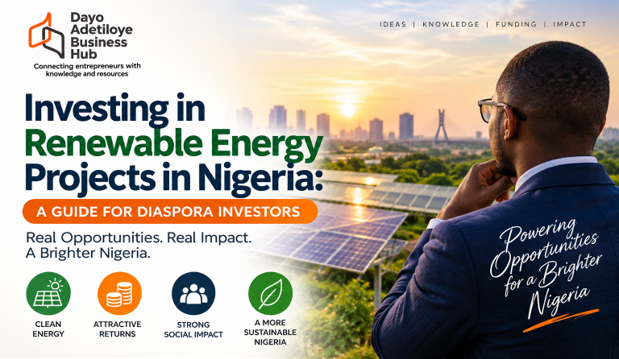
Nigeria’s electricity challenge is often discussed as a national infrastructure problem. For investors, however, it is also a large commercial opportunity.
Businesses need reliable power. Farms need energy for irrigation and cold storage. Hospitals need uninterrupted electricity. Schools, estates, factories, hotels, supermarkets and rural communities all require energy, while many still depend heavily on diesel generators or unreliable grid supply.
This is one reason renewable energy, particularly solar, battery storage and distributed energy systems, is attracting increasing private-sector attention.
The Nigerian Investment Promotion Commission describes solar as the fastest-growing and strategically important part of the country’s energy market. NIPC estimates Nigeria’s theoretical solar potential at about 427 GW, while solar still accounts for less than 2% of electricity generation. It also reports that solar installations grew by about 45% in 2024, driven largely by commercial, industrial and off-grid demand.
For Nigerians living abroad, renewable energy creates an opportunity to invest in a sector where the underlying problem is already visible.
But renewable energy investment should not be approached as:
“Nigeria has power problems, therefore any solar project will make money.”
A viable renewable-energy project requires the right market, tariff, technology, customers, financing structure, regulation and operating model.
This guide explains what diaspora investors should examine before committing capital.
Why Renewable Energy Investment in Nigeria Deserves Attention
Nigeria’s renewable-energy opportunity is being driven by two related needs: energy access and energy reliability.
The Nigeria Electrification Programme reports that its interventions have already deployed 176 mini-grids and impacted about 7.8 million Nigerians through private-sector-led distributed renewable-energy solutions.
The earlier phase of Nigeria’s electrification programme helped establish 125 mini-grids and distribute more than one million solar home systems, providing electricity access to more than 5.5 million Nigerians and creating over 5,000 private-sector green jobs, according to the World Bank.
The opportunity is now being scaled considerably.
The World Bank-backed Distributed Access through Renewable Energy Scale-up Project—DARES has a $750 million IDA financing component and is designed to mobilise more than $1 billion in private capital. Its target is to provide new or improved electricity access to more than 17.5 million Nigerians.
The IFC’s 2025 Nigeria Private Sector Diagnostic goes even further. Its analysis estimates potential for up to $8.5 billion of solar investment by 2030, potentially supporting as many as 365,000 jobs if the right reforms and investment conditions are achieved.
These figures do not mean every project will succeed. They show that Nigeria has a substantial addressable energy market.
Where Can a Diaspora Investor Enter the Renewable Energy Market?
Renewable energy is not one business.
There are several investment models, and each has different capital requirements and risk profiles.
1. Commercial and Industrial Solar
This is one of the most practical opportunities for private investors.
A solar company installs a solar-plus-battery system for a factory, hotel, hospital, school, warehouse, estate or other commercial customer.
Revenue could come through outright equipment sales, leases, energy-as-a-service arrangements or long-term power purchase agreements.
The commercial proposition is usually straightforward:
Can renewable energy provide the customer with more reliable electricity at an economically attractive cost compared with the customer’s existing combination of grid electricity, diesel or petrol generation?
For diaspora investors, this segment can be attractive because there is an identifiable paying customer rather than a theoretical market.
2. Solar Mini-Grids
Mini-grids can serve communities, markets, agricultural clusters and commercial locations that are unserved or poorly served by traditional electricity networks.
Nigeria now has a developed regulatory framework for mini-grids. NERC issued updated Mini Grid Regulations 2026, while the Electricity Act 2023 provides the broader framework within which the electricity market operates.
The DARES programme is particularly relevant to investors exploring this area. REA documentation describes a private-sector-led approach combining developer equity and financing with mechanisms such as minimum-subsidy tenders and performance-based grants for qualifying mini-grid projects.
This creates opportunities for developers capable of designing bankable projects rather than simply installing solar panels.
3. Solar for Agriculture and Productive Use
Agriculture creates another strong investment case.
Renewable energy can power:
- irrigation systems;
- cold rooms;
- milk cooling;
- agro-processing equipment;
- grain milling;
- poultry facilities;
- fish farms;
- packaging operations.
The business model becomes stronger where electricity directly increases the customer’s income or reduces losses.
For example, a solar-powered cold room serving fruit, vegetable, fish or poultry traders may create value by reducing spoilage rather than merely replacing electricity.
This distinction matters.
A productive-use renewable-energy investment often has a stronger commercial story because the energy supplied supports revenue-generating activity.
4. Solar Home Systems and Pay-As-You-Go Energy
Another entry point is household-scale solar.
Investors can participate through distribution networks, consumer financing, solar-as-a-service models or partnerships with existing solar companies.
However, this segment requires careful attention to customer acquisition, repayment collection and credit risk.
Selling 20,000 solar systems is one thing.
Collecting monthly payments consistently from 20,000 customers is another.
Before investing, examine the developer’s historical repayment performance, customer-acquisition cost, default rate and equipment-repossession process.
5. Renewable-Energy Equipment Distribution and Local Assembly
Not every investor needs to own electricity-generating assets.
There are opportunities throughout the renewable-energy value chain:
solar panels,
inverters,
batteries,
mounting systems,
meters,
cables,
controllers,
installation,
maintenance,
energy audits,
monitoring software,
and equipment financing.
NIPC’s 2026 energy-investment guidance identifies solar projects and supporting equipment as important investment areas and notes current tax and investment incentives available to qualifying energy-sector investments.
How Much Can a Renewable Energy Project Make?
There is no standard renewable-energy ROI.
Returns depend on system cost, customer tariff, financing, battery replacement, utilisation, foreign-exchange exposure, collection efficiency and maintenance.
Consider a simplified hypothetical commercial solar project.
Assume a developer installs a solar-and-battery system costing ₦120 million for a commercial facility.
Suppose the customer agrees to purchase energy under a contract that produces average revenue of ₦3.5 million monthly.
Annual revenue would be:
₦3.5 million × 12 = ₦42 million
Assume annual operations, maintenance, insurance, monitoring and administrative expenses total ₦9 million.
That produces approximately:
₦42 million – ₦9 million = ₦33 million
in annual operating cash flow before financing, tax, depreciation and major component replacement.
A simple ₦120 million ÷ ₦33 million calculation suggests roughly 3.6 years to recover initial investment.
But this calculation is not sufficient for an investment decision.
You must still model battery degradation, replacement cost, downtime, financing cost, customer default, inflation and currency movements.
If batteries require major replacement during the project period, that expense could materially change returns.
This is why renewable-energy investors need proper financial models, not simple “ROI percentage” advertisements.
Customer Quality May Matter More Than Technology
One of the biggest mistakes investors make is focusing almost entirely on solar technology.
The panels may be excellent.
The batteries may be excellent.
The engineering may be excellent.
But who is paying for the electricity?
If your project’s main customer cannot pay, your engineering quality will not protect your cash flow.
For commercial projects, examine the customer’s financial strength.
Ask:
How long has the business operated?
What is its historical electricity consumption?
Can it demonstrate revenue?
What happens if the customer relocates?
Is there a long-term lease on the property?
What security exists under the energy contract?
A renewable-energy project’s value is often closely linked to the strength of its off-taker.
Read also: SOLAR ENERGY EQUIPMENT SALES BUSINESS PLAN IN NIGERIA
Understand Nigeria’s Changing Electricity Regulation
This has become particularly important for new investors.
The Electricity Act 2023 decentralised Nigeria’s electricity market, allowing states to establish and regulate their own intrastate electricity markets. NERC continues to regulate national-grid, interstate and other federal electricity activities.
As of July 2026, NERC reported that 16 states had fully transitioned to state electricity regulation.
Therefore, you cannot assume that the same regulatory pathway applies to every project everywhere in Nigeria.
The relevant regulator may depend on:
- where the project is located;
- project capacity;
- whether it is grid-connected or off-grid;
- whether electricity crosses state boundaries;
- whether the project operates within a state electricity market.
Before investing, obtain current legal and regulatory advice specific to the project’s location.
Structure Diaspora Capital Properly
A Nigerian living abroad should not simply transfer money to a relative’s personal account and describe it as renewable-energy investment.
Define exactly what the money represents.
Is it:
equity?
shareholder loan?
convertible investment?
project debt?
joint-venture capital?
For enterprises with foreign participation operating in Nigeria, NIPC registration is required under Section 20 of the NIPC Act.
The capital-importation structure also deserves professional advice. Nigeria’s CBN maintains the electronic Certificate of Capital Importation system, while CBN rules provide mechanisms for documenting qualifying foreign capital inflows.
This can become important later when dealing with investment returns, repatriation and financial records.
Do not fix these issues after sending the money.
Structure them before investment.
Conduct Proper Due Diligence Before Investing
Before committing diaspora capital, examine at least five areas.
Technical feasibility: Is the proposed system properly sized? What are the expected energy yields? What happens during low-generation periods?
Commercial feasibility: Who will buy the electricity, and at what tariff?
Financial feasibility: What are CAPEX, OPEX, replacement costs, financing expenses, cash flow and expected returns?
Regulatory feasibility: What licences, permits and environmental approvals are required?
Management capability: Has the developer successfully implemented and operated similar projects?
Do not accept photographs of installed solar panels as proof of competence.
Ask for project references.
Speak with previous customers.
Review actual operating data.
Confirm ownership of the project company and assets.
Diaspora Investors Should Build Oversight into the Project
Distance makes governance even more important.
Your financial model might work perfectly while the project fails operationally because maintenance is poor or collections disappear.
Your investment structure should therefore specify:
who receives revenue;
who operates the bank account;
who approves expenditure;
what reports investors receive;
how energy generation is remotely monitored;
how customer collections are reconciled;
how often financial statements are prepared;
and what circumstances trigger investor intervention.
Modern renewable-energy systems can provide remote production and performance data.
Use it.
If the project operator tells you a 500kW system generated a particular amount of energy during the month, you should ideally have independent access to monitoring information rather than depending solely on a WhatsApp report.
Look for Blended-Finance Opportunities
One reason renewable-energy investment is interesting is that commercial capital does not always have to carry the full project cost.
Nigeria’s DARES programme is explicitly structured to mobilise private investment alongside public and development financing. The World Bank says the $750 million IDA project is expected to leverage more than $1 billion of private capital, alongside additional development-partner financing.
This creates opportunities for developers and investors that understand grant, subsidy, concessional-finance and commercial-capital structures.
But programme support is not automatic.
Projects still need to meet technical, financial and eligibility requirements.
Where Dayo Adetiloye Business Hub Can Help
For diaspora investors, renewable energy should begin with an investment case, not an equipment purchase.
Before committing significant capital, you need to understand the market, customer economics, regulatory structure, expected revenue, CAPEX, replacement costs, risks and funding options.
At Dayo Adetiloye Business Hub, we support Nigerian and diaspora investors with services including:
renewable-energy business plans,
feasibility studies,
market research,
financial projections,
investment-readiness documentation,
funding strategy,
pitch decks,
grant applications,
and due-diligence support.
If you are considering a solar, mini-grid, productive-use energy or other renewable-energy project, we can help you determine whether the numbers make commercial sense before you commit substantial capital.
Contact Dayo Adetiloye Business Hub
Call/WhatsApp: 08105636015, 08076359735, 08113205312
Email: dayohub@gmail.com
Website: www.dayoadetiloye.com
Prepare Your Renewable Energy Project for Funding
Renewable-energy projects often require significant upfront capital, making funding readiness particularly important.
A serious developer may need a feasibility study, business plan, financial model, project-development budget, customer agreements, regulatory documentation, technical design and evidence of promoter contribution before approaching funders.
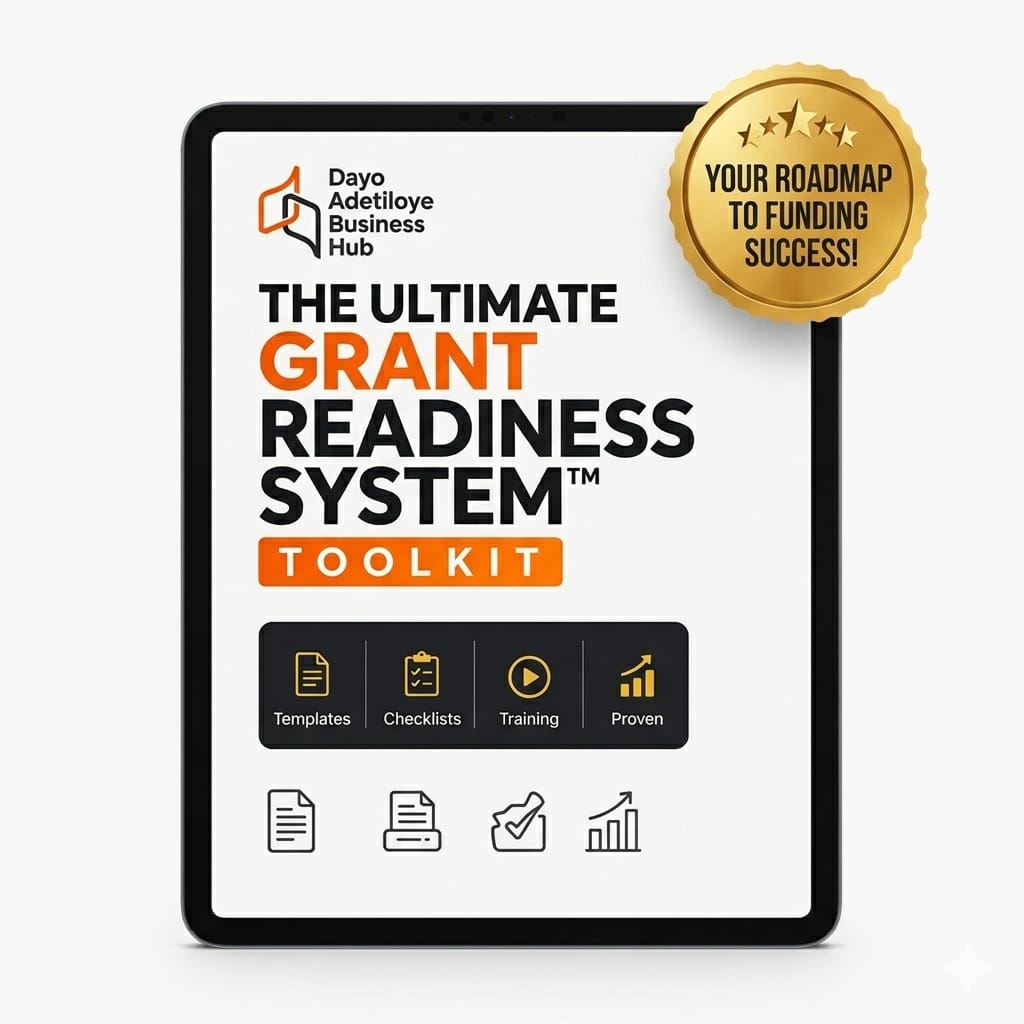
This is also where The Ultimate Grant Readiness System™ can help entrepreneurs and organisations strengthen their preparation for grants, concessional finance and other funding opportunities.
It provides practical tools, templates and funding-readiness resources that can help you organise your business before suitable opportunities arise.
The Ultimate Grant Readiness System™:
Access the Grant Readiness System
Related